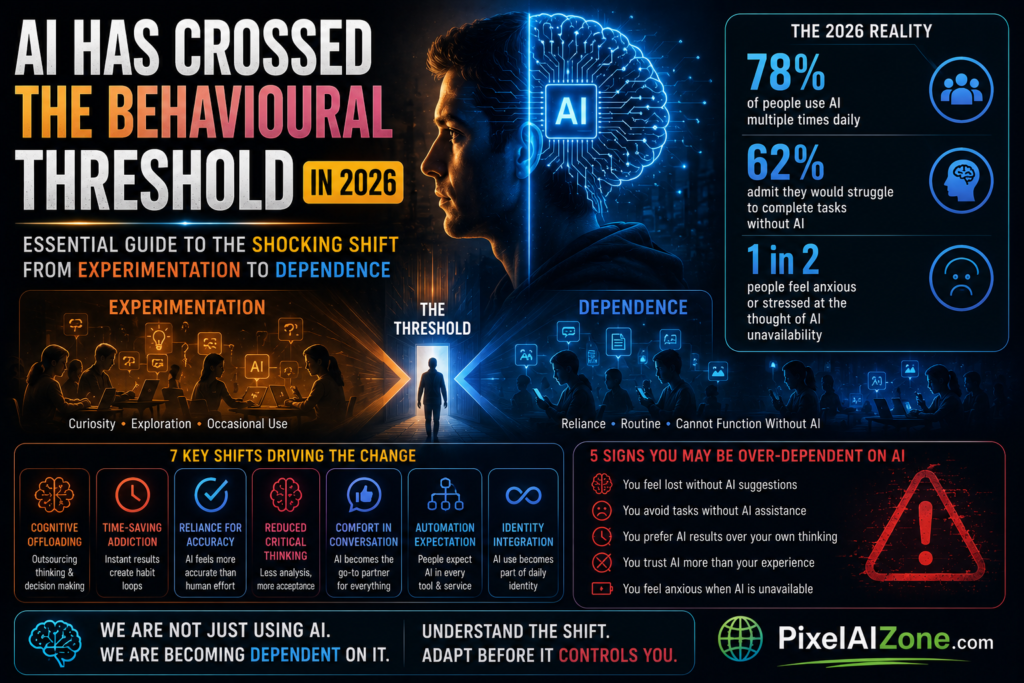
AI Has Crossed the Behavioural Threshold in 2026, marking a defining moment in how we interact with technology.
Let me show you something.
In just one year, global AI adoption has risen from 62% to 74% across 44 countries . But that’s not the most significant number. Thirty-nine percent of people now intentionally use AI “often” or “every day”—a 24-point jump from the previous year .
This marks a fundamental shift. AI has moved from experimentation to habit, from curiosity to competence, from something people are playing with to something they are building their lives around .
The behavioural threshold has been crossed.
This guide explains why AI Has Crossed the Behavioural Threshold and what it means for individuals, businesses, and societies.
Table of Contents
- The Data: A World That Has Crossed the Line
- What the Behavioural Threshold Actually Means
- The Four AI Maturity Profiles
- Trust Rises, Comfort Falls: The Paradox Deepens
- The Generational Divide: A Tale of Two Worlds
- From Experimentation to Dependence: The Slippery Slope
- The Workplace Gap: Personal Use vs Professional Use
- What This Means for You and Your Business
- FAQ
Why AI Has Crossed the Behavioural Threshold: The Data Behind the Shift
The data confirms that AI Has Crossed the Behavioural Threshold globally.

According to the WIN World AI Index 2026—drawing on nearly 40,000 respondents across 44 countries—AI has become “a background utility or an on-demand coach; something people consult multiple times a day to search, think, plan, analyse, and create” .
Key Numbers:
| Metric | 2025 | 2026 | Change |
|---|---|---|---|
| Global AI Adoption | 62% | 74% | +12% |
| Daily/Often Users | 15% | 39% | +24% |
| Trust in AI Accuracy | 45 | 42.5 | Declining comfort |
| Global Comfort Score | 45.0 | 42.5 | Falling |
In many countries, AI has quietly become a background utility—something people consult multiple times a day to search, think, plan, analyse, and create .
India remains the world’s most AI-engaged nation at 97%, followed by Ecuador (96%) and China (92%). Paraguay, Morocco, and Indonesia now complete the top five .
What the Behavioural Threshold Actually Means
Understanding why AI Has Crossed the Behavioural Threshold requires looking at usage patterns.
The concept of a behavioural threshold describes the point at which adoption of a technology shifts from sporadic experimentation to habitual dependence . The threshold has been crossed when:
- Usage becomes automatic — People no longer think about whether to use AI; they just use it.
- Frequency spikes — Once-weekly users become once-daily users.
- Integration deepens — AI becomes embedded in routines rather than a separate activity.
Richard Colwell, President of WIN, captured the moment: “As AI becomes woven into everyday behaviour, the challenge now is less about adoption and more about adaptation. The pace of change is accelerating, and societies will need to evolve just as quickly to ensure trust, transparency, and responsible use keep up” .
The Four AI Maturity Profiles
AI Has Crossed the Behavioural Threshold across all four maturity profiles.
The 2026 Index categorises the 44 surveyed nations into four distinct AI maturity profiles :
1. AI Leaders

Countries: India, China, Paraguay, Mexico, Indonesia
These populations are both high users and high believers. A staggering 69% of users in these countries are fully engaged “AI Champions” .
They don’t just use AI—they trust it, embrace it, and integrate it into their identities. Adoption is widespread, frequency is high, and concerns are notably lower than in other regions.
2. Rising Performers
Countries: South Korea, Hong Kong, Greece, Vietnam
These markets recognize AI’s functional value but haven’t fully committed emotionally. They are in a transition phase, balancing enthusiastic “Champions” (39%) with hesitant “Pragmatic Users” (35%) .
Vietnam, for example, saw daily usage rise from 13% to 19% in a single year, but comfort with AI as a social force declined sharply from 49.3 to 40.7 . People trust what AI tells them—they just don’t trust what it’s doing to society .
3. Cautious Adopters
Countries: US, UK, Germany, Japan, Canada
Predominantly developed Western markets with a “functional but concerned” mindset. Despite having the infrastructure and awareness, their growth is restrained by a massive base of Pragmatic Users (41%) and the highest global share of active “Resistors” (19%) .
These countries know what AI can do—and they’re worried about what it means.
4. Early Stage
Countries: Pakistan (33%), Ivory Coast (34%)
The lowest-usage markets, underscoring widening global disparities as they battle barriers of basic access and awareness. Nearly half of their populations are “Disengaged” (32%) or simply “Dreamers” (22%) who haven’t started using the tools yet .
Trust Rises, Comfort Falls: The Paradox Deepens
The paradox deepens as AI Has Crossed the Behavioural Threshold while trust declines.
Despite surging usage, public sentiment has grown more conflicted.
Trust in AI’s capabilities has improved slightly. People are becoming more confident in what AI can do .
But comfort has declined, falling from 45.0 to 42.5 . The world is becoming more confident in what AI can do—but less certain about what its growing influence means .
The Top Global Concerns
| Concern | Europe | Americas |
|---|---|---|
| Misinformation | 77% | 73% |
| Job Loss | High | High |
| Data Breaches | Consistent | Consistent |
Misinformation has emerged as the top global concern . Europe records the highest alarm at 77%, followed by the Americas at 73%, as AI-generated content becomes harder to distinguish from reality .
Fears of job loss and data breaches remain relatively high and consistent across regions. Europe remains the most cautious region; while 74% have tried AI, only 35% use it frequently. Still, Europeans hold the highest level of concern regarding misinformation .
The Generational Divide: A Tale of Two Worlds
AI Has Crossed the Behavioural Threshold differently across generations.
The generational gap is widening dramatically.
Only 7% of those 65+ intentionally use AI weekly, compared to 42% of the 18-24 age group .
The largest age difference measured was 24.3 points in the United Kingdom, followed by Vietnam and Venezuela .
The next generation is actively driving adoption globally . They are the ones pushing AI from novelty to necessity, from curiosity to expectation.
A UK Ofcom report found that 79% of 16-24 year olds use AI tools, and researchers describe a “pipeline from passive use to emotional dependence” . Young people are using AI not just for tasks, but for emotional support:
“Even through my break-up I’ve been like ‘Should I be feeling this way? What do you think he’s feeling?’ … I asked ChatGPT how to respond. And it [said] ‘Oh, I’m so sorry you’re going through that’ and then answered it.”
This shift—from instrumental use to companionship use to potential dependence—is one of the most significant social developments of the decade .
From Experimentation to Dependence: The Slippery Slope
The WIN Index isn’t just about numbers—it’s about a profound human shift.
When does experimentation become dependence?
| Stage | Description |
|---|---|
| Experimentation | Trying AI occasionally, curious about capabilities |
| Habit | Using AI regularly for familiar tasks |
| Routine | AI becomes woven into daily workflows |
| Dependence | Reliance on AI for decisions, creativity, and emotional support |
The data shows we are already at the “routine” stage for many and moving toward “dependence” for a significant minority .
In Vietnam, more people are moving from occasional experimentation to regular, habitual use—and it’s this group that tends to drive how attitudes and norms around AI develop over time .
The Workplace Gap: Personal Use vs Professional Use
Interestingly, fewer people use AI every day at Work (10%) than for personal usage (12%) .
Why the gap?
- Company security policies — Many organisations restrict or discourage AI use
- Concerns about misuse — Risks around data leakage and compliance
- Lack of clear guidelines — “Shadow IT” risks when employees use unauthorised tools
At work, professionals use AI most for research and data analysis (38%), and 28% rely on it for workflow automation with core functions shaping decision-making and productivity .
At home, AI is woven into daily routines:
What This Means for You and Your Business
If You’re a Business Leader
- The behavioural threshold has already been crossed — your employees are using AI whether you’ve approved it or not .
- Adoption is a continuum, not a toggle — from shallow to deep integration, and the real value is in moving people up that ladder .
- Trust and comfort are diverging — people trust AI accuracy but are uneasy about its broader role. Address both .
If You’re a Professional
- Usage without understanding is dependence in disguise . Learn to use AI as a collaborator, not a replacement.
- The pipeline to dependence is real — emotional reliance on AI is a documented risk .
- Critical thinking is the skill that matters most — question, verify, and don’t accept unverified results .
If You’re a Parent or Educator
- 79% of young people are using AI tools — often in ways you don’t see .
- The pipeline from instrumental use to emotional dependence is not theoretical—it’s happening .
- Education must adapt — teach metacognitive training, critical evaluation, and responsible use .
FAQ
Q: What is the behavioural threshold?
A: The point where adoption shifts from experimentation to dependence. According to the WIN World AI Index 2026, this threshold has now been crossed globally .
Q: Which countries are leading AI adoption?
A: India (97%), Ecuador (96%), China (92%), Paraguay, Morocco, and Indonesia round out the top five. Emerging markets dominate the top performers .
Q: Why is comfort with AI declining if adoption is rising?
A: People trust AI accuracy based on personal experience, but they’re uneasy about its broader role in society—misinformation, job displacement, and privacy erosion .
Q: What is the difference between “using” AI and “relying” on AI?
A: Using AI means leveraging it as a tool while maintaining critical thinking. Relying on AI means accepting answers without verification, which can erode independent reasoning over time .
Q: Is AI dependence really happening?
A: Yes. Studies show that 17-24% of adolescent heavy users develop AI dependencies linked to increased loneliness and depression . Researchers document a “pipeline from passive use to emotional dependence” .
Q: What should I do if I’m concerned about AI dependence?
A: Verify AI outputs (39% of users already fact-check), protect your data, demand training from your employer, and treat AI as a collaborator—not a replacement .
Q: What does it mean that AI Has Crossed the Behavioural Threshold?
A: It means AI is now a daily necessity.
Final Thoughts
The 2026 WIN World AI Index captures a pivotal moment: AI has moved beyond experimentation and into the realm of behavioural infrastructure .
More people have adopted it, people are using it more often, for more tasks, and in more parts of their lives than ever before. But this deepening reliance is accompanied by a new kind of unease—not about whether AI works, but about what its growing influence means for truth, trust, and society .
The question for 2026 is no longer whether people will use AI. They already are. The question now is how societies will adapt to a world where AI is both indispensable and increasingly scrutinised .
Now that AI Has Crossed the Behavioural Threshold, societies must adapt quickly.
Related Posts on Pixelaizone
- “The AI Trust Paradox 2026 Revealed : Why 74% of People Use AI Daily But Don’t Trust It (Powerful Insights)”
- “Pakistan’s Rs 283 Billion AI Programme 2026: A Game-Changing Opportunity for the Nation”
- Why Your AI Content Is Invisible: 9 Ways to Stand Out in 2026
- “The $1.3 Billion AI Ad Market: What It Means for Your Business (Game-Changing Trends)”
- “The Dark Side of AI in Pakistan: 5 Critical Threats We’re Ignoring”
- “Pakistan’s $1 Billion AI Investment 2026: What It Means for You (Game-Changing Opportunities)”
- “AI-Powered Finance in 2026: How Pakistani Businesses Are Transforming Banking (Revolutionary Changes)”
- “AI in Climate Change 2026: Powerful Strategies for Disaster Management in Pakistan”
- “AI Agents in 2026: The Ultimate Guide to How Autonomous Systems Are Changing Work”
- “AI in Pakistan Education 2026: A Complete Guide to the Future of Learning (Amazing Transformation)”
- Hostinger Review 2026: Why This is the Best Hosting for Small Businesses & Beginners
- The Future of Work in 2026: How AI Is Reshaping Jobs, Skills, and Careers
- 2026 AI Trends for Small Businesses: What’s Actually Working Right Now
- AI Side Hustles 2026: 7 Easy Ways to Earn Extra Income with Artificial Intelligence
What’s your relationship with AI—tool or crutch? Drop a comment below!