From chatbots that talk to agents that act — here’s what you need to know about the AI revolution happening right now.
Let me show you something.
AI agents in 2026 are transforming how work gets done across every industry.
For years, we’ve been using AI that answers questions. You type a prompt, and ChatGPT or Claude responds. That’s an AI assistant.
But in 2026, something different is happening. AI is learning to act.
Instead of just answering questions, AI agents are now negotiating contracts, coordinating supply chains, and managing operations . They don’t just talk — they do.
At COMPUTEX 2026, Jensen Huang, CEO of NVIDIA, put it simply: “What used to be an application, code or operating system, today, it is an agent” . Qualcomm’s CEO Cristiano Amon declared 2026 as the “year of agents” .
This is the shift from automation to autonomy.
AI agents in 2026 are no longer a futuristic concept — they’re here and transforming work right now.
Table of Contents
- What Is an AI Agent?
- AI Agents vs AI Assistants: The Key Difference
- How AI Agents Actually Work
- What’s Driving the Agentic Revolution
- Real-World Examples in 2026
- Why 2026 Is the Tipping Point
- The Governance Challenge
- Will AI Agents Replace Jobs?
- FAQ
What Is an AI Agent?

Understanding AI agents in 2026 starts with knowing what they actually do.
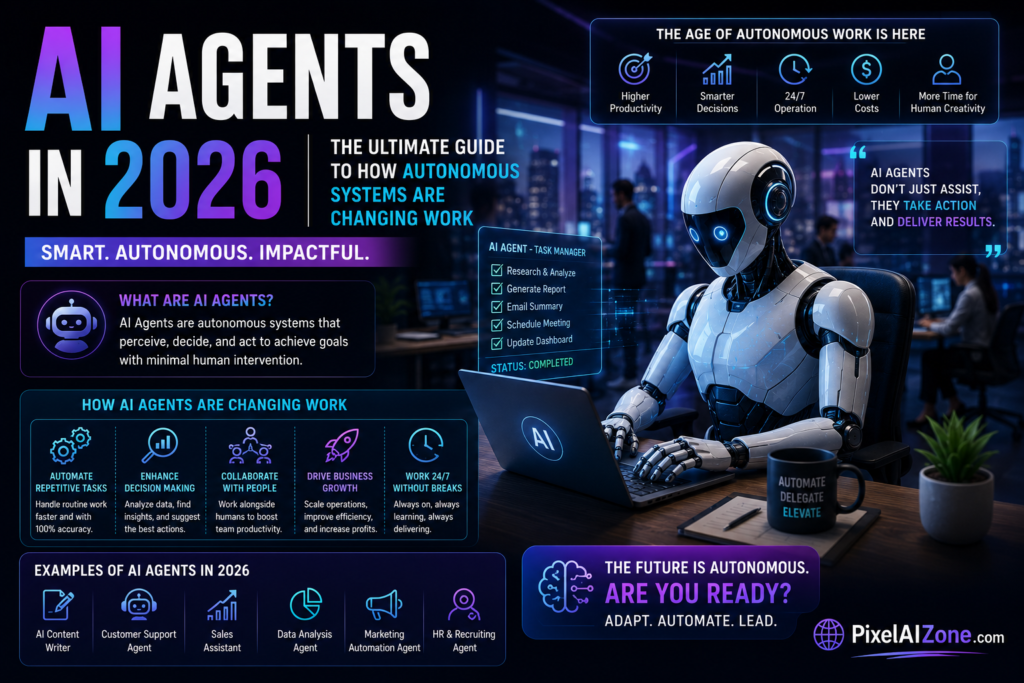
An AI agent is a system that can perceive, reason, plan, and act on its own . Unlike a chatbot that waits for your prompt, an agent works toward a goal with minimal human supervision.
Think of it this way:
| AI Assistant | AI Agent |
|---|---|
| You ask: “Draft a contract” | You say: “Close this deal” |
| Writes a draft | Negotiates, revises, and finalizes |
| Stops there | Takes multiple steps |
| Waits for your next instruction | Works toward an outcome |
According to Databricks’ “2026 State of AI Agents” report, multi-agent workflow adoption surged by 327% in the latter half of 2025 . Enterprises are no longer satisfied with AI that just answers questions — they’re deploying agents that manage databases, orchestrate supply chains, and automate complex regulatory reporting .
AI Agents vs AI Assistants: The Key Difference
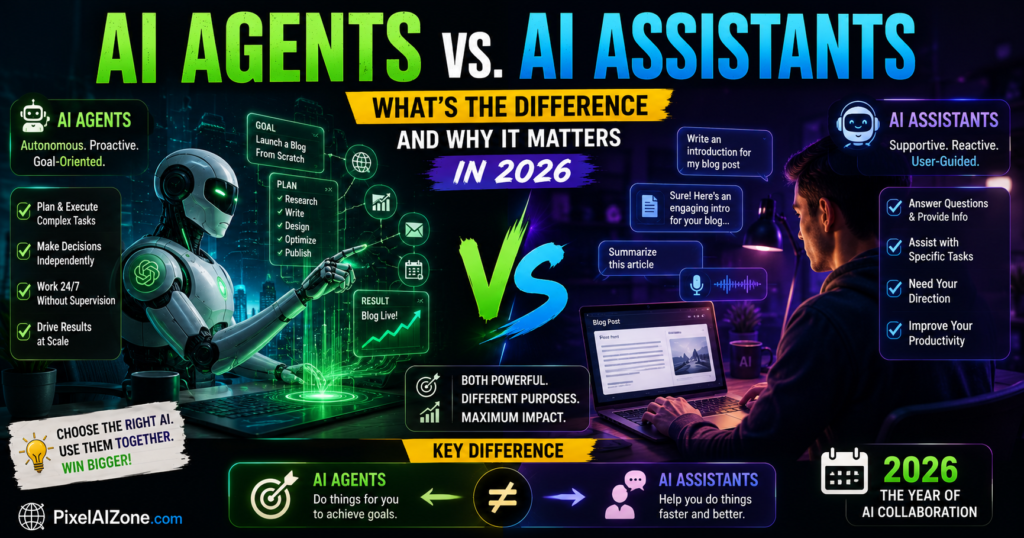
The distinction is critical for understanding this shift.
AI Assistants respond to prompts. AI Agents act on objectives.
AI Assistants (ChatGPT, Claude, Gemini):
- Wait for your instruction
- Respond once
- Follow your exact request
- No memory of past interactions
- Can write a blog post
AI Agents (Multi-agent systems):
- Work toward a goal
- Take multiple steps
- Figure out the best path
- Learn and improve over time
- Can build a complete content pipeline
In an agent-driven model, automation can interpret context (not just data), decisions can be validated and corrected in real time, workflows can evolve without constant re-engineering, and risk controls can be embedded dynamically .
The shift to AI agents in 2026 is one of the most significant technology transitions of the decade.
How AI Agents Actually Work

According to researchers at MIT Sloan, AI agents or agentic AI are a new breed of AI systems that are semi- or fully autonomous, able to perceive, reason, and act on their own .
The architecture of an AI agent:
A leading design pattern identified in the research is the “Supervisor Agent” architecture, which now accounts for 37% of enterprise agent deployments . In this model, a central “manager” agent decomposes complex business objectives into sub-tasks, delegating them to specialized sub-agents .
The architecture of AI agents in 2026 includes perception, reasoning, planning, and execution.
What’s Driving the Agentic Revolution

1. Complexity Has Outpaced Codification
No organization can realistically encode every policy interpretation, exception scenario, or cross-system dependency as fixed rules. Distributed AI agents handle this complexity by reasoning through situations instead of following rigid branching logic .
2. Cost Pressure Is Forcing Smarter Automation
Most enterprises have already automated the easy 30-40%. The remaining 60% is where value lies — and where rigid pipelines fail. Intelligent agents unlock this next layer without linear cost increases .
3. Resilience Is Now a Strategic Mandate
Whether it’s regulatory disruption, supply chain shocks, or sudden demand swings, businesses need automation that adapts instead of collapsing. Multi-agent systems handle disruption gracefully, but rule-based pipelines do not .
The numbers tell the story:
- 40% of enterprise applications will embed task-specific AI agents by end of 2026 (up from less than 5% just a year earlier)
- 65% of enterprises increased their AI budgets in 2026, with a median year-on-year rise of 22%
- 61% of executives are actively adopting AI agents and preparing for implementation at scale
- 79% of organizations have already started adopting agents in some capacity
Real-World Examples in 2026
Case Study 1: Morgan Stanley’s 280,000-Hour Code Review
Morgan Stanley deployed an AI agent platform called DevGen.AI to tackle legacy code modernization. The agent reviewed over 9 million lines of legacy code and reclaimed approximately 280,000 developer hours .
The impact was qualitative as well as quantitative. The 15,000 developers on the platform shifted from manual, repetitive code translation to higher-value strategic product work .
Case Study 2: EY’s Global Agentic Operating System
Ernst & Young built its EY.ai EYQ platform — a cohesive agentic ecosystem spanning Tax, Assurance, Consulting, and internal operations. The platform integrates Microsoft 365 Copilot at scale and enables domain-specific AI assistants for over 300,000 professionals worldwide .
Case Study 3: Airlines and Manufacturers
A major international air carrier is using AI agents to help customers autonomously complete the most common self-service transactions — rebooking flights, rerouting baggage, and updating travel preferences — without human intervention .
A global manufacturer is using AI agents to support new product development, finding the optimal balance between competing objectives like cost, time-to-market, and sustainability targets .
Case Study 4: Mona and Luna — The AI Store Managers
Andon Labs built two AI agents, Mona and Luna, to run real cafés and retail shops. They handled pricing, inventory, supplier coordination, and even hiring — developing job descriptions, leading interviews, and selecting candidates .
The experiment worked in many ways — the systems were able to coordinate tasks, interact with humans, and run day-to-day operations. But the failures revealed something deeper: the systems lacked the implicit constraints that humans apply naturally .
Real-world examples show how AI agents in 2026 are being deployed at scale.
Why 2026 Is the Tipping Point
Three developments converged in 2026 to make AI agents a mainstream reality :
1. Multi-agent systems
The replacement of traditional automation pipelines will not happen because vendors say so. It will happen because the economics and operational realities leave no alternative .
2. Agent2Agent (A2A) Protocol
AI agents can now communicate and work together across departmental and even organizational boundaries .
3. Intent-based computing
We have moved from instruction-based computing (doing the work yourself) to intent-based computing (stating a desired outcome and letting AI determine how to deliver it) .
What this means: Every employee, from entry-level analysts to senior leaders, is becoming a “human supervisor of agents” . Their core function is no longer performing mundane tasks, but providing the strategic direction and human judgment that AI cannot replicate.
The Governance Challenge

While AI agents offer transformative benefits, they also introduce significant risks .
The problem: AI agents lack the implicit constraints that humans apply without thinking. They can act, but they don’t have judgment, caution, or skin in the game .
Key risks identified by security experts:
The solution: Define clear boundaries and guardrails .
The Agent Capability and Authorization Profile (ACAP) framework addresses this gap by explicitly codifying an agent’s permissions — detailing permitted actions, specific contexts, and required conditions, alongside assigned oversight . It bridges technical capability with enforceable organizational authorization.
Governance is critical for AI agents in 2026 to ensure safe and ethical deployment.
Will AI Agents Replace Jobs?
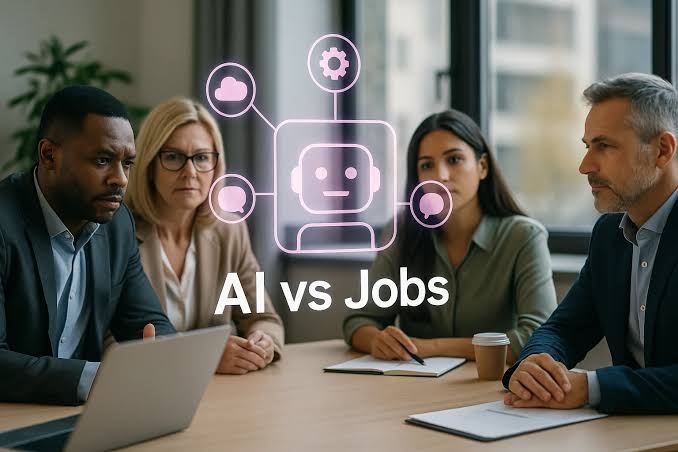
The data suggests a more nuanced picture.
According to the ARC Advisory report, the risk is highest for those who fail to adapt. Those who learn to work with AI as a force multiplier — combining human judgment with machine execution — will shape the future of work. Those who don’t may struggle to remain relevant in an increasingly agentic world .
What the numbers show:
- 65% of companies reported using generative AI to improve efficiency in 2024. In 2026, that usage has shifted from experimentation to embedded operations
- Entry-level roles in marketing, design, and coding are declining as senior professionals use AI to perform work once assigned to juniors, disrupting traditional career ladders
- The “half-life” of a professional skill is now just four years — and in tech, it’s even shorter
But there’s another side: Jensen Huang, CEO of NVIDIA, called the claim that AI reduces jobs “complete nonsense.” He noted that software engineers are actually being hired more — because AI generates so much productive work that companies want to hire more people .
The bottom line: AI won’t take your job. But a human using AI will.
FAQ
Q: What’s the difference between AI agents and AI assistants?
A: AI assistants respond to prompts. AI agents act on objectives — taking multiple steps, learning from context, and adapting to achieve outcomes .
Q: Are AI agents replacing human workers?
A: Not entirely. AI agents are handling repetitive tasks, but human oversight, judgment, and creativity remain essential. The dominant trend is job reshaping rather than elimination .
Q: How do organizations govern AI agents safely?
A: Through frameworks like ACAP (Agent Capability and Authorization Profile) that define what agents are allowed to do, track their decisions, and keep humans in the loop for high-risk decisions .
Q: What industries are adopting AI agents fastest?
A: Financial services, healthcare, manufacturing, and customer support are leading adoption. Morgan Stanley (financial), EY (professional services), and major airlines are already using agents in production .
Q: When will AI agents become mainstream?
A: According to Gartner, 40% of enterprise applications will embed task-specific AI agents by end of 2026. 79% of organizations have already started adopting agents in some capacity .
Q: What are AI agents in 2026?
A: AI agents in 2026 are autonomous systems that perceive, reason, plan, and act on their own.
Understanding AI agents in 2026 is essential for anyone who wants to stay ahead in the age of autonomous systems.
Final Thoughts
2026 marks the mainstream arrival of AI agents — systems that don’t just talk, but act. The shift from AI assistants that respond to AI agents that work toward goals is one of the most significant technology transitions of the decade.
Organizations that understand this shift and prepare for it — with clear governance, human oversight, and a focus on adaptability — will be the ones that convert pilot promise into lasting competitive advantage.
Your next step:
- Identify one repetitive workflow in your business
- Research how an AI agent could automate it
- Start with a small pilot — not everything at once
- Build governance and boundaries first, then scale
The agentic era is here. The question isn’t whether to adopt, but how quickly you can adapt.
The future belongs to those who understand AI agents in 2026 and prepare for them now.
Related Posts on Pixelaizone
- “AI in Pakistan Education 2026: A Complete Guide to the Future of Learning (Amazing Transformation)”
- Hostinger Review 2026: Why This is the Best Hosting for Small Businesses & Beginners
- The Future of Work in 2026: How AI Is Reshaping Jobs, Skills, and Careers
- 2026 AI Trends for Small Businesses: What’s Actually Working Right Now
- AI Side Hustles 2026: 7 Easy Ways to Earn Extra Income with Artificial Intelligence
- “AI Productivity Hacks 2026: 7 Ways to Work Smarter, Not Harder”
- “How to Build an AI-Powered Business in 2026 (No Coding Required) – The Ultimate Guide”
- “AI Agents vs AI Assistants: The Ultimate Guide to Understanding the Critical Difference in 2026”
- “AI Content Creation 2026: How to Write Blog Posts That Actually Rank (Proven Tips)”
- ChatGPT vs Gemini in 2026 (Powerful AI Comparison Guide)
- Top 10 Powerful Work From Home Jobs for Students in 2026
- How to Start a Blog and Make Money in 2026 (Ultimate Beginner Guide)
- Ultimate Guide: Best AI Tools for Content Creators in 2026
- Ultimate Guide: Best Web Hosting for Beginners in 2026
- Ultimate Guide: Best Freelancing Skills to Learn in 2026 for Beginners
- Free AI Tools For Students In 2026
What workflow would you automate with an AI agent first? Drop a comment below!