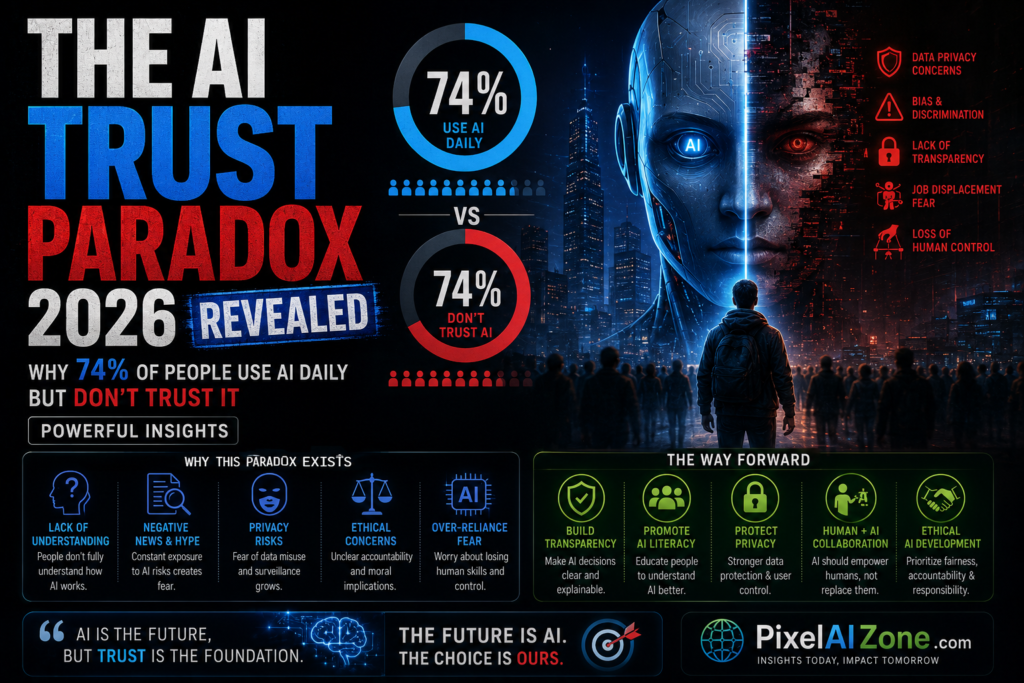
The AI Trust Paradox 2026 captures a world that has crossed a behavioural threshold: 74% adoption, yet trust is collapsing.
Let me show you something.
In one year, global AI adoption rose from 62% to 74% — a 12-point leap that marks a genuine behavioural threshold . Thirty-nine percent of people now use AI “often” or “every day,” a 24-point jump that signals a shift from experimentation to dependence .
Yet trust is declining. Fast.
ManpowerGroup’s 2026 Global Talent Barometer found that while regular AI usage jumped 13% among workers in 2025, confidence in the technology plummeted by 18% . According to Kantar and MMA research, almost four in five younger people use AI at least a few times a week, yet they also harbor apocalyptic fears: 74% believe AI will manipulate people at unprecedented scale, 72% think it will lead to mass unemployment, and 56% believe AI will eventually destroy humanity .
This is the AI Trust Paradox.
This guide explains The AI Trust Paradox 2026 and what it means for individuals, businesses, and governments.
Table of Contents
- The Data Behind the Paradox: Adoption vs. Trust
- Why Trust Is Falling: Three Key Drivers
- Regional and Generational Divides
- The Workplace Trust Gap
- What the Paradox Means for Businesses and Governments
- How to Navigate the Trust Paradox
- FAQ
The Data Behind The AI Trust Paradox 2026
Understanding The AI Trust Paradox 2026 starts with the data on adoption and trust.
The numbers tell a remarkable story of two opposing trends moving in tandem:
Adoption Is Accelerating

- Global adoption: 74% of people across 44 countries now use AI, up from 62% in 2025
- Daily active users: 39% use AI “often” or “every day” — a 24-point increase
- Younger generations: Almost 4 in 5 younger people use AI at least a few times a week
- Generative AI adoption: Faster than the internet and personal computer
Trust Is Declining
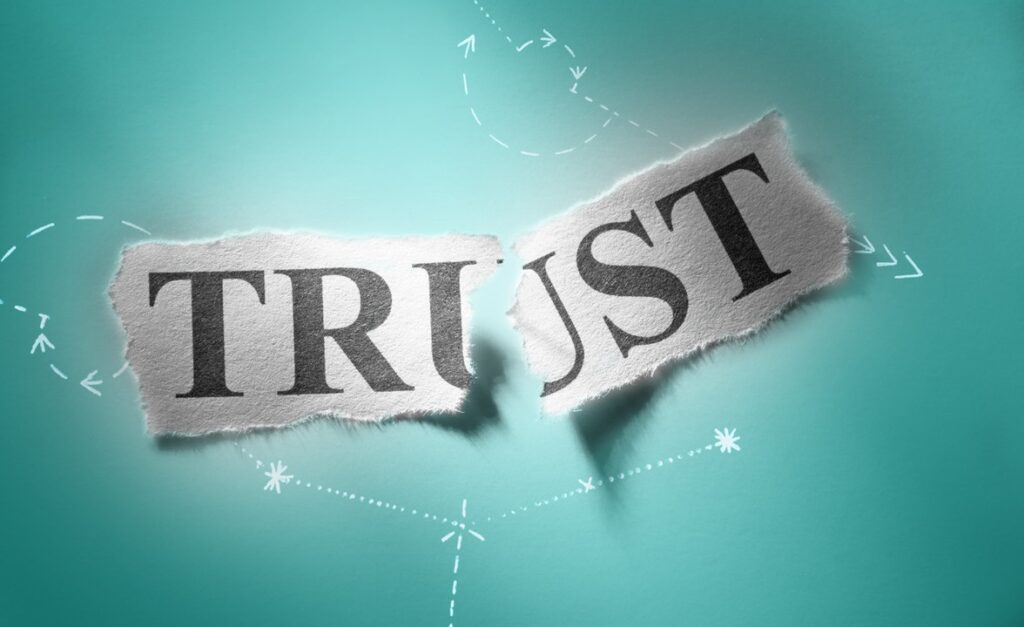
- Confidence drop: 18% decline in trust among workers in 2025
- Comfort decline: Global comfort with AI fell from 45.0 to 42.5
- Trust in AI agents: Confidence dropped from 48% in 2025 to 34% in 2026
- The verification habit: 39% of users verify AI-generated information using Google due to distrust
The WIN World AI Index, published annually across 44 countries, captures this split clearly. In Vietnam, trust in AI accuracy went up (from 65.6 to 69.4) while personal comfort with AI went down significantly (from 49.3 to 40.7) . People trust what AI tells them in the moment, but feel uneasy about what AI means for society at large.
Why Trust Is Falling: Three Key Drivers
Three key drivers explain The AI Trust Paradox 2026.
1. Misinformation and Deepfakes
Misinformation has emerged as the top global concern . Europe records the highest alarm at 77%, followed by the Americas at 73%, as AI-generated content becomes harder to distinguish from reality .
What’s driving this:
- 54% of users actively avoid sharing sensitive information with chatbots
- 42% refrain from uploading confidential files
- 36% avoid discussing work-related data
The Stanford AI Index Report 2026 warns that AI tools were adopted faster than the internet itself, yet transparency from frontier labs has decreased, making models more of a “black box” .
2. Job Displacement Fears
- 61% of Vietnamese respondents expressed high concern about AI causing job losses (up from 48% in 2025)
- 64% of workers are “job hugging” — staying in current roles out of AI automation fears
- White-collar workers fear displacement just as much as blue-collar workers
3. The Training Void
56% of workers globally received no recent skills development even though most workplaces have adopted AI in some capacity .
This mismatch between adoption and mastery is creating a tense environment. Companies like IBM and Accenture have rolled out internal “AI academies” to retrain staff, but many organizations lack this safety net .
Regional and Generational Divides
The AI Trust Paradox 2026 plays out differently across regions and generations.
The AI Leaders

India remains the world’s most AI-engaged nation at 97%, with Ecuador surging to 96% . Emerging markets dominate the top five: India, Ecuador, Paraguay, Morocco, and Indonesia . These nations are both high users and high believers, with 69% of users fully engaged as “AI Champions” .
The Cautious Adopters
Developed Western markets like the US, UK, Germany, and Japan are “functional but concerned.” Despite having the infrastructure and awareness, they have the highest global share of active “Resistors” (19%) .
In the United States:
- Only 30% trust their government to regulate AI — the lowest rating among all 30 countries surveyed
- The US has lower enthusiasm and adoption compared to many emerging markets
The Generation Gap
The generational divide is widening. Only 7% of those 65+ intentionally use AI weekly, compared to 42% of 18-24 year olds . Yet the same young people who drive adoption also hold the most extreme fears — 56% believe AI could eventually destroy humanity .
The Workplace Trust Gap
The workplace reveals The AI Trust Paradox 2026 most starkly.

The workplace reveals the paradox most starkly:
As one sales leader put it: “Almost half of teams don’t trust AI. Yet two-thirds don’t verify outputs before using them — a contradiction that shows learned helplessness” .
The Executive-Practitioner Gap

- 81% of CEOs have high trust in AI-driven delivery systems
- Only 50% of QA Directors share that confidence
This isn’t just a difference of opinion — it’s a visibility problem. Executives see strategic progress; practitioners see operational friction. The gap between them is where risk accumulates.
“Job Hugging” Takes Hold

The training void has created a tense environment. In a complete reversal from the Great Resignation, 64% of workers are “job hugging” — choosing to remain in current roles out of AI automation fears, despite burnout and skill shortages .
What the Paradox Means for Businesses and Governments
The AI Trust Paradox 2026 creates both risk and opportunity for businesses.
For Governments
The Stanford AI Index Report 2026 highlights a critical gap: policymakers lack data to regulate effectively. Transparency from frontier labs has decreased, and we know less about what goes into these models .
Key recommendations:
- Improve transparency around AI training data
- Develop better measurement frameworks
- Address the trust gap through regulation that protects without stifling innovation
For Businesses
The paradox creates both risk and opportunity. Brands cannot simply avoid AI; to do so ignores how consumers actually behave .
The consumer mandate:
- 81% see at least some meaningful benefits from AI in company products and services
- People expect companies to use AI for faster customer service, better deals, proactive problem solving, and help making better decisions
But trust is conditional:
- Users verify AI outputs (39% fact-check)
- Privacy concerns remain high (54% avoid sharing sensitive info)
- The training void is real — most workers lack the skills to properly evaluate AI
According to Forrester, by 2026, 30% of consumers will use generative AI tools for high-risk decisions such as personal finance and healthcare — despite low trust — by cross-referencing AI outputs, validating sources, and consulting professionals .
Brands must earn trust through action, not assumption.
How to Navigate the Trust Paradox
For Individuals
- Verify AI outputs: 39% of users already fact-check — that’s the right instinct
- Protect your data: Avoid sharing sensitive info with chatbots
- Seek training: The training void is real — demand it from your employer
- Be realistic: AI works best as a collaborator, not a replacement
For Businesses
- Build governance in by design: Organizations that build oversight into their AI workflows realize the benefits without the blind spots
- Train your workforce: The confidence gap is a training gap
- Be transparent: The public’s trust in AI is conditional on transparency and accountability
- Treat AI as a collaborator: The companies that win will treat AI as an assistant, not a replacement
For Policymakers
- Demand transparency: We need to know what these models are being trained on
- Invest in measurement: Without data, you can’t regulate effectively
- Address the trust gap: Only 30% of Americans trust their government to regulate AI — that needs to change
FAQ
Q: What is the AI Trust Paradox?
A: The contradiction between people’s rapid adoption of AI tools and their declining trust in the technology. Global AI adoption is 74% and rising, yet trust in AI systems and agents is declining sharply .
Q: Why do people use AI if they don’t trust it?
A: People find AI practically useful (it saves time, helps with research, makes work easier) but they’re wary of its societal impact (misinformation, job loss, privacy erosion). Trust in accuracy and comfort with the technology’s role in society are two different things .
Q: Is trust in AI really declining?
A: Yes. Confidence in AI dropped 18% among workers in 2025 while usage jumped 13% . Trust in AI agents making release decisions fell from 48% to 34% in one year .
Q: Which regions trust AI the most?
A: Emerging markets like India, Ecuador, Paraguay, and Indonesia lead the world in both adoption and trust. Developed Western markets like the US and Europe are more skeptical despite having more infrastructure .
Q: What’s the biggest AI concern people have?
A: Misinformation and deepfakes top the list. Europe records 77% concern and the Americas 73% . Job displacement and data privacy are also major concerns.
Q: Will AI eventually destroy humanity?
A: More than half of young people (56%) believe AI could eventually destroy humanity . While this is an extreme view, it reflects the deep unease underlying the adoption numbers.
Q: What is The AI Trust Paradox 2026?
A: It’s the gap between AI adoption and trust.
Final Thoughts
The numbers are clear: adoption is accelerating, trust is collapsing. The 2026 WIN World AI Index captures a world that has crossed a behavioural threshold — AI is no longer being experimented with but depended on .
Yet the next generation is actively driving adoption globally, even as they fear the technology’s darker possibilities . The training void — 56% of workers received no recent skills development — compounds the problem .
The AI Trust Paradox isn’t going away. But understanding it — why people use AI daily even as they mistrust its broader influence — is the first step to navigating it responsibly.
The question for 2026 is no longer whether people will use AI. They already are. The question now is how societies will adapt to a world where AI is both indispensable and increasingly scrutinised .
The AI Trust Paradox 2026 is not going away — understanding it is the first step.
Related Posts on Pixelaizone
- “Pakistan’s Rs 283 Billion AI Programme 2026: A Game-Changing Opportunity for the Nation”
- Why Your AI Content Is Invisible: 9 Ways to Stand Out in 2026
- “The $1.3 Billion AI Ad Market: What It Means for Your Business (Game-Changing Trends)”
- “The Dark Side of AI in Pakistan: 5 Critical Threats We’re Ignoring”
- “Pakistan’s $1 Billion AI Investment 2026: What It Means for You (Game-Changing Opportunities)”
- “AI-Powered Finance in 2026: How Pakistani Businesses Are Transforming Banking (Revolutionary Changes)”
- “AI in Climate Change 2026: Powerful Strategies for Disaster Management in Pakistan”
- “AI Agents in 2026: The Ultimate Guide to How Autonomous Systems Are Changing Work”
- “AI in Pakistan Education 2026: A Complete Guide to the Future of Learning (Amazing Transformation)”
- Hostinger Review 2026: Why This is the Best Hosting for Small Businesses & Beginners
- The Future of Work in 2026: How AI Is Reshaping Jobs, Skills, and Careers
- 2026 AI Trends for Small Businesses: What’s Actually Working Right Now
- AI Side Hustles 2026: 7 Easy Ways to Earn Extra Income with Artificial Intelligence
What’s your take on the AI Trust Paradox? Drop a comment below!