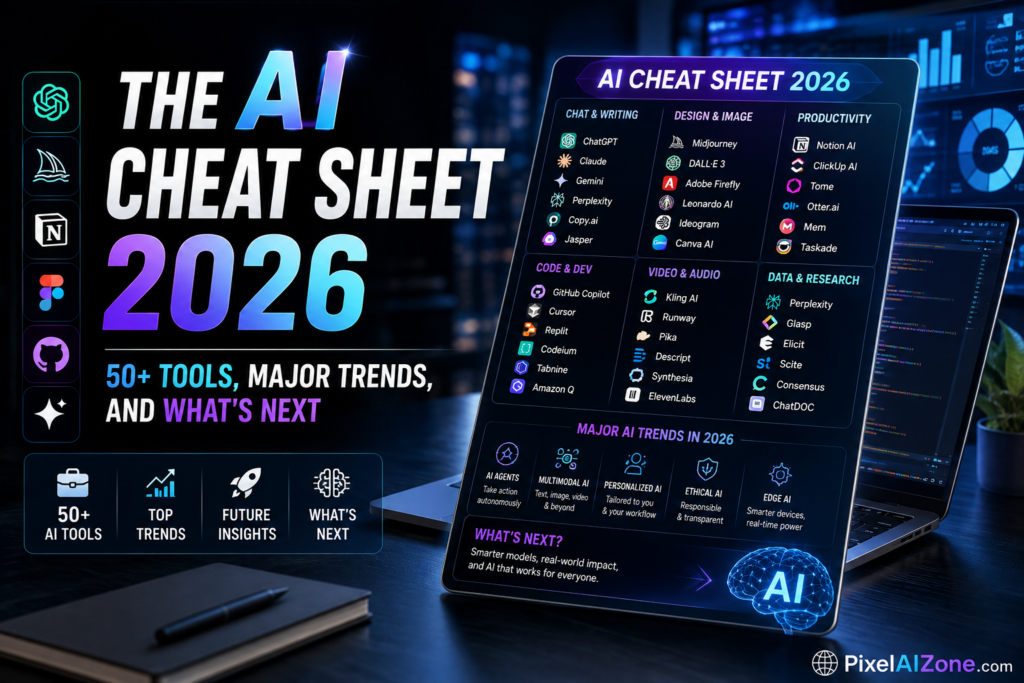
From ChatGPT to Claude, from vibe coding to video generation — here’s your complete guide to the AI tools and trends that are actually shaping 2026.The AI cheat sheet 2026 is your complete guide to 50+ tools and major trends shaping the industry.
Let me show you something.
The AI landscape has reached a tipping point. As of 2026, we have moved beyond the “which AI tool is best” debate and entered the “which AI tool is best for this specific task” era . The market is no longer growing simply through the emergence of clones, but through differentiation — users are gravitating toward tools that solve a specific need .
This is the only AI cheat sheet you’ll need in 2026. Whether you’re a beginner looking for your first tool, or a professional trying to optimize your workflow, this guide covers the 50+ tools that actually matter .
The AI cheat sheet 2026 covers everything from ChatGPT to agentic AI in one comprehensive guide.
Table of Contents
- The Big Picture: How AI Has Changed in 2026
- Top 10 AI Tools by Web Traffic
- Top 10 AI Apps by Mobile Usage
- AI Assistants: Which One Fits Your Workflow?
- Image Generation Tools
- Video Generation and Audio Tools
- Coding and Development Tools
- Vibe Coding: The Rise of No-Code AI
- Agentic AI: The Next Frontier
- Key AI Terms You Must Know in 2026
- AI Risks You Should Take Seriously
- FAQ
The Big Picture: How AI Has Changed in 2026
Understanding the AI cheat sheet 2026 starts with knowing how the landscape has changed.
According to Andreessen Horowitz’s (a16z) latest generative AI market report, the ecosystem is stabilizing — but there is still plenty of ground left to explore .
Two major shifts define 2026:
- Differentiation, not duplication: Users are gravitating toward tools that solve a specific need, whether conversational assistants, AI tools for creating images, video editors, or ways to program without technical knowledge .
- The rise of agentic AI: We’ve moved beyond simple prompt responses to systems that can plan, reason, and execute tasks across data, applications, and workflows .
Top 10 AI Tools by Web Traffic
The AI cheat sheet 2026 shows ChatGPT leading web traffic with 900 million weekly active users.
According to a16z’s analysis of Similarweb data, these are the top 10 generative AI tools on the web, ranked by unique monthly visits :
| Rank | Tool | Key Strength |
|---|---|---|
| 1 | ChatGPT | General-purpose AI assistant |
| 2 | Gemini | Google’s multimodal AI |
| 3 | Canva | AI-powered design platform |
| 4 | DeepSeek | Chinese LLM with strong reasoning |
| 5 | Grok | xAI’s social media-focused assistant |
| 6 | Claude | Anthropic’s writing-focused AI |
| 7 | Character | AI character interactions |
| 8 | Perplexity | Research and citations |
| 9 | Notion | AI-powered knowledge management |
| 10 | Google AI Studio | Google’s developer platform |
Key insight: ChatGPT remains the undisputed leader on the web, though the gap with Gemini is beginning to narrow . In third place, Canva — repositioned as a full-fledged AI-powered conversational design platform — has pushed down DeepSeek, which gained significant visibility following its launch .
Also notable at number 13 is Janitor.ai, a platform for creating and interacting with customized AI characters and chatbots .
Top 10 AI Apps by Mobile Usage
Mobile usage in the AI cheat sheet 2026 reveals Capcut and Gemini as top performers.
Based on Sensor Tower data for monthly active users, the mobile ranking reflects a similar dynamic but with some nuances :
| Rank | App | Key Strength |
|---|---|---|
| 1 | ChatGPT | Mobile AI assistant |
| 2 | Capcut | AI-powered video editing |
| 3 | Gemini | Google’s AI assistant |
| 4 | Canva | AI design on mobile |
| 5 | AI Gallery | AI image tools |
| 6 | Picsart | AI photo editing |
| 7 | Doubao | ByteDance’s Chinese chatbot |
| 8 | Microsoft Edge | AI-powered browser |
| 9 | Meituan | Chinese super app |
| 10 | Yandex | Russian search and AI |
Key insight: Capcut — which shares a parent company with TikTok — allows users to edit short videos with AI features such as background removal, AI effects, auto captions, and text-to-video generation . Chinese apps like Doubao, Meituan, and Yandex lead massive markets in Asia and Eastern Europe .
AI Assistants: Which One Fits Your Workflow?
The AI cheat sheet 2026 compares ChatGPT, Gemini, Claude, and Perplexity for different workflows.
The AI cheat sheet 2026 also covers Grok and DeepSeek as emerging assistants in the ecosystem.
In 2026, choosing an AI assistant is like hiring a new employee. You don’t just want someone who can talk; you want someone who can code, write, search Google, generate images, respect your privacy, and maybe even hold your hand through a tough day .
ChatGPT: Best All-Rounder
Best for: Complex tasks, versatility, writing, coding, and general-purpose use .
Launched by OpenAI in late 2022, ChatGPT has grown into the most widely used AI assistant on the planet, with over 900 million weekly active users as of 2026 . It runs on OpenAI’s latest GPT-5 series of models, which are among the most capable large language models ever built .
Core capabilities:
- Multimodal interaction: text, images, files, and voice
- Strong reasoning capabilities for technical and analytical tasks
- Tools like Projects and Canvas for iterative collaboration
- Broad integration ecosystem
Google Gemini: Best Value Overall
Best for: Google Workspace users, research, multimodal tasks, and daily productivity .
Gemini positions itself as a productivity-first AI, deeply integrated into Gmail, Docs, and Sheets . Its biggest differentiator is real-time access to Google Search, which allows it to deliver up-to-date, source-backed responses . Gemini’s ability to understand documents and workflows in context makes it an intelligent layer across Google tools.
Standout feature: Multimodal inputs and deep integration with Google Workspace .
Claude: Best for Long-Form Content
Best for: Developers, writers, analysts, and professionals working with large datasets or documents .
Claude, built by Anthropic, is the favorite for those who value writing quality and ethical guardrails. It was designed using “Constitutional AI” to ensure it is helpful and honest . Claude’s prose is often cited as the most human and natural of all the major bots.
Standout feature: Massive context window capable of holding up to 1 million tokens, making it the go-to for analyzing massive legal documents, codebases, or books . Claude Code, a command-line agent for developers, grew to $1 billion in annual revenue within six months of launch .
Perplexity: Best for Research
Best for: Students, researchers, and professionals who need accurate, verifiable information .
Perplexity brands itself as an “answer engine” rather than a chatbot. It scours the live internet and provides direct answers backed by clickable, real-time citations . It allows you to switch between different models like GPT, Claude, and Gemini to see how different AI brains interpret the same research query .
Standout feature: Real-time web search with citations and collaborative Spaces for research hubs .
Grok: Best for Social Media Research
Best for: Tracking trends, public opinion, and breaking news discussions .
Grok, developed by xAI, is plugged directly into the X (formerly Twitter) content firehose, meaning it knows what is happening right now before it even hits the news . It also has a looser moderation style, allowing for more edgy or taboo conversations .
Microsoft Copilot: Best for Microsoft Ecosystem
Best for: Enterprise users and office professionals who rely heavily on Microsoft tools .
Copilot operates as a contextual assistant within Word, Excel, PowerPoint, and Teams, reducing friction in professional environments by automating repetitive tasks and enhancing productivity .
DeepSeek: Best for Developers
Best for: Developers, researchers, and technical professionals .
DeepSeek made waves by proving that a smaller budget could still produce a world-class model. Its R1 reasoning model is highly intelligent and, most importantly, open-source — developers can host it themselves for free . It is particularly strong in math, logic, and technical problem-solving.
Image Generation Tools
Image generation tools in the AI cheat sheet 2026 include Midjourney and Adobe Firefly.
Visual generation has cut creative production time by 60%+ . The creative tools landscape has also shifted — in September 2023, 7 of 9 creative tools were image-generation AIs. In 2026, image-generation AIs are only 3, with the remaining slots filled by products related to video, music, and voice .
| Tool | Best For |
|---|---|
| Midjourney | Cinematic and artistic images |
| DALL-E | Conceptual visuals |
| Leonardo AI | Ads and game assets |
| Adobe Firefly | Brand-safe outputs |
| Freepik/Magnific | Spanish AI design platform |
| Remove.bg | Background removal |
| Pixelcut | Image enhancement |
| Photoroom | Automatic graphic generation |
Video Generation and Audio Tools
Video and audio tools are a key part of the AI cheat sheet 2026 with Runway and Kling AI leading.

AI video and audio generation has crossed the usability threshold for short-form social content .
Coding and Development Tools

AI coding tools have moved beyond autocomplete to agentic workflows .
Key trend: Vibe coding — the ability to build complete web applications simply by chatting with AI — has become one of the most interesting generative AI trends in 2026 .
Agentic AI: The Next Frontier

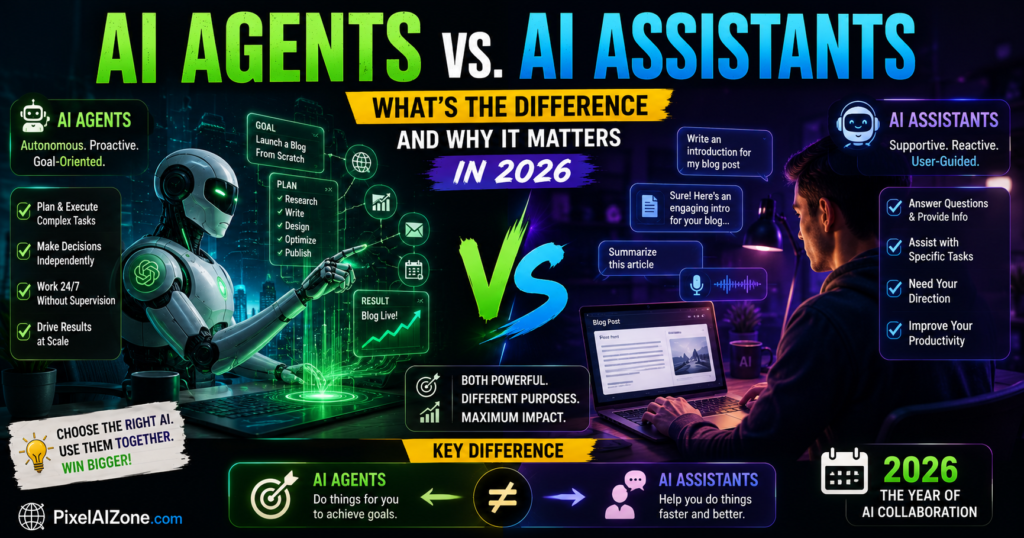
The emergence of Agentic AI marks an inflection point — a structural migration from LLMs as mere reasoning engines to LLMs as execution kernels . This transition moves AI from a consultant to an autonomous delegate .
What makes Agentic AI different:
Unlike traditional chatbots that mostly respond to prompts, AI agents are designed to take action. They can browse websites, analyze files, connect to apps, write code, make decisions, complete tasks, and even coordinate with other AI systems with little human involvement .
Key characteristics:
- Planning: Break complex goals into smaller tasks
- Tool use: Interact with APIs, databases, websites, and apps
- Autonomy: Work without constant human input
- Self-correction: Recognize mistakes and adjust approaches
Key Protocols
- Model Context Protocol (MCP): Developed by Anthropic — standardizes how applications feed context and tools into language models
- Agent2Agent Protocol (A2A): Developed by Google — allows agents on different servers to securely speak, negotiate, and delegate tasks to one another
Key AI Terms You Must Know in 2026
According to the AI Cheatsheet 2026, if you don’t know these, you’re guessing:
AI Risks You Should Take Seriously
The rule: AI means leverage, not a replacement for thinking .
FAQ
Q: Which AI tool is the best in 2026?
A: There is no single “best” tool — only the best tool for your specific task. ChatGPT is the best all-rounder, Claude excels at writing, Perplexity dominates research, and Gemini offers the best value .
Q: Is ChatGPT still the leader?
A: Yes. ChatGPT leads with 900M+ weekly active users, but competition is intensifying — Gemini and Claude are growing faster in paid subscribers .
Q: What is agentic AI?
A: Agentic AI refers to systems that can pursue complex goals autonomously — they reason, plan, use tools, and take action without constant human supervision .
Q: How do I start learning AI in 2026?
A: Start by understanding the basics: AI vs ML vs DL, then experiment with free tools like ChatGPT, Claude, or Perplexity .
Q: What is the AI cheat sheet 2026?
A: It’s a comprehensive guide to AI tools and trends.
Final Thoughts
The 2026 AI landscape is no longer about a single dominant tool. It’s about a rich ecosystem where each tool solves a specific need.
What the AI Cheat Sheet 2026 reveals:
- ChatGPT leads, but the competition is fierce
- Agentic AI is the next major frontier — from chatbots to digital workers
- 77% of enterprises already have AI agents running in production
- The AI services market is set to reach $515 billion by 2029
The AI cheat sheet 2026 reveals a rich ecosystem of specialized tools solving specific needs.
The AI cheat sheet 2026 is your go-to resource for navigating the evolving AI landscape.
Related Posts on Pixelaizone
- 11 AI Coding Tools You Should Use in 2026 (Beyond GitHub Copilot) – Game-Changing Guide
- The Best AI Image Generator in 2026: Midjourney vs Kling AI vs Adobe Firefly
- 5 Free AI Tools That Are Better Than ChatGPT for Specific Tasks
- Perplexity vs ChatGPT: Why Researchers Are Switching to Perplexity in 2026
- Claude vs ChatGPT : Which AI Tool Is Better for Long-Form Content in 2026?
- Google AI Mode vs ChatGPT: Which Search Engine Will Win in 2026? Complete Analysis
- AI in 2026: The Year Everything Changed Ultimate Guide (Revolutionary Insights)
- Why 39% of Americans Would Stop AI Development If They Could
- “2026 AI Writing Tools Comparison: Which One Actually Deserves Your Money? (Honest Comparison)”
- “Global AI Adoption Rankings 2026: The Ultimate Guide to Which Country Is Winning the AI Race”
- “Agentic AI Is Transforming Pakistan’s SMEs: 7 Powerful Ways to Stay Ahead”
- “Alibaba’s Accio Work in Pakistan 2026: The Ultimate AI Export Revolution for SMEs”
- “ChatGPT Hits 1 Billion Users: What Comes Next for the AI Giant? (Revolutionary Milestone)”
Which AI tool are you using most in 2026? Drop a comment below!