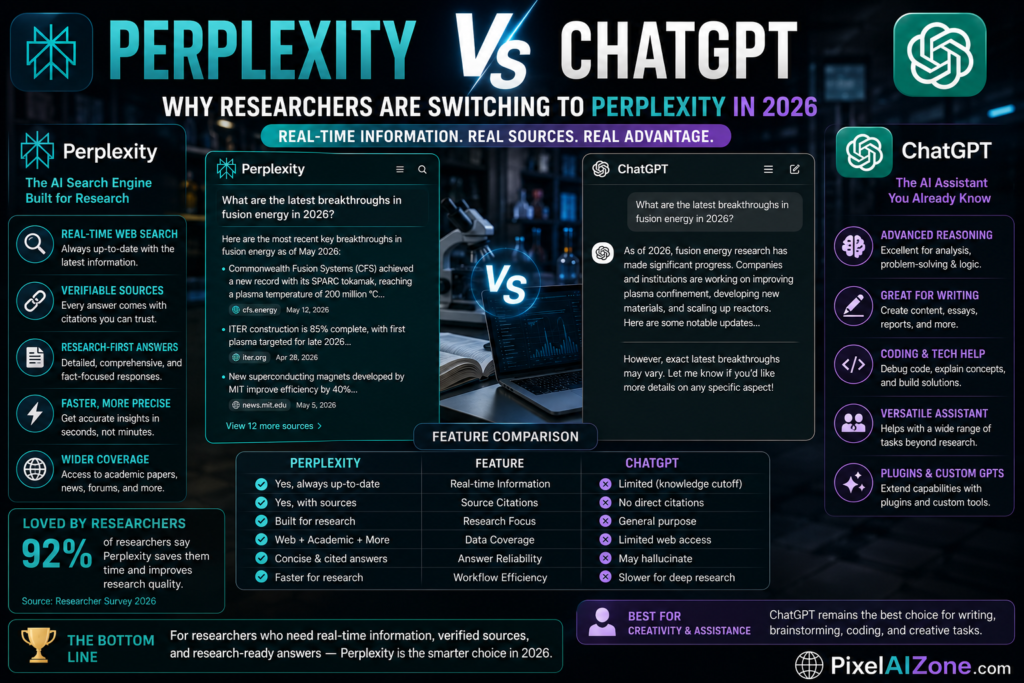
For researchers who need accuracy, citations, and current information, the choice between Perplexity and ChatGPT has become one of the most important workflow decisions in 2026.
Let me show you something.
In 2026, the AI landscape has matured beyond simple chatbots. Researchers, academics, and knowledge workers are discovering that Perplexity vs ChatGPT is not about which tool is “better” — it’s about which tool is built for the specific job of research .
According to a 2026 ACL study on web search credibility, Perplexity demonstrated the highest source credibility among major AI assistants . A comparative study of digital reference services found that while ChatGPT excels at rapid generation and usability, its limitations include information inaccuracies caused by hallucinations . Perplexity’s architecture, built around real-time web retrieval and inline citations, directly addresses these limitations .
This is the story of why researchers are making the switch to Perplexity — and why ChatGPT remains the better tool for other tasks.
The Perplexity vs ChatGPT debate is reshaping how researchers find and verify information in 2026.
Table of Contents
- The Quick Answer: Which Tool Is Better for Research?
- What Each Tool Is Built For
- Perplexity’s Citation-First Architecture
- Research Depth: How Each Tool Works
- Academic and Scholarly Research
- The Hallucination Problem
- Price and Usage Limits
- Which One Should You Choose?
- The Researcher’s Workflow
- FAQ
The Quick Answer: Which Tool Is Better for Research?
The Perplexity vs ChatGPT comparison is incomplete without understanding their research capabilities.

The honest verdict is this: Perplexity wins for research and source verification, while ChatGPT wins for writing, coding, and general-purpose reasoning .
According to independent 2026 research comparing Perplexity and ChatGPT for developers and researchers, Perplexity’s retrieval-first architecture means its responses are anchored to actual sources, making factual errors easier to catch . The Perplexity vs ChatGPT comparison for students shows Perplexity is a research librarian that consistently references its sources, while ChatGPT is a writing tutor that assists with problem-solving and idea drafting .
What Each Tool Is Built For
Understanding Perplexity vs ChatGPT starts with knowing what each tool is built for.
Perplexity was founded in 2022 as an AI-powered search engine. It uses a combination of large language models and real-time web retrieval to answer questions with cited sources. Instead of returning a list of links like a traditional search engine, Perplexity synthesises information from multiple sources into a direct answer, then lists those sources so you can verify the claims .
ChatGPT is OpenAI’s conversational AI assistant, built on the GPT-4 family of models and designed for multi-turn conversation, reasoning, code generation, writing, analysis, and task execution . ChatGPT is a general-purpose tool that happens to have research capabilities, while Perplexity is a research tool that happens to use language models.
Perplexity’s Citation-First Architecture
In the Perplexity vs ChatGPT comparison, citations are the key differentiator.

The Perplexity vs ChatGPT debate often comes down to citations. Perplexity’s core advantage is that every answer comes with numbered source citations. Each claim maps to a specific URL you can click and verify. This is not optional or inconsistent. It is the fundamental design of the product .
Citation Overlap: A Key Finding
A 2026 study found that Perplexity’s citation behavior differs significantly from other AI platforms. ChatGPT is the most likely to hallucinate confidently, while Perplexity’s citations reduce the verification overhead that generative AI typically requires . For citation-heavy professional work, Perplexity is more reliable .
Source Credibility
Source credibility is a major factor in the Perplexity vs ChatGPT debate.
According to ACL’s 2026 study assessing web search credibility and response groundedness in chat assistants, Perplexity achieved the highest source credibility among major assistants when evaluated across 100 claims on misinformation-prone topics . Perplexity’s retrieval-grounded architecture produces near-zero HTTP fabrication rates — 9.2 times lower than ChatGPT .
Research Depth: How Each Tool Works
Research depth shows a clear difference in Perplexity vs ChatGPT.
The Perplexity vs ChatGPT comparison reveals two fundamentally different approaches to finding information.
Perplexity: Deep Web Search
Perplexity reads full pages, cross-references multiple sources, and synthesizes information from 5-10 web results. It can search the web for real-time, up-to-date answers with inline citations, often citing 5-10 sources for each claim . ChatGPT’s web browsing often pulls from snippets and may not read full articles. When you need complete coverage of a topic, Perplexity’s search pipeline produces more thorough results .
ChatGPT: Web Browsing as a Feature
ChatGPT with web browsing enabled can retrieve current information, but it is less consistent about surfacing sources . ChatGPT’s research capability is stronger for synthesising information you already have: analysing a document you paste in, reasoning across multiple data points you provide, or generating a structured research framework .
The Speed-Depth Tradeoff
Perplexity’s Deep Research mode is the headline feature. Give it something thorny and it runs an autonomous loop, reading dozens of pages and assembling a structured report in two to three minutes . ChatGPT Deep Research is the slow, thorough end of the spectrum. Where Perplexity sprints, this one takes its time, often 15 to 25 minutes, browsing 50 to 100 sources and reasoning visibly as it goes .
Academic and Scholarly Research
Academic research is where Perplexity vs ChatGPT truly diverges.

Perplexity: Academic Filter
The Perplexity vs ChatGPT comparison shows different strengths in academic contexts.
Perplexity’s Academic Filter searches specifically for peer-reviewed papers and scholarly articles. The built-in citations make it easy to build your bibliography . For literature reviews, market research, and technical due diligence, this focused search mode saves significant time compared to filtering through general web results .
Perplexity vs ChatGPT for Students
For research tasks requiring citations and academic sources, Perplexity is the clear winner. ChatGPT helps you understand sources, but it’s not built for source discovery . Here’s the student workflow that works:
- Use Perplexity to find sources
- Use ChatGPT to analyze them
- Use Perplexity for evidence, then switch to ChatGPT for drafting
Medical Research Case Study
A 2026 study evaluating LLM responses to frequently asked queries on refractive errors found that all chatbots — including Perplexity — achieved comparable accuracy scores over 85% across all categories. However, Perplexity achieved the highest mean comprehensiveness score (8.13 ± 0.95, P = 0.028) . This suggests that for medical research questions requiring complete, thorough answers, Perplexity may provide the most comprehensive responses.
The Hallucination Problem
Hallucination rates are a critical factor in Perplexity vs ChatGPT decisions.

Perplexity vs ChatGPT both hallucinate — but in different ways and with different consequences.
Perplexity’s Failure Mode
Perplexity hallucinates less on factual claims but is weak on analysis . If its sources contain errors or bias, it incorporates those problems into its answer. The difference is that it shows you the sources, so you can evaluate them yourself .
ChatGPT’s Failure Mode
ChatGPT occasionally “hallucinates” and asserts incorrect information with confidence, particularly when discussing current affairs or specialized subjects outside its training data . It also may oversimplify difficult ideas to make them easier to understand, which can be problematic if technical accuracy is required .
Empirical Evidence
A 2026 pre-registered factorial study on source fabrication found that Perplexity’s near-zero HTTP fabrication rate masks near-universal content misattribution (95.5% of HTTP-validated URLs pointed to topically related but entity-unspecific pages) . Platform architecture was the dominant determinant of fabricated source rate: ChatGPT averaged FSR=0.075, Perplexity FSR=0.008 — a 9.2x difference .
Price and Usage Limits
Price and usage limits complete the Perplexity vs ChatGPT comparison.

Both tools offer free tiers and paid Pro tiers at similar price points. The pricing structure reflects their different philosophies.
Message and Deep Research Limits
The Perplexity vs ChatGPT choice ultimately depends on your specific research needs.
| Limit | Perplexity | ChatGPT |
|---|---|---|
| Deep Research Quota (Pro) | 20/day | 10/month (Plus) |
| Deep Research Quota (Max) | Unlimited Labs/month | 250/month (Pro Max, $200) |
The Student Deal
Perplexity Pro is available for $10/month with student verification — half the price of ChatGPT Plus . For researchers on a budget, this makes Perplexity an even more compelling choice.
Which One Should You Choose?
The Perplexity vs ChatGPT choice depends on your primary use case.
Choose Perplexity If:
- You need cited, verifiable answers
- Your work requires real-time information
- You’re doing academic research and need peer-reviewed sources
- You need fast briefings (2-3 minutes per deep research run)
- You want access to multiple AI models (GPT, Claude, Gemini) for $20/month
Choose ChatGPT If:
- You need writing and drafting (essays, reports, content)
- You need coding help (code generation, debugging)
- You need image or video generation
- You want a general-purpose assistant, not just a research tool
- You need deep analytical reasoning over complex topics
Choose Both If:
You’re a serious researcher or knowledge worker. According to the 2026 research, the most productive technical professionals use both and know clearly which to reach for when .
The Researcher’s Workflow
The most effective 2026 research workflow uses Perplexity and ChatGPT in sequence:
- Perplexity: Real-time research and source discovery. Pull live data, cite sources inline, find recent studies, competitor pricing, market trends, or industry news .
- ChatGPT (or Claude): Analysis and synthesis. Take what you found and turn it into a structured report, essay, presentation outline, or code .
- ChatGPT (or Claude): Execution. Draft the final deliverable, create tables, generate visuals, and produce the output .
FAQ
Q: Is Perplexity more accurate than ChatGPT?
A: For factual questions, Perplexity is more reliable because it searches the web in real-time and cites sources. ChatGPT relies on training data (potentially outdated) unless it decides to browse. Perplexity does not hallucinate less, but its citations let you verify claims quickly .
Q: Can Perplexity replace Google?
A: For question-based searches, yes. Perplexity provides direct answers with sources instead of a list of blue links. For navigational searches or shopping, Google is still better .
Q: Does Perplexity use ChatGPT?
A: Perplexity routes to models from OpenAI, Anthropic, and Google plus its own Sonar models, and runs Deep Research on Claude Opus 4.5. It can run on GPT models among others. Its product is the search-and-cite workflow, not a model it trains .
Q: Which is better for students?
A: For research and cited sources, Perplexity wins. For essay drafting and brainstorming, ChatGPT wins. Many students use both free versions .
Q: How much do they cost?
A: Perplexity: Free $0, Pro $20/month ($10/month with student discount). ChatGPT: Free $0, Plus $20/month .
Q: Why are researchers switching to Perplexity?
A: Researchers are switching because Perplexity provides verifiable, cited answers with real-time information. A 2026 ACL study found Perplexity achieved the highest source credibility among major AI assistants, and a study found Perplexity’s fabricated source rate is 9.2x lower than ChatGPT’s .
Q: Which is better in Perplexity vs ChatGPT for research?
A: Perplexity wins.
The Perplexity vs ChatGPT choice depends on your primary workflow needs. Understanding the Perplexity vs ChatGPT difference helps you choose the right tool for your workflow.
Related Posts on Pixelaizone
- Claude vs ChatGPT : Which AI Tool Is Better for Long-Form Content in 2026?
- Google AI Mode vs ChatGPT: Which Search Engine Will Win in 2026? Complete Analysis
- AI in 2026: The Year Everything Changed Ultimate Guide (Revolutionary Insights)
- Why 39% of Americans Would Stop AI Development If They Could
- “2026 AI Writing Tools Comparison: Which One Actually Deserves Your Money? (Honest Comparison)”
- “Global AI Adoption Rankings 2026: The Ultimate Guide to Which Country Is Winning the AI Race”
- “Agentic AI Is Transforming Pakistan’s SMEs: 7 Powerful Ways to Stay Ahead”
- “Alibaba’s Accio Work in Pakistan 2026: The Ultimate AI Export Revolution for SMEs”
- “ChatGPT Hits 1 Billion Users: What Comes Next for the AI Giant? (Revolutionary Milestone)”
- The ‘Cheating Fruit’ AI Trend: Why 10 Million People Are Watching Strawberries Cheat
- “AI Agents Are Changing How the World Shops 2026 — Here’s How (Revolutionary Shift)”
- “1 in 4 People Now Use AI Every Day — Here’s What They’re Actually Doing (Shocking Insights)”
- “AI Has Crossed the Behavioural Threshold in 2026: Essential Guide to the Shocking Shift from Experimentation to Dependence”
- “The AI Trust Paradox 2026 Revealed : Why 74% of People Use AI Daily But Don’t Trust It (Powerful Insights)”
Which AI research tool do you use? Drop a comment below!