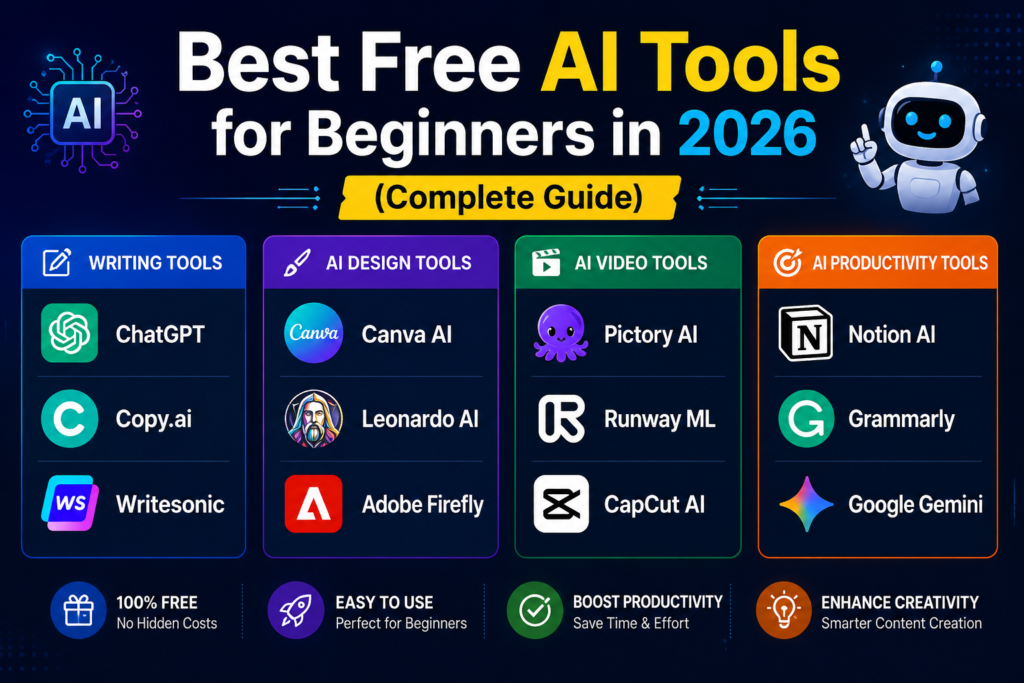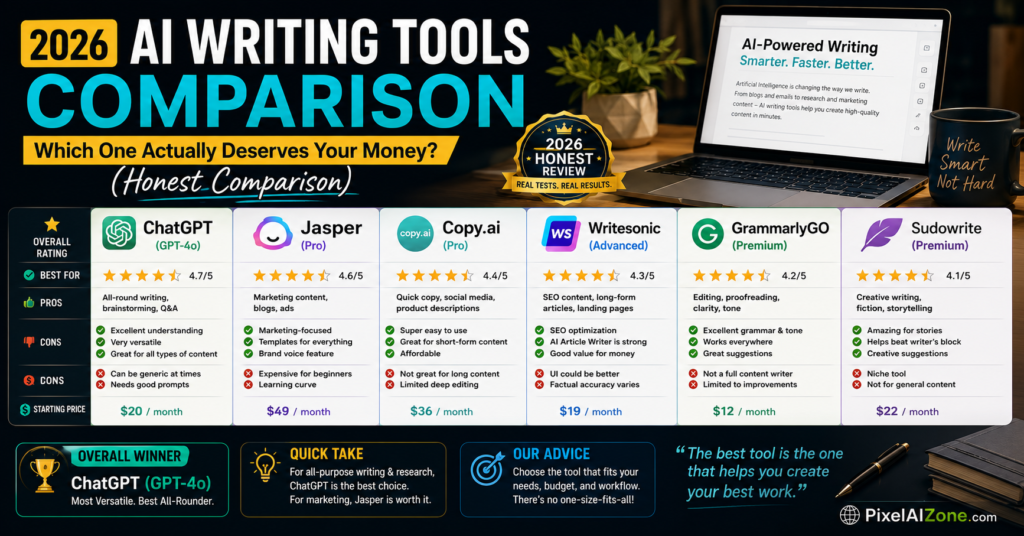
ChatGPT, Claude, Gemini, Jasper, Copy.ai, and Writesonic each promise to make you a better writer. Here’s the truth about which one is worth paying for.
A 2026 AI writing tools comparison is essential because over 50% of marketers now use generative AI for content creation.
Let me show you something.
Over 50% of marketers now use generative AI for content creation. But here’s the problem: the tool alone is no longer an advantage. In 2026, the real difference is how you use it — your workflow, your brand voice, and your human editing process.
There is no “best” AI writing tool for everyone. But there is a tool that’s best for you and your specific workflow.
This guide compares the top AI writing tools of 2026, breaking down what each tool actually does well (and what it doesn’t), so you can decide which one deserves your money.
This 2026 AI writing tools comparison breaks down ChatGPT, Claude, Gemini, Jasper, Copy.ai, and Writesonic.
This 2026 AI writing tools comparison covers the top platforms and their real strengths.
Table of Contents
- The Landscape: How AI Writing Tools Have Changed in 2026
- ChatGPT: The All-in-One Workhorse
- Claude: The Thinking Writer’s Choice
- Gemini: Google’s Integrated Assistant
- Jasper: The Marketer’s Power Tool
- Copy.ai: The Short-Form Specialist
- Writesonic: The Value Contender
- How to Choose the Right Tool for Your Workflow
- FAQ
The Landscape: How AI Writing Tools Have Changed in 2026
A proper 2026 AI writing tools comparison shows that capabilities have converged significantly.
Back in 2023, just having access to an AI writing tool gave you a competitive edge. Not anymore.
By 2026, AI writing tools have become a commodity. The major platforms have converged on similar capabilities, and most can handle the core tasks — drafting emails, writing blog posts, creating social media content, and generating copy.
So what’s changed?
| What Used to Matter | What Matters Now |
|---|---|
| Access to any AI tool | Having the right tool for your specific workflow |
| Basic prompt writing | Advanced prompt engineering and reasoning |
| The tool’s raw capability | How you use it — voice, editing, integration |
Over 50% of marketers now use GenAI for content — but the real advantage is no longer the tool itself. It’s your workflow, your brand voice, and your human editing process that makes the difference. As search results highlight, tech workshops are now focused on teaching people “how AI actually works” and how to craft prompts to get accurate, relevant responses, rather than just introducing tools.
In 2026, the question isn’t which tool is “best.” It’s which tool fits YOUR workflow.
ChatGPT: The All-in-One Workhorse
ChatGPT is the most versatile in any 2026 AI writing tools comparison.

Best for: Versatile content creation, research, and workflow integration
| Feature | Detail |
|---|---|
| Free Tier | Yes |
| Paid Tier | $20/month (Plus), $30/month (Pro) |
| Context Window | Up to 1M tokens |
| Best For | Content drafts, research, brainstorming, coding assistance |
| Enterprise | Yes (custom pricing) |
What ChatGPT Does Best
ChatGPT remains the most versatile general-purpose AI tool on the market. It handles writing, research, analysis, coding, and creative tasks in one platform. The o3 reasoning model can think through complex problems before responding, producing dramatically better results on nuanced tasks that require careful reasoning.
Strengths:
- Unmatched flexibility — one tool for nearly every content task
- Massive user community and ecosystem of plugins
- Continuously improving reasoning capabilities
- Works across desktop, mobile, and web
Weaknesses:
- May require careful prompting to get exactly what you want
- Content can feel generic without human editing
- Still needs manual fact-checking for accuracy
Who Should Pay for ChatGPT?
Get ChatGPT Plus if:
- You need one tool for multiple content types (writing, research, coding)
- You value access to the latest reasoning models
- You want to integrate AI across your entire workflow
- You’re starting with AI and want the most widely supported option
Stick with free if:
- You only need occasional writing help
- You’re comfortable with GPT-3.5 level capabilities
Claude: The Thinking Writer’s Choice
Claude excels at nuanced writing in this 2026 AI writing tools comparison.

Best for: Nuanced writing, long-document analysis, and reasoning
| Feature | Detail |
|---|---|
| Free Tier | Yes |
| Paid Tier | $20/month (Pro) |
| Context Window | 1 million tokens |
| Best For | Long-form content, legal/contract review, nuanced writing |
| Enterprise | Yes (custom pricing) |
What Claude Does Best
Claude is the thinking person’s AI assistant. It excels at nuanced writing, careful reasoning, and strong coding abilities . Where ChatGPT sometimes rushes to produce output, Claude takes time to think through the problem, producing more thoughtful and accurate responses.
Strengths:
- Best-in-class reasoning for complex, nuanced tasks
- Massive 1M token context window — can process entire documents
- More natural, human-like writing style
- Strong at following complex instructions and maintaining consistency
Weaknesses:
- Limited integration with third-party tools
- Smaller user community and fewer plugins
- May not be as fast for simple, straightforward tasks
Who Should Pay for Claude?
Get Claude Pro if:
- You write long-form content (white papers, reports, articles)
- You need careful, nuanced analysis of complex topics
- You value thoughtful reasoning over speed
- You’re a professional writer or researcher
Stick with free if:
- You only need short-form content
- You’re primarily using AI for simple drafting tasks
Gemini: Google’s Integrated Assistant
Gemini offers the best value in a 2026 AI writing tools comparison.
Best for: Research, search integration, and multimodal tasks
| Feature | Detail |
|---|---|
| Free Tier | Yes |
| Paid Tier | $5/month (Pro), $20/month (Advanced) |
| Context Window | Varies by model |
| Best For | Research, multimodal content, Google ecosystem integration |
| Enterprise | Yes |
What Gemini Does Best
Google’s Gemini (formerly Bard) integrates deeply with Google’s search and ecosystem . It excels at research tasks where real-time information matters. Its multimodal capabilities allow it to work with text, images, audio, and video simultaneously.
Strengths:
- Real-time information through Google Search integration
- Multimodal capabilities across text, image, and video
- Competitively priced (Pro starting at $5/month)
- Deep integration with Google Workspace
Weaknesses:
- Smaller user community than ChatGPT
- Fewer third-party integrations
- May not match Claude for deep reasoning tasks
Who Should Pay for Gemini?
Gemini’s value pricing makes it a strong contender in any 2026 AI writing tools comparison.
Get Gemini if:
- You rely on Google Workspace (Docs, Gmail, Drive)
- You need real-time, search-backed responses
- You want multimodal capabilities at a competitive price
Stick with free if:
- You only need basic text generation
- You prefer ChatGPT or Claude’s approach
Jasper: The Marketer’s Power Tool
Jasper is built for marketing teams — a key finding in any 2026 AI writing tools comparison.

Best for: Marketing copy, brand consistency, and team workflows
| Feature | Detail |
|---|---|
| Free Tier | No (trial available) |
| Paid Tier | $49-$125/month |
| Context Window | Varies |
| Best For | Marketing copy, campaigns, brand voice consistency |
| Enterprise | Yes |
What Jasper Does Best
Jasper is built specifically for marketing teams that need large volumes of content while maintaining a consistent voice . It helps streamline campaign creation without sacrificing brand guidelines.
Strengths:
- Brand voice functionality for consistent messaging across teams
- Templates designed for marketing workflows
- Works across multiple content types (blogs, ads, emails)
- Collaboration features for teams
Weaknesses:
- More expensive than general-purpose tools
- May be too specialized for non-marketing writing
- Requires significant setup for brand voice training
Who Should Pay for Jasper?
Get Jasper if:
- You’re managing a marketing team producing high volumes of content
- Brand consistency across multiple channels is critical
- You need templates for specific marketing workflows (ads, email campaigns)
Skip Jasper if:
- You’re an individual writer or freelancer
- You only need occasional writing help
- Your budget is limited
Copy.ai: The Short-Form Specialist

Best for: Sales copy, emails, and short-form marketing content
| Feature | Detail |
|---|---|
| Free Tier | 2,000 words/month |
| Paid Tier | $18/user/month |
| Best For | Short-form marketing content, sales copy |
| Enterprise | Yes |
What Copy.ai Does Best
Copy.ai focuses on generating persuasive copy designed for sales and customer acquisition. Its templates are geared toward outreach, lead generation, and customer engagement.
Strengths:
- Focused on revenue-generating content
- Good for short-form copy (emails, social posts, ads)
- Affordable pricing
- Easy to use for non-writers
Weaknesses:
- Better for short-form than long-form
- May require additional editing for nuance
- Less versatile than general-purpose tools
Who Should Pay for Copy.ai?
Get Copy.ai if:
- Your primary need is short-form marketing copy
- You’re on a tight budget ($18/month)
- You need to generate high volumes of outreach content
Skip Copy.ai if:
- You need long-form content (blogs, articles, reports)
- You prefer a more versatile tool
Writesonic: The Value Contender
Writesonic offers the best SEO value in a 2026 AI writing tools comparison.

Best for: SEO articles, landing pages, and website copy
| Feature | Detail |
|---|---|
| Free Tier | 10,000 words free |
| Paid Tier | From $16/month |
| Best For | SEO articles, landing pages, website copy |
| Enterprise | Yes |
What Writesonic Does Best
Writesonic combines AI writing with search-focused content creation tools. It helps users produce articles, landing pages, and website copy that align with SEO best practices.
Strengths:
- SEO-focused content generation
- Affordable pricing (from $16/month)
- Good for website and landing page copy
- Strong free tier to test the tool
Weaknesses:
- May need separate editing tools
- Less versatile for non-SEO content
- Requires human oversight for quality
Who Should Pay for Writesonic?
Get Writesonic if:
- SEO content is your primary need
- You want an affordable entry point ($16/month)
- You write landing pages, product descriptions, and website copy
Skip Writesonic if:
- You need a wide range of content types
- You prefer a more general-purpose tool
Quick Comparison Table
| Tool | Best For | Free Tier | Starting Price | Context Window | Key Strength |
|---|---|---|---|---|---|
| ChatGPT | Versatile content | Yes | $20/month | 1M tokens | Most flexible |
| Claude | Nuanced writing | Yes | $20/month | 1M tokens | Best reasoning |
| Gemini | Research + multimodal | Yes | $5/month | Varies | Google integration |
| Jasper | Marketing teams | No | $49/month | Varies | Brand consistency |
| Copy.ai | Short-form copy | 2,000 words | $18/month | Varies | Sales copy |
| Writesonic | SEO content | 10,000 words | $16/month | Varies | SEO focus |
How to Choose the Right Tool for Your Workflow
The key insight from writing tool comparisons is that the tool alone is never the solution. The best tool depends on your specific workflow, content needs, and budget.
Decision Framework
If you want ONE tool for everything:
→ Get ChatGPT Plus. It’s the most versatile, widely supported, and continuously improving option.
If you write long-form, nuanced content:
→ Get Claude Pro. The 1M token context window and superior reasoning make it the best choice for in-depth writing.
If you’re a marketer or content professional:
→ Consider Jasper. It’s more expensive, but the brand voice and team collaboration features justify the cost for professionals.
If you’re on a budget or need SEO content:
→ Try Writesonic first. The free tier and affordable pricing make it an easy entry point.
If you primarily write short-form copy:
→ Copy.ai offers the best value for high-volume short-form content.
If you rely on Google Workspace:
→ Gemini integrates directly with your existing workflow and offers competitive pricing.
FAQ
Q: Is ChatGPT the best AI writing tool in 2026?
A: It’s the most versatile and widely used, but “best” depends on your specific needs. Claude is better for nuanced, long-form writing. Jasper is better for marketing teams. Choose based on your workflow, not the brand name.
Q: Do I need to pay for an AI writing tool?
A: Not necessarily. Free tiers from ChatGPT, Claude, and Gemini handle most basic writing tasks. You should only pay when you need advanced features, larger context windows, or team collaboration tools.
Q: Will AI replace human writers?
A: No. In 2026, the most successful content creators are using AI as a collaborator, not a replacement. AI handles research, drafting, and formatting — humans add voice, judgment, and original insights that AI cannot replicate.
Q: Which tool is best for SEO content?
A: Writesonic has built-in SEO features at a competitive price. However, ChatGPT and Claude with the right prompts and additional SEO tools can produce equally effective content.
Q: How do I know which tool is right for me?
A: The right tool depends on your workflow, not the tool’s features. Identify your most common content tasks, then match the tool to those tasks. All major tools offer free trials to test before committing.
Q: What is the best tool in a 2026 AI writing tools comparison?
A: It depends on your workflow.
Final Thoughts
The AI writing tool market has matured in 2026. The capabilities across the major platforms have converged significantly, and the choice is no longer about who has the best model — it’s about which tool best fits your workflow.
What matters more than the tool is how you use it:
- Your ability to craft effective prompts
- Your workflow for editing and fact-checking
- Your ability to add human voice and judgment
Start with free tiers. Test different tools based on your specific content tasks. Only upgrade when you need the additional capabilities — because in 2026, the real advantage isn’t the tool. It’s how you use it.
The 2026 AI writing tools comparison shows that the tool matters less than how you use it.
The 2026 AI writing tools comparison ultimately depends on your specific workflow needs.
Related Posts on Pixelaizone
- “Global AI Adoption Rankings 2026: The Ultimate Guide to Which Country Is Winning the AI Race”
- “Agentic AI Is Transforming Pakistan’s SMEs: 7 Powerful Ways to Stay Ahead”
- “Alibaba’s Accio Work in Pakistan 2026: The Ultimate AI Export Revolution for SMEs”
- “ChatGPT Hits 1 Billion Users: What Comes Next for the AI Giant? (Revolutionary Milestone)”
- The ‘Cheating Fruit’ AI Trend: Why 10 Million People Are Watching Strawberries Cheat
- “AI Agents Are Changing How the World Shops 2026 — Here’s How (Revolutionary Shift)”
- “1 in 4 People Now Use AI Every Day — Here’s What They’re Actually Doing (Shocking Insights)”
- “AI Has Crossed the Behavioural Threshold in 2026: Essential Guide to the Shocking Shift from Experimentation to Dependence”
- “The AI Trust Paradox 2026 Revealed : Why 74% of People Use AI Daily But Don’t Trust It (Powerful Insights)”
- “Pakistan’s Rs 283 Billion AI Programme 2026: A Game-Changing Opportunity for the Nation”
- Why Your AI Content Is Invisible: 9 Ways to Stand Out in 2026
- “The $1.3 Billion AI Ad Market: What It Means for Your Business (Game-Changing Trends)”
Which AI writing tool are you using in 2026? Drop a comment below!