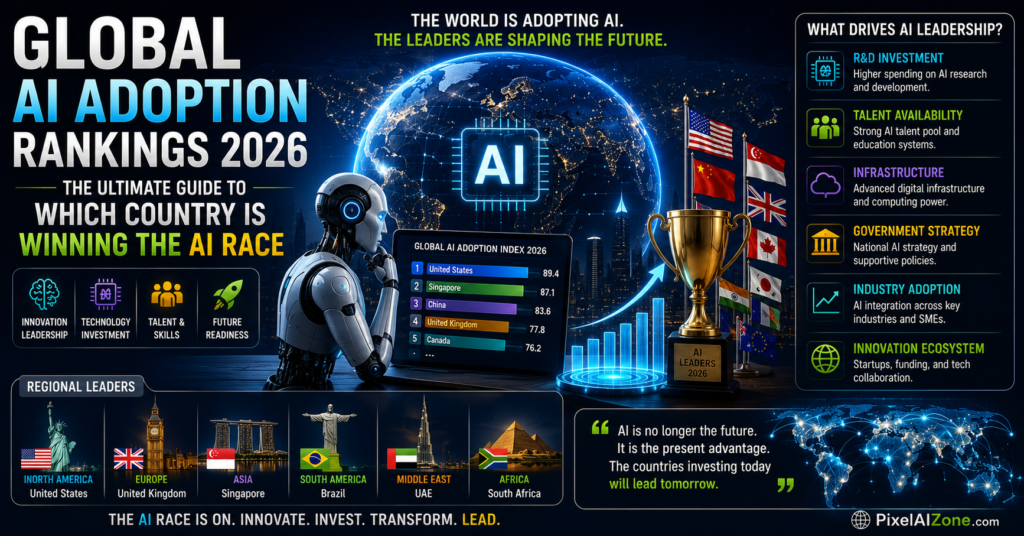
The UAE leads at 70%, Singapore follows at 63%, and the US ranks 21st despite building most of the world’s AI models. Here’s the full picture.
The global AI adoption rankings 2026 reveal a surprising leaderboard — UAE leads at 70%, while the US ranks 21st.
Let me show you something.
For years, we’ve been told that the United States and China are the undisputed leaders in artificial intelligence. And in many ways, that’s still true — American companies dominate AI development, and Chinese firms lead in patents and publication volume .
But there’s a crucial distinction: building AI and using AI are two very different things.
When it comes to which countries are actually adopting AI into everyday life, the rankings look completely different. Small, highly digitized economies like the UAE, Singapore, and Norway are leaving tech superpowers behind . And Asia is emerging as the fastest-growing region for AI adoption .
This is the story of the 2026 AI adoption race — and what it means for the global economy.
This guide breaks down the global AI adoption rankings 2026 and what they mean for the future of the global economy.
The Global AI Adoption Rankings 2026 reveal a surprising leaderboard that challenges conventional thinking.
Table of Contents
- Global Adoption at a Glance
- The Top 10 Countries Using AI in 2026
- Why Small Economies Are Winning the AI Race
- The US Paradox: Building AI vs. Using AI
- Asia’s Rise: The New AI Engine
- The Digital Divide: AI Gap Widens Between North and South
- The Human Element: Skills and Development
- The Economic Impact: AI’s Productivity Promise
- FAQ
Global Adoption at a Glance
Understanding the Global AI Adoption Rankings 2026 starts with knowing the top performers.
According to Microsoft’s Global AI Diffusion Report for Q1 2026, global AI usage has reached 17.8% of the world’s working-age population — up from 16.3% in the second half of 2025 .
Twenty-six economies now have AI usage rates above 30% of their working-age populations . By comparison, the internet took much longer to reach similar levels of adoption .
Key takeaways:
- The UAE leads the world with 70.1% adoption
- Singapore ranks second at 63.4%
- The United States ranks 21st at 31.3%
- South Korea saw the fastest growth: +43.2%
- Europe accounts for 11 of the top 20 adoption markets
Global AI Adoption Rankings 2026: The Top 10 Countries
The Global AI Adoption Rankings 2026 show that smaller economies are leading the race.

Based on Microsoft’s Q1 2026 AI Diffusion Index data, here are the top 10 countries by regular AI usage among working-age adults:
| Rank | Country | AI Adoption Rate |
|---|---|---|
| 1 | United Arab Emirates | 70.1% |
| 2 | Singapore | 63.4% |
| 3 | Norway | ~48.6% |
| 4 | Ireland | 48.4% |
| 5 | France | 40%+ |
| 6 | Spain | 40%+ |
| 7 | Netherlands | 40%+ |
| 8 | South Korea | 37.1% |
| 9 | United States | 31.3% |
| 10 | Japan | 30%+ |
Source: Microsoft Global AI Diffusion Report Q1 2026
What’s notable: The United States, which dominates global AI development, is barely in the top 20 . Europe’s strong performance — with 11 of the top 20 countries — reflects widespread enterprise digitization and advanced broadband infrastructure .
Why Small Economies Are Winning the AI Race
The rankings suggest that building world-leading AI models does not automatically translate into widespread everyday usage .
Smaller economies like the UAE and Singapore have moved faster for three reasons:
1. Centralized Digital Strategies
The UAE appointed the world’s first AI minister and created a national AI strategy that integrates the technology across business, education, and government services . Singapore’s “Smart Nation” initiative has embedded AI into governance and public services .
2. Heavy Infrastructure Investment
These countries have invested heavily in cloud computing, broadband, and digital literacy programs . They have compact labor markets where rolling out new technology is easier than in massive economies .
3. High Digital Literacy
Populations in these countries are already accustomed to using digital services, making AI adoption a natural next step .
“Smaller economies like the UAE and Singapore have moved faster to integrate AI across business, education, and government services through centralized digital strategies and heavy infrastructure investment.” — Visual Capitalist
The US Paradox: Building AI vs. Using AI
The US paradox in the Global AI Adoption Rankings 2026 is striking.

The United States leads the world in AI investment, model development, and chip design, yet ranks 21st in actual usage .
The Numbers
Why Is the US Falling Behind in Usage?
1. Scale and Heterogeneity
Rolling out AI tools across a massive and diverse workforce is far more difficult than in smaller, digitally centralized economies like Singapore or the UAE .
2. Regional Disparities
AI adoption is highly uneven across the US. One study found that 22.4% of workers in Washington state use AI, compared with just 13.1% in South Dakota . Regions with dense tech ecosystems and high concentrations of digital talent see significantly stronger usage rates than less digitized states.
3. Low Trust in Government Regulation
Globally, the US reported the lowest level of trust in its own government to regulate AI — just 31% .
The Takeaway
“The rankings suggest that building the world’s best AI models does not automatically translate into widespread everyday usage. While America dominates AI model development, chip design, and venture funding, several smaller economies are integrating AI into everyday work at a faster pace.”
Asia’s Rise: The New AI Engine
Asia’s rise is a key story in the Global AI Adoption Rankings 2026.

Asia is becoming the fastest-growing AI region in the world. Twelve of the 15 fastest-growing economies since June 2025 were in Asia, each with at least 25% more AI users than in June 2025 .
Fastest-Growing AI Markets
| Country | Growth (YoY) |
|---|---|
| South Korea | 43.2% |
| Thailand | 36.4% |
| Japan | 34.1% |
| Mongolia | 32.2% |
Source: Microsoft Global AI Diffusion Report Q1 2026
What’s Driving Asia’s Growth?
1. Improved Non-English AI Performance
The surge reflects major improvements in non-English AI performance, making AI tools far more useful across Asian markets. South Korea saw a 6.4 percentage point jump to 37.1%, while Japan’s usage rose by 3.4 percentage points — more than three times the global average .
2. Aggressive Government-Led Strategies
Asian governments have invested heavily in digital infrastructure and AI education . Japan’s rise from 56th place in H1 2025 to 48th in Q1 2026 reflects these efforts .
3. High Consumer Openness
Populations in Asia show a high degree of consumer openness to new technologies .
“Asia has emerged as a new engine of global artificial intelligence adoption.” — Microsoft Global AI Diffusion Report
Vietnam’s Surge: Vietnam ranks second in Southeast Asia at 26.5% adoption, behind Singapore (63.4%). Vietnam’s AI users grew 24.9% annually, making it one of the 15 fastest-growing economies since mid-2025 .
The Digital Divide: AI Gap Widens Between North and South
The digital divide in the Global AI Adoption Rankings 2026 is widening.

The Microsoft report revealed a widening gap in AI adoption between developed and developing regions .
| Region | AI Usage | Change |
|---|---|---|
| Global North | 27.5% | +2.8% |
| Global South | 15.4% | +1.3% |
Source: Microsoft Global AI Diffusion Report Q1 2026
The Divide in Context
An estimated 50 times more ChatGPT users are in high-income countries than in low-income countries . Fewer than one in five workers in low-income countries are exposed to AI .
What’s Causing the Gap?
- Infrastructure gaps: Reliable electricity, internet connectivity
- Digital skills: Lack of digital literacy and training
- Language barriers: Limited access to AI tools in local languages
Why It Matters
“As AI becomes more embedded in everyday work, adoption gaps could increasingly shape which countries gain the biggest productivity and economic advantages over the next decade, similar to how internet adoption reshaped global competitiveness in the early digital era.”
The Human Element: Skills and Development

AI adoption is spreading at historic speed, but education is struggling to keep up .
Key Statistics
- Over 80% of US high school and college students now use AI for school-related tasks
- Only half of middle and high schools have AI policies in place
- Just 6% of teachers say those policies are clear
The Skill Shift
AI engineering skills are accelerating fastest in the United Arab Emirates, Chile, and South Africa . The number of new AI PhDs in the US and Canada increased 22% from 2022 to 2024 .
The Trust Gap
73% of experts expect a positive impact from AI on how people do their jobs, compared with just 23% of the public — a 50-point gap . Similar divides appear for AI’s impact on the economy and medical care.
The Economic Impact: AI’s Productivity Promise

Higher-adoption economies tend to share several traits: strong internet infrastructure, service-heavy economies, high digital literacy, and significant investment in cloud computing and AI education .
What AI Adoption Means for Economies
- Productivity gains: AI is becoming embedded in everyday work, potentially increasing productivity and competitiveness
- New economic divide: Adoption gaps could reshape which countries gain the biggest productivity advantages over the next decade
- Job transformation: Entry-level roles in marketing, design, and coding are declining as senior professionals use AI to perform work once assigned to juniors
AI Incidents Are Rising
Documented AI incidents rose to 362 in 2025, up from 233 in 2024 . Responsible AI is not keeping pace with AI capability, with safety benchmarks lagging .
FAQ
Q: Which country leads the world in AI adoption?
A: The UAE leads globally at 70.1%, followed by Singapore at 63.4% and Norway at 48.6% .
Q: Why does the US rank 21st despite leading AI development?
A: The US invests more in AI than any other country, but large, diverse workforces are harder to digitize than smaller economies. Building AI doesn’t automatically translate into widespread everyday usage .
Q: Which region is growing fastest in AI adoption?
A: Asia. Twelve of the 15 fastest-growing AI markets are in Asia, led by South Korea (43.2%), Thailand (36.4%), and Japan (34.1%) .
Q: What’s the AI adoption gap between developed and developing countries?
A: AI usage is 27.5% in the Global North compared to 15.4% in the Global South . The gap is widening.
Q: How many people use AI globally?
A: 17.8% of the world’s working-age population regularly uses AI — about one in every six working-age adults .
Q: What is driving Asia’s rapid AI adoption?
A: Better non-English AI performance, aggressive government investment, high consumer openness, and strong digital infrastructure .
Q: What are the Global AI Adoption Rankings 2026?
A: The Global AI Adoption Rankings 2026 show UAE leading at 70%.
Final Thoughts
The global AI race has a surprising leaderboard. The countries winning the adoption race are not the ones building the models — they’re the ones integrating AI into everyday work faster than anyone else.
What’s clear:
- Building AI and using AI are entirely different capabilities
- Small, digitally centralized economies have an adoption advantage
- Asia is emerging as the fastest-growing AI region
- The gap between the Global North and South is widening
What this means:
- AI adoption will increasingly shape economic competitiveness
- Countries that delay adoption risk falling behind
- The “AI divide” could become as significant as the digital divide
The Global AI Adoption Rankings 2026 will shape economic competitiveness for years to come.
Related Posts on Pixelaizone
- “Agentic AI Is Transforming Pakistan’s SMEs: 7 Powerful Ways to Stay Ahead”
- “Alibaba’s Accio Work in Pakistan 2026: The Ultimate AI Export Revolution for SMEs”
- “ChatGPT Hits 1 Billion Users: What Comes Next for the AI Giant? (Revolutionary Milestone)”
- The ‘Cheating Fruit’ AI Trend: Why 10 Million People Are Watching Strawberries Cheat
- “AI Agents Are Changing How the World Shops 2026 — Here’s How (Revolutionary Shift)”
- “1 in 4 People Now Use AI Every Day — Here’s What They’re Actually Doing (Shocking Insights)”
- “AI Has Crossed the Behavioural Threshold in 2026: Essential Guide to the Shocking Shift from Experimentation to Dependence”
- “The AI Trust Paradox 2026 Revealed : Why 74% of People Use AI Daily But Don’t Trust It (Powerful Insights)”
- “Pakistan’s Rs 283 Billion AI Programme 2026: A Game-Changing Opportunity for the Nation”
- Why Your AI Content Is Invisible: 9 Ways to Stand Out in 2026
- “The $1.3 Billion AI Ad Market: What It Means for Your Business (Game-Changing Trends)”
What do you think — will the AI adoption gap reshape the global economy? Drop a comment below!