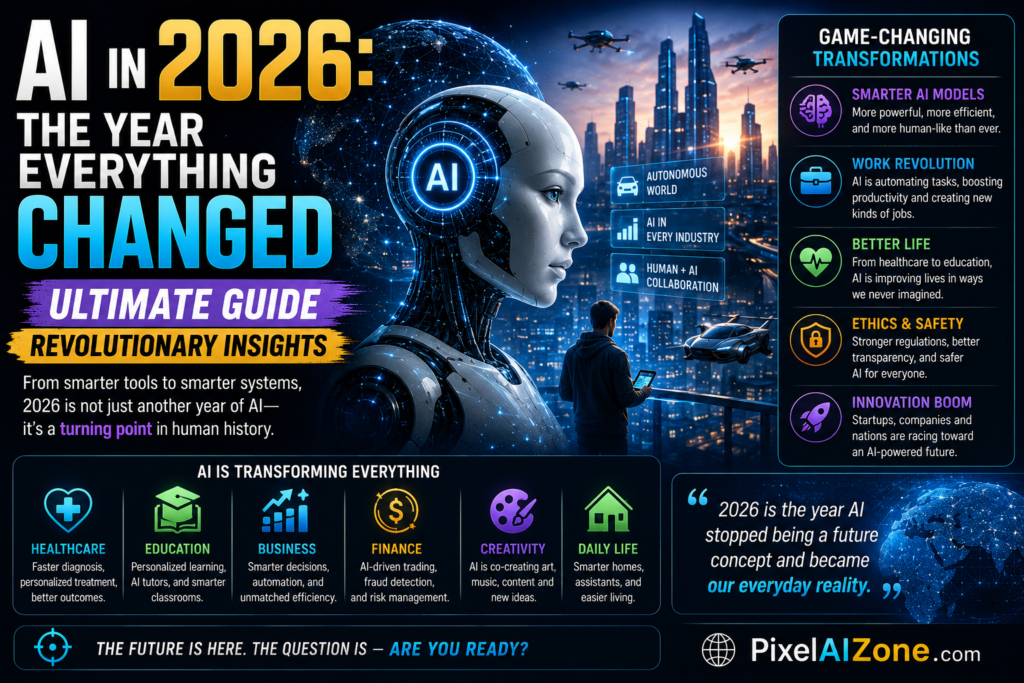
From autonomous agents to global governance, 2026 became the year artificial intelligence moved from promise to reality.
Let me show you something.
In just three years, generative AI has reached more than half the global adoption level achieved by the internet or personal computers over much longer periods . By the first quarter of 2026, generative AI use had reached 17.8 percent of the world’s working-age population, up from 16.3 percent in the second half of 2025 . Twenty-six economies now report generative AI usage above 30 percent among working-age adults .
AI in 2026 is no longer a conversation about what could be. It’s a conversation about what already is.
AI in 2026 is no longer a conversation about what could be — it’s about what already is.
Table of Contents
- AI Has Stopped Chatting and Started Working
- Global AI Adoption: The Numbers That Matter
- The Rise of Agentic AI: From Assistants to Partners
- Pakistan’s AI Moment: Governance Goes Digital
- The Trust Gap: Why People Are Using AI but Don’t Trust It
- Regulation and Governance: The Year of Reckoning
- What AI in 2026 Means for You
- FAQ
AI Has Stopped Chatting and Started Working
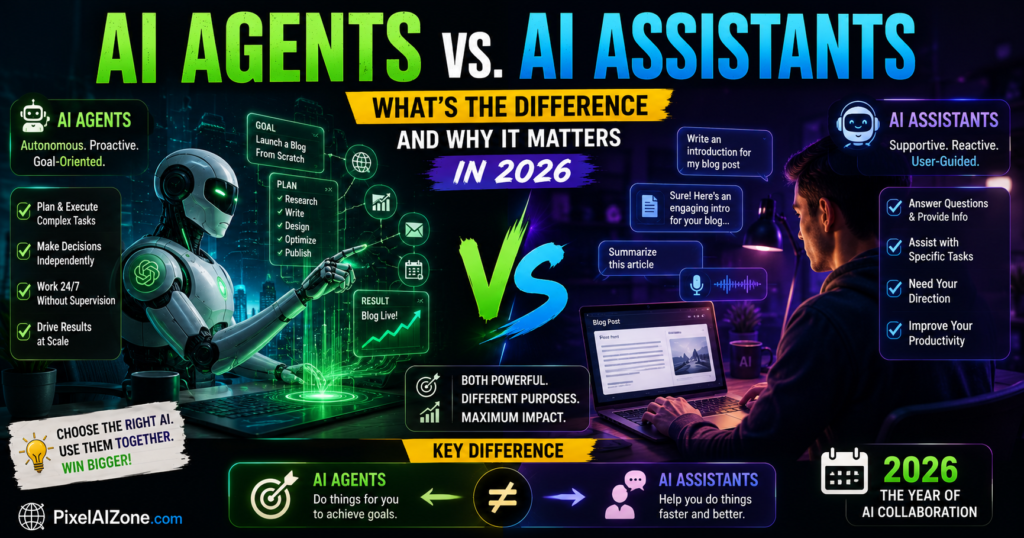
The biggest shift in AI in 2026 is the move from chatbots to autonomous agents.
In 2024, generative AI was being talked about as “an iPhone moment.” The excitement was that AI could chat. In 2026, the excitement is that AI can do the work .
The shift in 2026 is dramatic. According to IBM, the average enterprise is expected to be running more than 1,600 AI agents by the end of 2026 . The AI summit in London was dominated by one word: agents .
What changed?
AI is no longer just a support tool. It is becoming an autonomous agent capable of making decisions, executing tasks, and driving entire workflows with minimal human involvement . This evolution is fundamentally changing how enterprises operate and what skills professionals need to stay competitive .
In 2026, AI is being embedded directly into CRM, ERP, supply chain, and financial planning systems . It’s not a feature anymore — it’s becoming the backbone of every company’s architecture .
Global AI Adoption: The Numbers That Matter
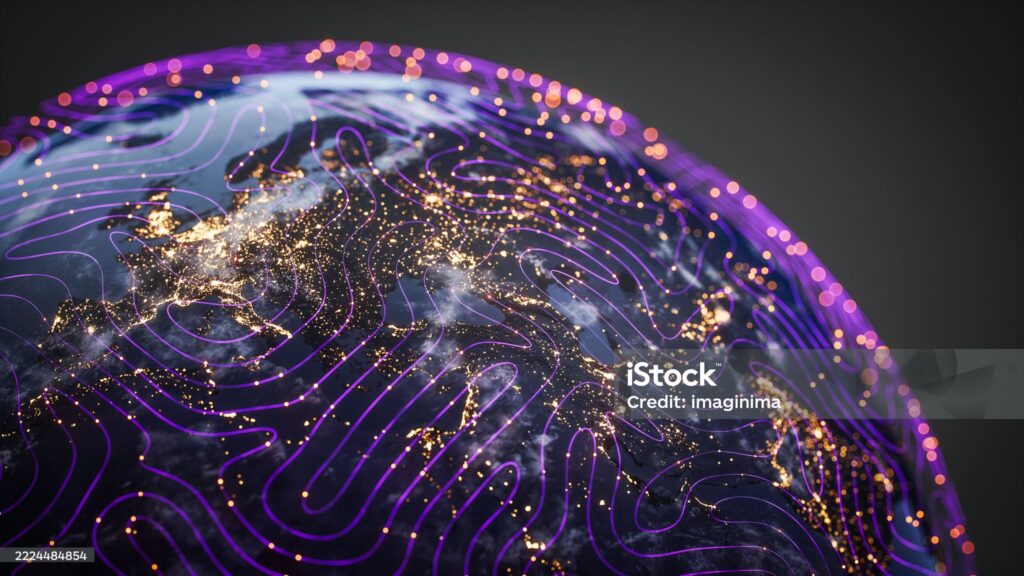
Global adoption data shows AI in 2026 reaching 17.8 percent of the working-age population.
The Global Diffusion Report
According to Microsoft’s Global AI Diffusion Report for Q1 2026, global AI usage increased to 17.8% of the world’s working-age population . This represents a steady climb from 16.3% in the second half of 2025.
Key findings:
| Metric | Value |
|---|---|
| Global AI usage (Q1 2026) | 17.8% |
| Economies above 30% AI usage | 26 |
| UAE AI adoption | 70.1% (global leader) |
| US AI adoption | 31.3% (21st globally) |
Asia’s Rise
Asia has emerged as a new engine of global AI adoption . Twelve of the 15 fastest-growing economies since June 2025 were in Asia, each with at least 25% more AI users than in June 2025 .
Fastest-growing AI markets:
| Country | Growth |
|---|---|
| South Korea | 43.2% |
| Thailand | 36.4% |
| Japan | 34.1% |
The Digital Divide
The adoption gap between developed and developing regions is widening . AI usage is now at 27.5% in the Global North and 15.4% in the Global South .
50 times more ChatGPT users are in high-income countries than in low-income countries . Fewer than one in five workers in low-income countries are exposed to AI .
The Rise of Agentic AI: From Assistants to Partners
Agentic AI defines AI in 2026, with systems that plan, execute, and coordinate autonomously.
The chatbot era is over. AI systems are becoming autonomous agents — planning workflows, using tools, executing multi-step tasks without human intervention . This is the year agents become partners, not just assistants .
What Is Agentic AI?
Agentic AI refers to systems that can plan actions, make decisions, integrate with enterprise tools, and complete business tasks end-to-end . Unlike generative AI, which responds to prompts, agentic AI:
- Executes end-to-end workflows independently
- Coordinates tasks across tools and platforms
- Makes decisions based on goals rather than instructions
- Operates continuously, without constant human supervision
Enterprise Deployment
AI models are evolving from predictive assistants to full-scale agents that can complete business tasks across marketing, operations, HR, sales, customer service, and technology . Gartner expects that GenAI-enabled knowledge management will advance with multimodal search and early agentic workflows, allowing virtual agents to reason and act on user queries .
Inference Will Dominate AI Compute
By 2026, most AI computing is spent on inference rather than training . Organizations are focusing more on deploying models efficiently, optimizing hardware resources, and lowering cost per prediction . Skills in model deployment, compression, and edge computing are becoming more valuable .
Pakistan’s AI Moment: Governance Goes Digital
Pakistan’s AI in 2026 moment came with the launch of the AI-powered PM Office System.

In 2026, Pakistan launched its first AI-powered government platform. Prime Minister Shehbaz Sharif introduced the Artificial Intelligence-based Prime Minister Office System (PMOS) on July 21, 2026 .
What PMOS does:
- It is the first government platform in Pakistan to integrate AI as a central component of decision-making and implementation monitoring
- It records, communicates, monitors, and tracks every directive issued by the Prime Minister
- It serves as a secure technology-driven decision-support platform
- It creates a comprehensive digital repository that records every directive together with the complete chain of implementation
The Prime Minister’s message was clear: “From today onwards, I will not expect any of you with a file in your hands. Everything will be discussed through this mechanism.”
This move signals Pakistan’s entry into AI-driven governance, joining a growing list of nations using AI to modernize public administration.
The Trust Gap: Why People Are Using AI but Don’t Trust It
The trust gap is one of the defining challenges of AI in 2026.
Despite widespread adoption, trust in AI is fragile. People are using AI daily, but they’re uneasy about its broader role in society.
The “Wonder vs. Worry” Divide
At the UN Global Dialogue on AI Governance in July 2026, panelists highlighted a critical tension: people are using AI, but they don’t trust it .
What’s driving the concern:
The Human-in-the-Loop Challenge
London Business School’s Michael Jacobides and Catriona Campbell highlighted a key challenge: “Human in the loop” has quietly become a phrase we hide behind . It sounds reassuring, but in practice, it can mean no one person is actually accountable .
The solution: Put a named human in charge of each AI loop . That person must be accountable for the process, inputs, outputs, and critically, the cost to deploy and run those agents .
Regulation and Governance: The Year of Reckoning

UN Global Dialogue on AI Governance
In July 2026, the United Nations convened its first Global Dialogue on AI Governance . UN Secretary-General António Guterres said the key takeaways were about:
- The speed of AI development — faster than anyone can keep up
- The concentration of AI power — in a handful of companies and countries
- The persuasiveness of AI-enabled falsehoods — misinformation and deception
The UN’s message: “We may be the last generation able to set the terms on which humanity and machines coexist” .
The Scientific Panel on AI
The Preliminary Report by the Independent International Scientific Panel on AI warned that “concentrated commercial and geopolitical interests are largely dictating the speed and direction of AI development” . The panel called for a coordinated international and democratic approach to AI governance.
What AI in 2026 Means for You
For Employees
- Your role is moving up the stack. AI will handle routine tasks. Your responsibilities will shift from doing the task to checking the output and designing the process .
- Accountability matters. A named human must be responsible for AI outputs .
For Businesses
- Production is the only thing that counts. “Pilotitis is a disease,” said AstraZeneca’s Chief Digital, Data and AI Officer, Anne-Claire Gerbaldi . Getting something into production, with a return on investment you can measure, is what matters .
- Data and context matter more than models. LLMs are becoming a commodity . The advantage is in your data and the context wrapped around it .
For Global Citizens
- AI adoption is not predetermined. The choices being made today on data, infrastructure, governance, skills, procurement, and public oversight will shape whether AI expands opportunity or reinforces existing inequalities .
- Access to AI is not the same as agency in how it is adopted, adapted, and used .
FAQ
Q: What is the biggest AI trend in 2026?
A: The shift from AI assistants to AI agents. AI is no longer just chatting — it’s working autonomously across business workflows .
Q: How many people use AI globally?
A: 17.8% of the world’s working-age population uses generative AI . The UAE leads at 70.1%, while the US ranks 21st at 31.3% .
Q: Is AI taking jobs?
A: The data shows that AI coding capabilities may be increasing demand for software developers. US software developer employment reached a record high of 2.2 million in 2025 . However, entry-level roles are declining as AI handles work once assigned to juniors .
Q: What is Pakistan doing with AI?
A: Pakistan launched its first AI-powered government system — the PM Office System (PMOS) — to digitize and track government directives .
Q: Why don’t people trust AI?
A: Concerns about misinformation, job displacement, data privacy, and concentration of power are driving the trust gap . Even as people use AI daily, they’re uneasy about its broader role in society.
Final Thoughts

AI in 2026 is not about what could be. It is about what already is.
In just three years, AI has reached more than half the adoption level of the internet. It is being embedded into the backbone of companies. It is running governments. It is reshaping work.
The question for 2026 is no longer whether AI will transform societies. It is who gets to shape and benefit from that transformation .
The future of AI is still open. But it is already being shaped where people learn, work, access services, build livelihoods, participate in public life, and respond to crisis .
AI will not advance human development on its own. That will depend on whether we have the foundations to use it well, the institutions to govern it responsibly, and the safeguards to protect people when systems fail .
AI in 2026 has crossed the threshold from promise to reality.
Related Posts on Pixelaizone
- Why 39% of Americans Would Stop AI Development If They Could
- “2026 AI Writing Tools Comparison: Which One Actually Deserves Your Money? (Honest Comparison)”
- “Global AI Adoption Rankings 2026: The Ultimate Guide to Which Country Is Winning the AI Race”
- “Agentic AI Is Transforming Pakistan’s SMEs: 7 Powerful Ways to Stay Ahead”
- “Alibaba’s Accio Work in Pakistan 2026: The Ultimate AI Export Revolution for SMEs”
- “ChatGPT Hits 1 Billion Users: What Comes Next for the AI Giant? (Revolutionary Milestone)”
- The ‘Cheating Fruit’ AI Trend: Why 10 Million People Are Watching Strawberries Cheat
- “AI Agents Are Changing How the World Shops 2026 — Here’s How (Revolutionary Shift)”
- “1 in 4 People Now Use AI Every Day — Here’s What They’re Actually Doing (Shocking Insights)”
- “AI Has Crossed the Behavioural Threshold in 2026: Essential Guide to the Shocking Shift from Experimentation to Dependence”
- “The AI Trust Paradox 2026 Revealed : Why 74% of People Use AI Daily But Don’t Trust It (Powerful Insights)”
What do you think about AI in 2026? Drop a comment below!