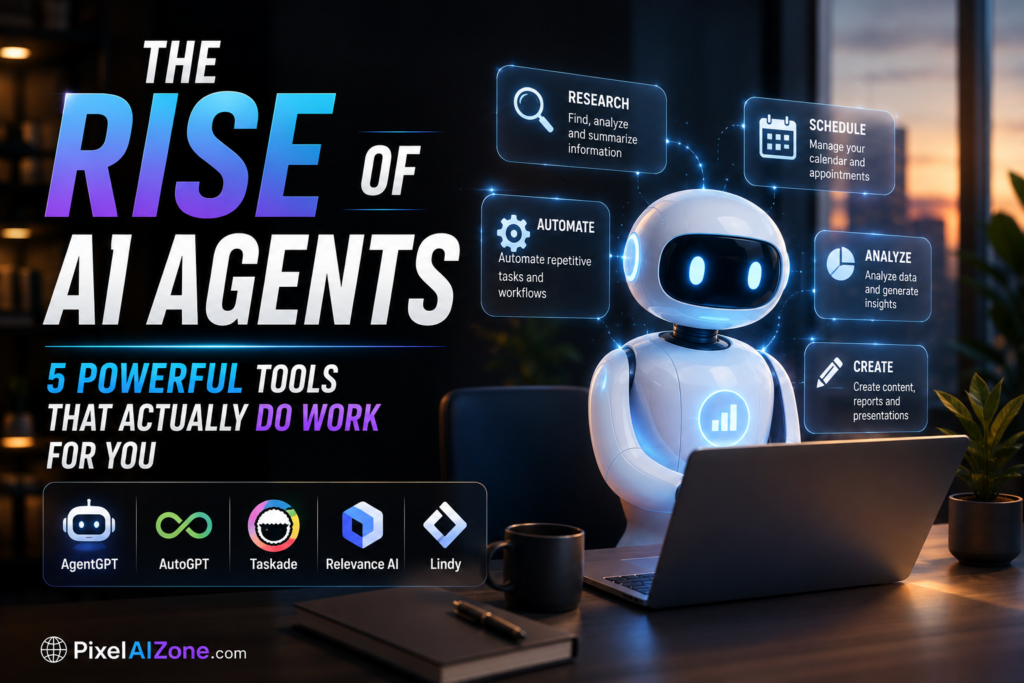
Chatbots answer questions. AI agents get things done. Here are five tools that actually handle tasks for you — from scheduling meetings to building software. The rise of AI agents in 2026 marks a fundamental shift from chatbots that talk to agents that actually do work.
Let me show you something.
In 2026, the difference between a chatbot and an agent is simple: a chatbot responds, an agent acts . You give it a goal — not a question. Something like: “Research our top competitors and drop a comparison into this Notion doc.” Then it goes and does it. Across multiple tools. Without you clicking through each step .
This is what makes 2026 different. The gap between the agent promise and reality has closed dramatically. Three breakthroughs finally made agents useful: computer-use APIs that let them click buttons and fill forms, reliable memory that persists across weeks of work, and error-handling that adapts when things go wrong .
In fact, a staggering 77 percent of enterprises already have AI agents running in production, according to IDC .
Here are five tools that actually work.
The rise of AI agents in 2026 is transforming how work gets done across industries.
This guide explores the rise of AI agents and the 5 tools that actually get things done.
Table of Contents
- ChatGPT Agent: The Familiar Face with New Muscle
- Claude Code / Claude Cowork: The Developer and Document Agent
- Perplexity Computer: The Research Automation Agent
- Genspark: The “Super Agent” That Can Make Phone Calls
- Manus: The Hybrid Cloud-to-Local Agent
- How to Choose the Right Agent
- What Still Doesn’t Work
- FAQ
ChatGPT Agent: The Familiar Face with New Muscle
Understanding the rise of AI agents starts with knowing the difference between chatbots and agents.
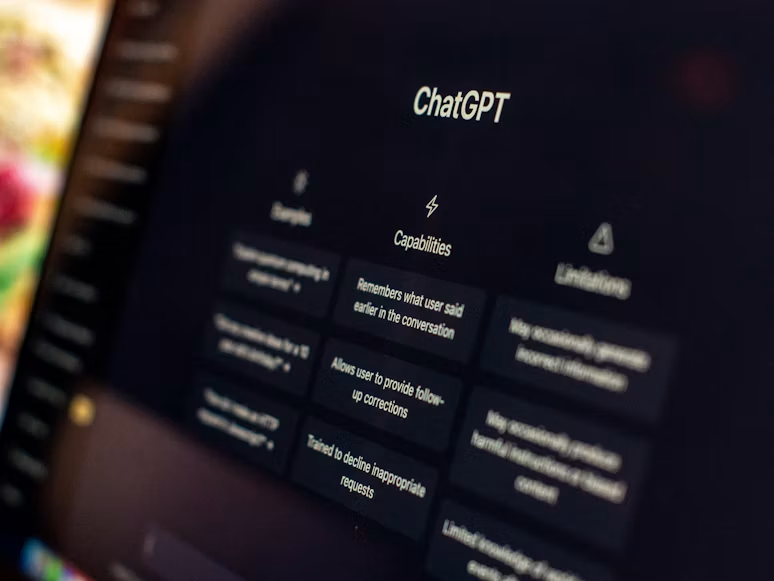
The rise of AI agents is reshaping how professionals approach repetitive tasks.
Best for: General-purpose tasks, research, multi-step workflows, and users already in the ChatGPT ecosystem .
OpenAI’s ChatGPT Agent operates in a sandboxed cloud environment — you can launch it from the desktop app, but the actual work happens in OpenAI’s virtual machine . It includes features like Deep Research, Canvas, and Agent Mode, running on GPT-5.4 with monthly updates .
What it does:
- Handles multi-step workflows
- Conducts deep research across hundreds of sources
- Uses tools like Projects and Canvas for iterative collaboration
MIT’s AI Agent Index lists ChatGPT Agent as one of the top agents with agentic tools, offering extensive tool access for general-purpose coding and workflow tasks .
The tradeoff: For existing ChatGPT Plus subscribers, this is the path of least resistance — same interface, expanded capabilities. But users wanting true local file access will need to manually upload documents into the chat .
Claude Code / Claude Cowork: The Developer and Document Agent
The rise of AI agents is evident in tools like ChatGPT Agent and Claude Code.

Best for: Developers, document processing, and Microsoft Office workflows .
Anthropic’s Claude Code — which grew to $1 billion in annual revenue within six months of launch — is a command-line agent that can write code, run tests, browse repositories, and interact with development environments . It includes tool use, computer control, and support for the Model Context Protocol (MCP) .
What it does:
- Writes, tests, and deploys code
- Understands your codebase context
- Handles edge cases without breaking
Claude Cowork extends this to desktop automation. Running a local virtual machine, it handles Word, Excel, and PowerPoint with native-level fidelity that cloud-only competitors can’t match .
The catch: Claude’s desktop app must stay running for scheduled tasks to work. No app, no automation .
Perplexity Computer: The Research Automation Agent
Perplexity Computer is another example of the rise of AI agents in research.

Best for: Research, data collection, and due diligence .
Perplexity Computer leans into what Perplexity already does well: research. Its multi-model orchestration assigns tasks to 19 different specialized AI models . In testing, one user watched it produce a four-sheet spreadsheet with 33 cited sources and a custom Python script in seven minutes — work that would typically consume hours .
What it does:
- Scours the live internet and provides direct answers with real-time citations
- Allows switching between different models like GPT, Claude, and Gemini
- The Personal Computer companion app currently only runs on macOS
MIT’s AI Agent Index lists Perplexity Comet as a browser-based agent with extensive browser/computer interaction tools — distinct from chat agents with web search, which primarily perform retrieval and summarization .
Genspark: The “Super Agent” That Can Make Phone Calls
Genspark shows the rise of AI agents with real-world communication capabilities.

Best for: Tasks requiring real-world communication and multi-model orchestration .
Genspark positions itself as the “super agent” with one genuinely unique feature: it can make actual phone calls using AI-generated voice. One user reportedly had it order pizza while they continued working .
What it does:
- Runs a mixture-of-agents architecture combining multiple specialized models
- Can make phone calls
- Operates across multiple channels
The complexity shows in the pricing — a credit-based system that can get expensive fast .
Manus: The Hybrid Cloud-to-Local Agent
Manus demonstrates the rise of AI agents with hybrid cloud-to-local execution.

Best for: Power users who want 24/7 autonomous access and hybrid cloud-local execution .
Manus has differentiated itself with a hybrid cloud-to-local architecture. Its desktop app creates a bridge between cloud processing power and your local file system, letting you trigger tasks from a phone that execute on your home computer .
What it does:
- Provides significantly faster processing for local tasks than browser-based agents
- The recommended setup is running it on a dedicated Mac mini for 24/7 autonomous access
MIT’s AI Agent Index lists Manus AI as a general-purpose coding agent with agentic tools .
How to Choose the Right Agent
The rise of AI agents has made it easier to choose the right tool for your workflow.
| Tool | Best For | Key Differentiator |
|---|---|---|
| ChatGPT Agent | General-purpose workflows | Familiar interface, broad ecosystem |
| Claude Code/Cowork | Development & Office | Native integration, local VM |
| Perplexity Computer | Research | 19-model orchestration, citations |
| Genspark | Phone calls & multi-modal | Real-world communication |
| Manus | Power users | Hybrid cloud-to-local, 24/7 autonomy |
The real differentiation is happening in integration depth and specialized use cases . Choose based on what you actually need to automate — not the tool with the most features .
What Still Doesn’t Work
Despite the rise of AI agents, some tasks like phone calls still need improvement.
- Phone calls: Voice agents still struggle with accents and background noise
- Creative judgment: Agents can’t decide if a headline is “clever” or “clever-ish”
- Complex negotiations: Don’t let an agent negotiate your salary (yet)
FAQ
Q: What’s the difference between an AI assistant and an AI agent?
A: An assistant responds to prompts. An agent acts on goals — it plans, reasons, and executes tasks without constant human supervision .
Q: Are AI agents actually reliable in 2026?
A: Yes, for defined, repeatable workflows. Three breakthroughs made them useful: computer-use APIs, persistent memory, and error handling .
Q: How much do these tools cost?
A: Most are converging around a $20-25 monthly subscription market . ChatGPT Plus and Claude Pro are $20/month. Perplexity Pro is $20/month. Genspark uses a credit-based system .
Q: What’s the most popular AI agent for developers?
A: Claude Code is the developer’s choice — it grew to $1 billion in annual revenue within six months of launch .
Q: What is the rise of AI agents?
A: It’s the shift from chatbots to autonomous tools.
Final Thoughts
In 2026, AI agents are no longer vaporware demos. They’re shipping products with paying customers and measurable productivity gains . The agents that work don’t replace humans. They handle the boring stuff so humans can focus on what matters .
The rise of AI agents is transforming how we work and automate tasks.
The rise of AI agents is just beginning — and the best tools are still emerging. The rise of AI agents represents a fundamental shift in how we interact with technology.
Related Posts on Pixelaizone
- 11 AI Coding Tools You Should Use in 2026 (Beyond GitHub Copilot) – Game-Changing Guide
- The Best AI Image Generator in 2026: Midjourney vs Kling AI vs Adobe Firefly
- 5 Free AI Tools That Are Better Than ChatGPT for Specific Tasks
- Perplexity vs ChatGPT: Why Researchers Are Switching to Perplexity in 2026
- Claude vs ChatGPT : Which AI Tool Is Better for Long-Form Content in 2026?
- Google AI Mode vs ChatGPT: Which Search Engine Will Win in 2026? Complete Analysis
- AI in 2026: The Year Everything Changed Ultimate Guide (Revolutionary Insights)
- Why 39% of Americans Would Stop AI Development If They Could
- “2026 AI Writing Tools Comparison: Which One Actually Deserves Your Money? (Honest Comparison)”
- “Global AI Adoption Rankings 2026: The Ultimate Guide to Which Country Is Winning the AI Race”
- “Agentic AI Is Transforming Pakistan’s SMEs: 7 Powerful Ways to Stay Ahead”
- “Alibaba’s Accio Work in Pakistan 2026: The Ultimate AI Export Revolution for SMEs”
- “ChatGPT Hits 1 Billion Users: What Comes Next for the AI Giant? (Revolutionary Milestone)”