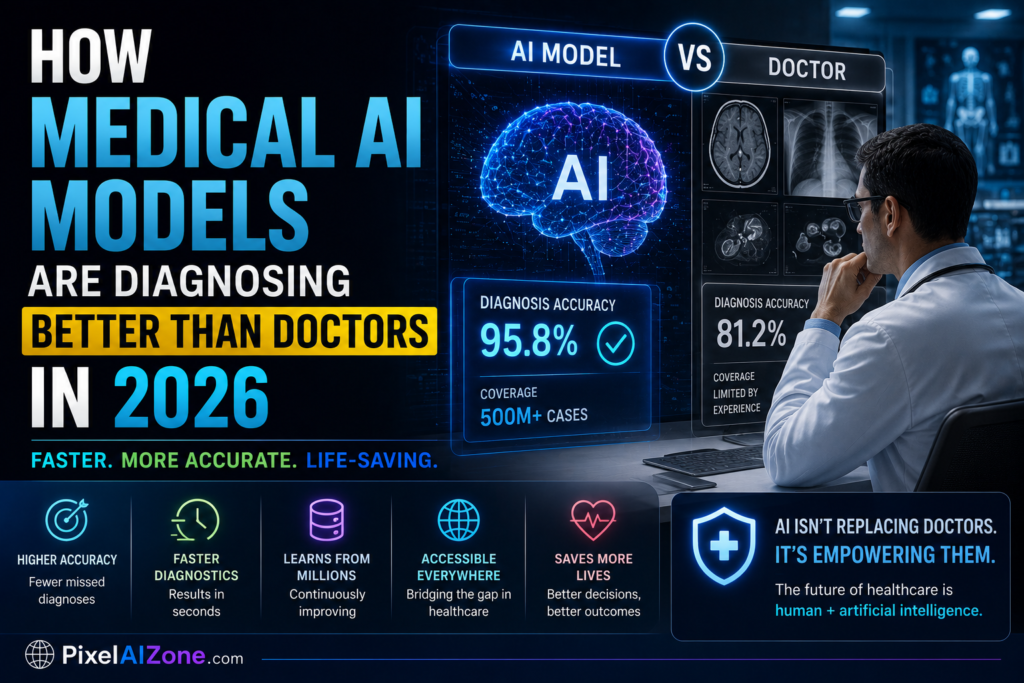
From emergency room triage to complex patient management, AI models are now matching or exceeding physicians in clinical reasoning. Here’s what the data actually shows.Medical AI models have reached a turning point in 2026, outperforming physicians in diagnostic accuracy.
Let me show you something.
In 2026, the question is no longer whether AI can assist with diagnosis. The question is how quickly it will be integrated into clinical workflows. Multiple studies published this year have demonstrated that advanced AI models can outperform physicians in diagnostic accuracy, clinical reasoning, and treatment planning — across emergency medicine, primary care, and specialized fields.
A Harvard-led study published in Science found that OpenAI’s o1 reasoning model outperformed physicians across virtually every benchmark tested . Across 143 complex diagnostic cases from the New England Journal of Medicine, the model included the correct diagnosis in its differential 78.3% of the time — and accuracy rose to 97.9% when near-miss diagnoses were included .
This guide explores how medical AI models are diagnosing better than doctors and what it means for healthcare. Medical AI models are transforming how doctors diagnose and treat patients in 2026.
Table of Contents
- The Harvard Study: AI Outperforms Emergency Doctors
- MIRA and AMIE: Nature’s Autonomous Medical Agents
- A Real-World Test: The Kenya Primary Care Trial
- Where AI Still Falls Short
- What This Means for the Future of Medicine
- FAQ
Medical AI Models: The Harvard Study on Emergency Diagnosis
The Harvard study shows that medical AI models can outperform physicians in clinical reasoning. Medical AI models are now being evaluated in real-world clinical settings with promising results.

Medical AI models are being integrated into emergency rooms and primary care settings worldwide.
The most comprehensive evaluation of AI clinical reasoning to date was published in Science on April 30, 2026 . Researchers from Harvard Medical School and Beth Israel Deaconess Medical Center tested OpenAI’s o1 reasoning model across six experiments with human physician baselines .
Key findings across all experiments:
| Task | AI Performance | Physician Performance |
|---|---|---|
| NEJM diagnostic cases | Correct diagnosis in 78.3% of 143 cases | Physicians (historical): 74% |
| Clinical reasoning scoring | Perfect score in 78 of 80 cases | Attending physicians: 28 of 80 |
| Management reasoning | 89% median score | Physicians with conventional resources: 34% |
| ER triage | 67.1% correct or near-correct | 50-55% accuracy |
The ER triage experiment was particularly striking. In 76 real-world emergency department cases, the AI was given the same electronic health record information as human physicians — vital signs, demographics, and brief nursing notes. Using only text-based information, the AI identified the exact diagnosis or a very close diagnosis in 67.1% of cases, compared to 50-55% for human physicians .
When additional clinical detail was provided, the AI’s accuracy increased to 82% . Human experts achieved 70-79% accuracy under those circumstances.
One case highlighted the AI’s unique value. A patient with a pulmonary embolism and worsening symptoms was believed by doctors to have failing anticoagulant treatment. The AI identified that the patient had a history of lupus, which may have been responsible for inflammation in the lungs — something clinicians had overlooked. The AI’s interpretation was confirmed as correct .
MIRA and AMIE: Nature’s Autonomous Medical Agents
Medical AI models like MIRA are designed to handle complex diagnostic and treatment workflows.
Two independent AI models published in Nature in June 2026 demonstrated that AI can handle multiple stages of patient management, from diagnosis to treatment decisions .
MIRA: The EHR-Powered Diagnostic Agent
Medical AI models like MIRA have achieved 87.8 percent diagnostic accuracy.
Developed by researchers at TU Dresden and Heidelberg University Hospital, MIRA (Medical Intelligence for Reasoning and Action) can access patient data in an isolated electronic health record system .
What MIRA can do:
- Conduct conversations with a patient AI agent to gather medical history
- Choose from over 85,000 options to order diagnostic tests
- Interpret results and make treatment plans
- Prescribe medication, schedule procedures, and arrange admissions
The numbers:
| Metric | MIRA | Physicians |
|---|---|---|
| Diagnostic accuracy | 87.8% | 78.1% |
| Medication safety | 99.8% correct | Lower |
MIRA was evaluated using real-world data from more than 500 emergency department clinical cases . Its medication recommendations were 99.8% correct, and its treatment decisions aligned with clinical guidelines at a higher rate than the physician panel .
AMIE: Google’s Conversational Clinician
Google’s AMIE is another example of medical AI models excelling in patient management.
Google DeepMind’s AMIE (Articulate Medical Intelligence Explorer) is a large language model-based system optimized for clinical management and dialogue .
What AMIE does differently:
- Performs continuous reasoning across multiple patient visits
- Tracks disease progression and therapeutic response
- Aligns output with clinical practice guidelines and drug formularies
In a virtual clinical examination study, AMIE was compared to 21 primary care physicians across 100 multi-visit case scenarios . AMIE performed as well as real physicians in management reasoning capabilities, and better than physicians in treatment preciseness, investigation preciseness, and alignment with clinical guidelines .
A Real-World Test: The Kenya Primary Care Trial
Real-world trials show medical AI models improve clinical documentation quality. Medical AI models are demonstrating real-world value in clinical documentation and cost reduction.

While lab studies show impressive results, a large real-world trial published in Nature Medicine in June 2026 asked the harder question: does AI actually improve patient outcomes?
The study involved more than 9,600 patients attending 16 primary care clinics in Kenya . Clinicians were randomly assigned to use an electronic medical record system with or without an integrated AI consult tool that provided real-time diagnostic and treatment suggestions aligned with Kenyan national clinical guidelines .
What the trial found:
| Outcome | AI-Supported Care | Standard Care |
|---|---|---|
| Treatment failure within 14 days | 2.2% | 2.0% |
| Patient satisfaction | Same in both groups | Same in both groups |
| Clinical documentation quality | Significantly improved | Lower |
| Antibiotic costs | Lower | Higher |
The AI tool did not produce statistically significant improvements in short-term patient outcomes . However, it significantly improved the quality of clinical documentation and treatment planning, and antibiotic-related costs were lower in the AI-supported group due to more cost-conscious prescribing choices .
Where AI Still Falls Short
Despite progress, medical AI models have limitations including text-only inputs.
Despite the impressive results, researchers are emphatic that AI is not ready to replace physicians .

Medical AI models are advancing rapidly, but governance and validation must catch up.
The Text-Only Limitation
The Harvard study only assessed AI systems using text-based patient information. It did not evaluate the AI’s ability to interpret non-verbal clinical signals that doctors routinely use during patient assessment, such as visible distress, facial appearance, behavior, and physical examination findings . As a result, the AI functioned more like “a clinician reviewing paperwork and offering a second opinion” .
The Benchmark Trap
Outperforming physicians in controlled settings and being ready for consequential deployment in clinical trials are two different sentences. A researcher at Harvard noted that “the field is ahead of its own governance” .
Model Bias in Underserved Regions
A comparative study published in July 2026 found that LLM accuracy varied significantly by disease category. In the Hemoglobinopathy category, GPT-4 scored only 10% accuracy . These errors must be interpreted with caution; there may be limited model exposure to certain case types that are more prevalent in South Asia and the Middle East compared to the Americas and Europe .
What This Means for the Future of Medicine
The future of medical AI models lies in collaboration with physicians, not replacement.
AI is moving from narrow, single-purpose tools to agentic systems that orchestrate complex clinical workflows . By late 2026, we are seeing a shift toward systems that integrate multimodal data, track patient progress, and proactively coordinate care with clinicians in the loop .
The Triadic Care Model
Harvard researchers predict healthcare may move toward what they describe as a “triadic care model” involving “the doctor, the patient, and an artificial intelligence system” .
The Governance Gap
The regulatory gap is widening. As one researcher put it: “We may be witnessing the most profound change in technology that will reshape medicine, but we need to evaluate this technology now in rigorously conducted prospective clinical trials” .
FAQ
Q: Can AI diagnose better than doctors in 2026?
A: Yes, in controlled studies. AI models have demonstrated superior diagnostic accuracy in text-based clinical reasoning tasks, but they are not yet ready for real-world deployment without human oversight .
Q: What is MIRA and what can it do?
A: MIRA is an AI model that can access patient data, conduct diagnostic conversations, order tests, interpret results, and make treatment plans including prescribing medication. It achieved 87.8% diagnostic accuracy vs. 78.1% for physicians .
Q: Does AI actually improve patient outcomes?
A: A large Kenya trial found AI improved clinical documentation and reduced antibiotic costs but did not significantly change short-term patient outcomes .
Q: Is AI going to replace doctors?
A: No. Researchers emphasize AI will work alongside physicians in a collaborative model, not replace them .
Q: What are the limitations of current medical AI?
A: AI cannot interpret non-verbal cues, physical examination findings, or handle incomplete data. It also shows bias in underserved regions .
Q: Can medical AI models diagnose better than doctors?
A: Yes, in controlled studies.
Final Thoughts
2026 is the year medical AI moved from “promising” to “proven” in controlled settings. The data is clear: AI models can now match or exceed physicians in diagnostic and management reasoning tasks.
But the gap between controlled studies and real-world deployment remains significant. Governance, bias, and integration challenges still need to be addressed.
What’s clear: AI will not replace doctors. But doctors who use AI will likely outperform those who don’t.
Medical AI models are not replacing doctors but augmenting their capabilities. Medical AI models will continue to evolve, but human oversight remains essential for patient safety.
Related Posts on Pixelaizone
- Generative AI in Healthcare: MIRA and AMIE Outperform Physicians in 2026 Complete Guide
- EU AI Act 2026: What Pakistani Businesses Need to Know. Urgent Compliance Guide
- DBS Bank Introduces Agentic AI to 350,000 Corporate Clients Game-Changing Move Ultimate Guide
- HSBC Just Hired 100 AI Specialists — Here’s What They’ll Be Doing (Game-Changing Move)
- AI Ethics Explained: Why 90% of Americans Want AI Regulated in 2026 Essential Guide
- Agentic AI vs Generative AI: The Ultimate Guide to What’s the Difference and Why 2026 Matters
- “The Rise of AI Agents: 5 Powerful Tools That Actually Do Work for You”
- 11 AI Coding Tools You Should Use in 2026 (Beyond GitHub Copilot) – Game-Changing Guide
- The Best AI Image Generator in 2026: Midjourney vs Kling AI vs Adobe Firefly
- 5 Free AI Tools That Are Better Than ChatGPT for Specific Tasks
- Perplexity vs ChatGPT: Why Researchers Are Switching to Perplexity in 2026
- Claude vs ChatGPT : Which AI Tool Is Better for Long-Form Content in 2026?
- Google AI Mode vs ChatGPT: Which Search Engine Will Win in 2026? Complete Analysis
Would you trust an AI to help with your medical diagnosis? Drop a comment below!