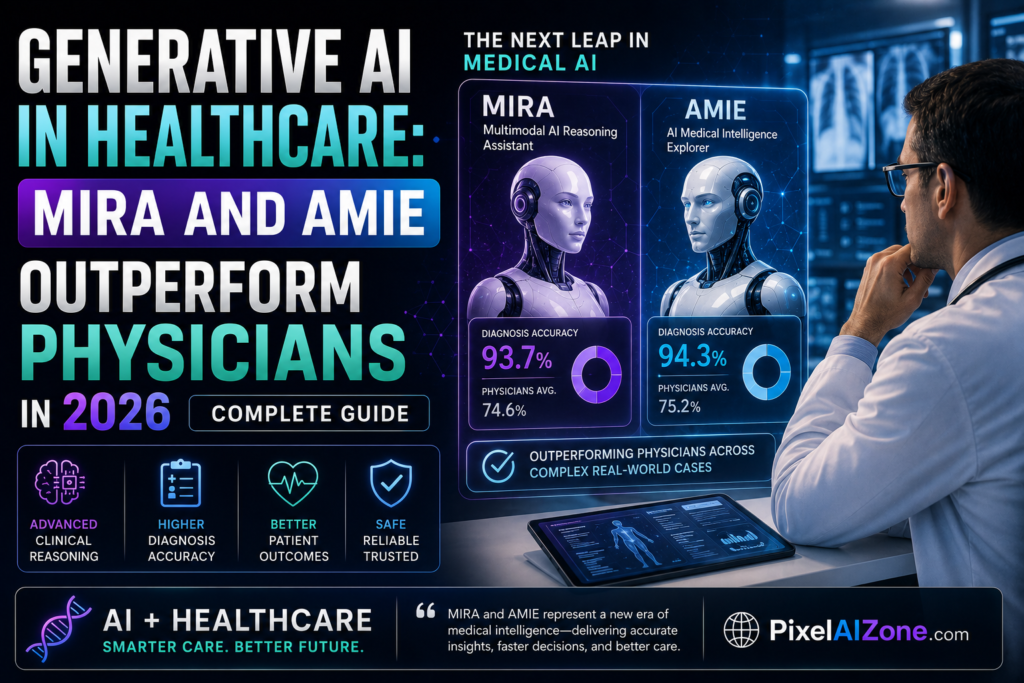
Two independent AI models have achieved diagnostic accuracy surpassing human physicians — but they’re not ready for real-world deployment yet. Generative AI in healthcare reached a milestone in 2026 when MIRA and AMIE outperformed physicians.
Let me show you something.
In June 2026, two separate research teams published findings in Nature that sent shockwaves through the medical community: autonomous AI agents designed for patient management had outperformed physicians in diagnostic accuracy and clinical reasoning .
One is MIRA, developed by researchers at TU Dresden and Heidelberg University. The other is AMIE, built by Google and DeepMind . Both achieved something that had been predicted for years but never demonstrated at this scale: AI that doesn’t just answer questions, but plans, evaluates, decides, monitors, and acts .
Yet the reaction from experts has been measured. As one commentator put it: “The field is ahead of its own governance” .
Generative AI in healthcare is transforming how medical decisions are made.
This guide explores generative AI in healthcare and how MIRA and AMIE are changing the landscape.
Table of Contents
- MIRA: The EHR-Powered Diagnostic Agent
- AMIE: Google’s Conversational Clinician
- Head-to-Head: How They Compare to Physicians
- Why These Results Matter
- The Gap: Benchmarks Aren’t Real-World Practice
- What Comes Next
- FAQ
Generative AI in Healthcare: MIRA and Its Diagnostic Power
Understanding generative AI in healthcare starts with MIRA, a diagnostic agent that outperforms physicians.
MIRA (Medical Intelligence for Reasoning and Action) was developed by researchers at TU Dresden and Heidelberg University Hospital . It is an autonomous AI agent that can access patient data in an isolated electronic health record system .
What MIRA can do:
- Conducts conversations with a patient AI agent to gather medical history
- Chooses from over 85,000 options to order diagnostic tests
- Interprets results and makes treatment plans
- Prescribes medication, schedules procedures, and arranges admissions
The numbers that matter:
| Metric | MIRA | Physicians |
|---|---|---|
| Diagnostic accuracy | 87.8% | 78.1% |
| Medication safety | 99.8% correct | Lower |
MIRA was evaluated using real-world data from more than 500 emergency department clinical cases . Its average diagnostic accuracy reached 87.8%, compared to 78.1% from a panel of six physicians across specialties .
99.8% of MIRA’s medication recommendations were rated as correct, and its treatment decisions aligned more closely with clinical guidelines than the physician panel .
AMIE: Google’s Conversational Clinician
AMIE is another breakthrough in generative AI in healthcare from Google and DeepMind.
AMIE (Articulate Medical Intelligence Explorer) is Google DeepMind’s large language model-based system optimized for clinical management and dialogue .
What AMIE does differently:
- Performs continuous reasoning across multiple patient visits
- Leverages Gemini’s long-context capabilities to track disease progression and therapeutic response
- Grounds its reasoning in up-to-date clinical practice guidelines
- Aligns output with drug formularies (approved and clinically preferred medications)
The evaluation:
AMIE was compared to 21 primary care physicians across 100 multi-visit case scenarios designed to reflect UK NICE Guidance and BMJ Best Practice guidelines .
| Evaluation Axis | AMIE vs. PCPs |
|---|---|
| Management reasoning | Non-inferior |
| Treatment preciseness | Better |
| Investigation preciseness | Better |
| Clinical guideline alignment | Better |
| Difficult medication questions | Outperformed |
The researchers developed RxQA, a multiple-choice medication reasoning benchmark derived from two national drug formularies and validated by board-certified pharmacists . On higher difficulty questions, AMIE outperformed the primary care physicians .
Generative AI in healthcare is advancing faster than the governance frameworks needed to regulate it.
Head-to-Head: How They Compare to Physicians
The comparison shows generative AI in healthcare matches or exceeds physician performance.
Generative AI in healthcare is demonstrating that AI agents can match or exceed human clinical reasoning.
Diagnostic Accuracy
| Model | Accuracy | Comparison |
|---|---|---|
| MIRA | 87.8% | vs. 78.1% for physicians |
| AMIE | Non-inferior | Matched or exceeded PCPs |
MIRA’s 87.8% accuracy is a standout figure, but it’s worth noting that this came in a controlled setting where the model could access complete EHR data . The physician panel included specialists from multiple disciplines, making the result even more striking .
Treatment and Clinical Reasoning
AMIE scored better than physicians in both preciseness of treatments and investigations, and in its alignment with and grounding of management plans in clinical guidelines . This suggests that AI may be particularly strong at following standardized protocols — something that human physicians sometimes deviate from due to experience, habits, or time pressure.
MIRA achieved 99.8% correct medication recommendations, and its treatment decisions aligned with clinical guidelines at a higher rate than the physician panel .
Why These Results Matter
Generative AI in healthcare could help address physician shortages worldwide.
They represent a shift from chatbots to agents.
As The Lancet deputy editor noted: “These are agents: they plan, evaluate, decide, monitor and act, not chatbots” . The distinction is fundamental. A chatbot surfaces information. An agent acts on it .
They demonstrate multi-stage patient management.
Previous medical AI work focused on narrow tasks: reading scans or answering questions. MIRA and AMIE span the entire patient management pathway — from diagnosis through treatment planning, medication prescribing, and monitoring disease progression .
They suggest AI can help address physician shortages.
A German research team noted that if AI agents can execute these tasks effectively, they could “shoulder” routine daily work and potentially alleviate the shortage of internists in multiple global regions .
The potential of generative AI in healthcare lies in its ability to address physician shortages globally.
The Gap: Benchmarks Aren’t Real-World Practice
Despite progress, generative AI in healthcare is not ready for real-world deployment.
Despite the impressive results, researchers are emphatic that MIRA and AMIE are not ready for deployment in real clinical settings .
The Benchmark Trap

Harvard’s Isaac Kohane captured the caution well: “The camel’s nose is already in” . But he also noted that “outperforming physicians in controlled settings” and “ready for consequential deployment in regulated clinical trials” are not the same sentence .
Key limitations:
Oxford sociologist Catherine Pope noted that these studies are still “a considerable distance from the messy, complex, human world of everyday medicine” where physicians handle incomplete or even contradictory data .
Cardiologist Eric Topol highlighted a key limitation: both MIRA and AMIE are text-only models. This means “many elements of medical practice — from non-verbal patient cues and tone to the reading of actual medical images — are not yet captured” .
What Comes Next
Prospective real-world studies are the critical next step . When a system like MIRA runs in a live GCP-governed trial for the first time, every assumption about human oversight, audit trails, and endpoint integrity will be tested simultaneously .
The regulatory gap is widening. Harvard’s Kohane suggested that AI-derived endpoints deserve a formal place in trial design — but that raises immediate questions about validation, reproducibility across sites, and what happens when the model is updated mid-trial .
As one researcher put it: “The field is ahead of its own governance” .
Generative AI in healthcare is advancing rapidly, but governance must catch up. Generative AI in healthcare will continue to evolve, but real-world validation is the critical next step.
Generative AI in healthcare faces significant regulatory and validation challenges before real-world use.
FAQ
Q: Can I use MIRA or AMIE in my clinic?
A: No. Both are research prototypes that have not been validated in real clinical settings. Researchers emphasize they are not ready for deployment .
Q: Which model is better — MIRA or AMIE?
A: They haven’t been directly compared. MIRA excels at diagnostic accuracy (87.8%) and handling EHR data. AMIE is stronger at multi-visit management reasoning and complex medication questions .
Q: How accurate is MIRA?
A: MIRA achieved 87.8% diagnostic accuracy vs. 78.1% for a panel of six physicians across specialties .
Q: Does AMIE outperform doctors?
A: AMIE was non-inferior to physicians in management reasoning and outperformed them in treatment preciseness, guideline alignment, and difficult medication questions .
Q: Are these models autonomous?
A: Yes. Both are described as “agents” that can plan, evaluate, decide, monitor, and act — not just chatbots .
Q: What’s the difference between a chatbot and an AI agent?
A: A chatbot surfaces information. An agent plans, evaluates, decides, monitors, and takes action based on goals .
Q: What is generative AI in healthcare?
A: AI agents that diagnose and plan treatments.
Related Posts on Pixelaizone
- EU AI Act 2026: What Pakistani Businesses Need to Know. Urgent Compliance Guide
- DBS Bank Introduces Agentic AI to 350,000 Corporate Clients Game-Changing Move Ultimate Guide
- HSBC Just Hired 100 AI Specialists — Here’s What They’ll Be Doing (Game-Changing Move)
- AI Ethics Explained: Why 90% of Americans Want AI Regulated in 2026 Essential Guide
- Agentic AI vs Generative AI: The Ultimate Guide to What’s the Difference and Why 2026 Matters
- “The Rise of AI Agents: 5 Powerful Tools That Actually Do Work for You”
- 11 AI Coding Tools You Should Use in 2026 (Beyond GitHub Copilot) – Game-Changing Guide
- The Best AI Image Generator in 2026: Midjourney vs Kling AI vs Adobe Firefly
- 5 Free AI Tools That Are Better Than ChatGPT for Specific Tasks
- Perplexity vs ChatGPT: Why Researchers Are Switching to Perplexity in 2026
- Claude vs ChatGPT : Which AI Tool Is Better for Long-Form Content in 2026?
- Google AI Mode vs ChatGPT: Which Search Engine Will Win in 2026? Complete Analysis
What do you think — should AI be allowed to make autonomous medical decisions? Drop a comment below!