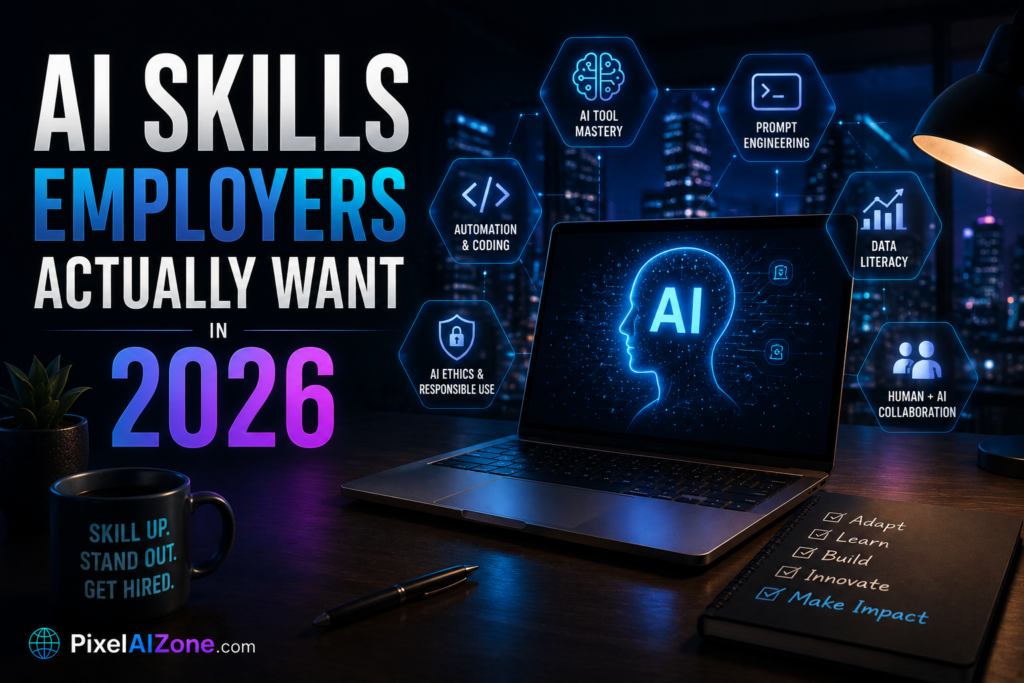
The AI job market isn’t creating armies of prompt engineers. Instead, employers want marketers, engineers, and analysts who can use AI effectively within their existing roles.
AI skills employers want in 2026 are evolving faster than most professionals realize. When ChatGPT arrived in 2022, we were told to expect a wave of entirely new careers, from prompt engineers to AI ethicists. Four years later, employers certainly want AI skills, but the roles they are hiring for tell a more interesting story .
Rather than creating armies of people with shiny new AI job titles, businesses are increasingly looking for marketers, engineers, project managers, analysts and other professionals who know how to use AI effectively within their existing roles. AI skills employers want in 2026 are about integration, not isolation . AI skills employers want include prompt engineering, agentic AI, and machine learning — but each serves a different purpose.
So which AI skills actually matter to employers in 2026? Let’s look at the data.
Table of Contents
- Prompt Engineering: In Demand, But Not as a Job Title
- Agentic AI: The Fastest-Growing Skill
- Machine Learning: Still the Foundation
- AI Literacy and Generative AI Fluency
- AI Ethics and Governance: The Surprising Gap
- How Employers Actually Test AI Skills
- The AI Skills Premium: What Pays More
- FAQ
Prompt Engineering: In Demand, But Not as a Job Title
Understanding which AI skills employers want is the first step to building a career that pays.

This was widely expected to be one of the most in-demand AI skills employers want. Many predicted it could become a common job title. That isn’t quite how things have worked out — but prompt engineering as a skill is already highly in demand .
Statistics gathered by Stanford for their 2026 AI index suggest that 22,227 US job listings sought applicants with this proficiency in 2025, a huge increase from 6,152 the previous year . AI skills employers want in 2026 include prompt engineering, but not as a standalone job.
So while companies aren’t specifically hiring to fill prompt engineer roles, they are hiring marketers, analysts, project managers and engineers with strong prompt engineering skills to help them deploy AI across their organizations.
According to LinkedIn’s 2026 Skills on the Rise report, prompt engineering is one of the top 10 fastest-growing AI engineering skills, alongside FastAPI, LangChain, RAG, and vector databases . AI skills employers want in 2026 are about how you apply the skill, not just having it.
The bottom line: Prompt engineering is a skill, not a job title. The real career payoff is combining prompt engineering with domain expertise .
Agentic AI: The Fastest-Growing Skill

This was the subset of AI skills employers want that Stanford’s researchers found had increased by the largest amount, from just 151 mentions in 2024 job ads to 16,541 in 2025 . AI skills employers want in 2026 are increasingly agentic.
Ads seeking professionals skilled in LangGraph, an open-source platform for deploying AI agents, increased by over 2,000 percent, from 194 to 4,294, in the same period .
Orchestrating teams of agents to work cooperatively, agentic specialisms like web browsing and online shopping, and UX design focusing on creating tools that can be used by both agents and humans, all fall into this category. AI skills employers want include these agentic capabilities.
Agentic AI skills include:
- Building AI agents that use tools and APIs
- Agent orchestration and multi-step workflow design
- LangGraph and agent frameworks
- Agentic architecture with state management, tool validation, and loop controls
Agentic AI in 2026: From Chatbots to Digital Workers Revolutionary Shift
According to DataCamp’s State of AI Careers 2026 report, AI engineering roles grew 255% year-over-year, with Generative AI engineering roles seeing a 197% increase .
Machine Learning: Still the Foundation

Machine learning is best thought of as the technical nuts and bolts that make every application we call “AI” work. According to Stanford’s research, it’s still the most frequently requested AI skill in job ads . AI skills employers want are built on this foundation.
As a technical skill, requiring knowledge of computer programming, mathematics and statistics, it’s the “hard skill” underpinning everything else on the list. AI skills employers want in 2026 are built on this foundation .
While newer and more trendy terms cover technologies that handle human-machine interfacing and workflow automation, ML algorithms quietly power recommendation engines, predictive maintenance, fraud detection, risk modeling and all the vital workloads industry entrusts to AI in 2026 .
The Coursera Job Skills Report 2026 confirms that foundational technologies like SQL, JSON, and Web Applications remain indispensable, with learners actively layering on new AI competencies .
AI Literacy and Generative AI Fluency

In 2026, AI literacy is becoming a baseline expectation across many roles. According to a Zapier survey, 98% of executives now expect employees to have some level of AI proficiency . AI skills employers want in 2026 include this fluency.
AI literacy is defined as incorporating tools like ChatGPT, Claude, and Gemini into your daily workflow, rather than just occasionally using them. According to DataCamp’s analysis, communication emerged as a universal job requirement across all 25 AI and data career paths studied, alongside Python, SQL, and computer science .
The Coursera report also highlights that GenAI remains the most in-demand skill in Coursera’s history, with 14 enrollments per minute .
What employers want: People who can explain insights, apply judgment, and connect technical work to business decisions — not just use AI tools .
AI Ethics and Governance: The Surprising Gap

This might be the skill showing the biggest gap between expectation and reality — which should probably be a cause for concern. AI skills employers want in this category are surprisingly low.
It could be that many businesses don’t feel that their AI strategies are mature enough to warrant hiring people with skills in this field. According to the AI index, just 0.05 percent of US job listings specifically sought candidates with these abilities .
This makes it the smallest of the 10 AI skill clusters tracked by Stanford’s report . Is this a sign that industry isn’t yet treating oversight as an operational priority, preferring to see it as a problem to be dealt with when things go wrong? With the need to navigate increasingly complex and onerous regulatory frameworks — the EU AI Act, for example — this could be a mistake, and a lot of companies could be setting themselves up to learn this the hard way .
“Agentic AI Is Transforming Pakistan’s SMEs: 7 Powerful Ways to Stay Ahead”
How Employers Actually Test AI Skills
According to hiring data, employers are testing AI skills employers want differently than many candidates expect. Nearly 90% of companies now use AI to rank or filter resumes .
How AI skills are tested:
| Skill | How It’s Tested |
|---|---|
| Directing AI | Live pairing sessions where you work with an AI assistant while the interviewer watches how you instruct, correct, and steer it |
| Reviewing AI output | “Here’s AI-generated code/analysis — what’s wrong with it?” |
| Building with APIs | Portfolio inspection: do you have a deployed project with a real AI feature |
| Agent fundamentals | System-design conversations: “how would you automate X?” — listening for loop thinking, verification, and honest scope |
The pattern: Every skill is judgment wrapped around the tools, not the tools themselves. When the tool is universal, the tool differentiates no one; employers pay for what the tool can’t supply.
The AI Skills Premium: What Pays More
According to LinkedIn data, AI skills are now the most sought-after enterprise capability. AI skills employers want command significant salary premiums.
Highest-demand roles :
| Role | Growth |
|---|---|
| AI Engineer (#1 fastest-growing job title) | 143% year-over-year |
| AI engineering roles | 255% year-over-year |
| Generative AI engineering roles | 197% year-over-year |
Highest-paying roles:
- Large Language Model Architects: $240,000 average in the US
- Data Science Managers: approaching $190,000 median base salary
- AI engineering roles: median base salaries above $100,000
DBS Bank Introduces Agentic AI to 350,000 Corporate Clients Game-Changing Move Ultimate Guide
Entry-level jobs now require AI skills at triple the rate reported in fall 2025, according to NACE’s 2026 Job Outlook Spring Update .
FAQ
Q: Do I need to learn programming to get an AI job?
A: It depends on the role. For technical AI roles, Python, SQL, and computer science fundamentals are essential. For non-technical roles, AI literacy, prompt engineering, and domain expertise are more important .
Q: Is prompt engineering a good career?
A: Prompt engineering is a valuable skill, but it’s rarely a standalone job title. Employers want professionals who combine prompt engineering with domain expertise .
Q: What’s the most in-demand AI skill?
A: Machine Learning is still the most requested AI skill in job ads. Agentic AI skills are the fastest-growing category .
Q: Are AI ethics skills in demand?
A: Surprisingly, only 0.05% of US job listings specifically seek AI ethics skills. However, the underlying technical skills for AI oversight are in high demand .
Q: How do employers test AI skills?
A: Employers often use live pairing sessions, portfolio inspections, and system-design conversations to test practical AI abilities .
Q: Are AI skills worth learning in 2026?
A: Yes. AI skills are now a baseline requirement across industries. Workers with AI skills command significant salary premiums, and AI engineering roles grew 255% year-over-year .
Final Thoughts
The AI skills landscape in 2026 is different from what many predicted. Prompt engineers aren’t taking over the job market — but AI literacy is becoming a baseline requirement across industries. AI skills employers want in 2026 are about integration, not isolation.
What the data tells us:
- Prompt engineering is a skill, not a job title
- Agentic AI skills grew from 151 to 16,541 mentions in one year
- AI engineering roles grew 255% year-over-year
- Employers pay for production experience, not just tool familiarity
- Communication is as important as technical skills
What employers actually want: Professionals who can combine AI skills with domain expertise, build workflows not just use tools, evaluate AI outputs critically, and connect technical work to business decisions.
Related Posts on Pixelaizone
- How to Build AI Agents: A Step-by-Step Guide for Beginners in (2026)
- Claude for Beginners: The Complete Tutorial to Anthropic’s AI Assistant in 2026
What AI skill are you planning to learn in 2026? Drop a comment below!