Master the art of communicating with AI — the most valuable skill in the age of artificial intelligence.
Prompt engineering for beginners starts with one simple truth: the quality of your AI output depends entirely on the quality of your input . When ChatGPT arrived in 2022, most people treated it like a search engine — typing a few words and hoping for the best. By 2026, that approach is no longer enough.
Prompt engineering has become one of the most valuable and in-demand skills in the fast-changing world of artificial intelligence . Whether you’re coding, marketing, writing content, or automating workflows, the input you provide defines the output quality you receive . This prompt engineering tutorial will take you from absolute beginner to confident practitioner — no technical background required.
Table of Contents
- What Is Prompt Engineering?
- Why Prompt Engineering Matters in 2026
- The Anatomy of a Strong Prompt
- 5 Core Prompt Engineering Techniques
- Common Mistakes to Avoid
- Prompt Engineering by Use Case
- How to Build a Reusable Prompt Library
- FAQ
What Is Prompt Engineering?

Prompt engineering for beginners starts with understanding the basics. Prompt engineering means creating structured inputs — called prompts — to derive the best possible outputs from AI models . A prompt can be a question, an instruction, or a command issued to AI systems like ChatGPT, Claude, or Gemini .
The golden rule: The better your prompt, the better your results . Poorly constructed prompts produce vague, irrelevant, or incorrect answers. Well-crafted prompts generate accurate, useful, and actionable responses.
Prompt engineering for beginners is about learning this fundamental skill. As one expert puts it, “Two people. Same AI tool. Wildly different results. The difference is rarely the tool. The difference is how they ask” .
Why Prompt Engineering Matters in 2026

Prompt engineering is the new coding . In a world increasingly driven by machine learning, the ability to communicate with AI systems through natural language is essential .
Key benefits of mastering prompt engineering for beginners :
- Improves the accuracy of AI responses
- Saves time and effort
- Enhances productivity
- Enables automation
- Supports better decision-making
According to IBM’s 2026 guide, “the ability to create precise instructions for AI models has become a critical skill” across every industry . Whether you’re working with proprietary systems or open-source alternatives, prompt engineering is the key to unlocking the full potential of AI tools .
The Anatomy of a Strong Prompt

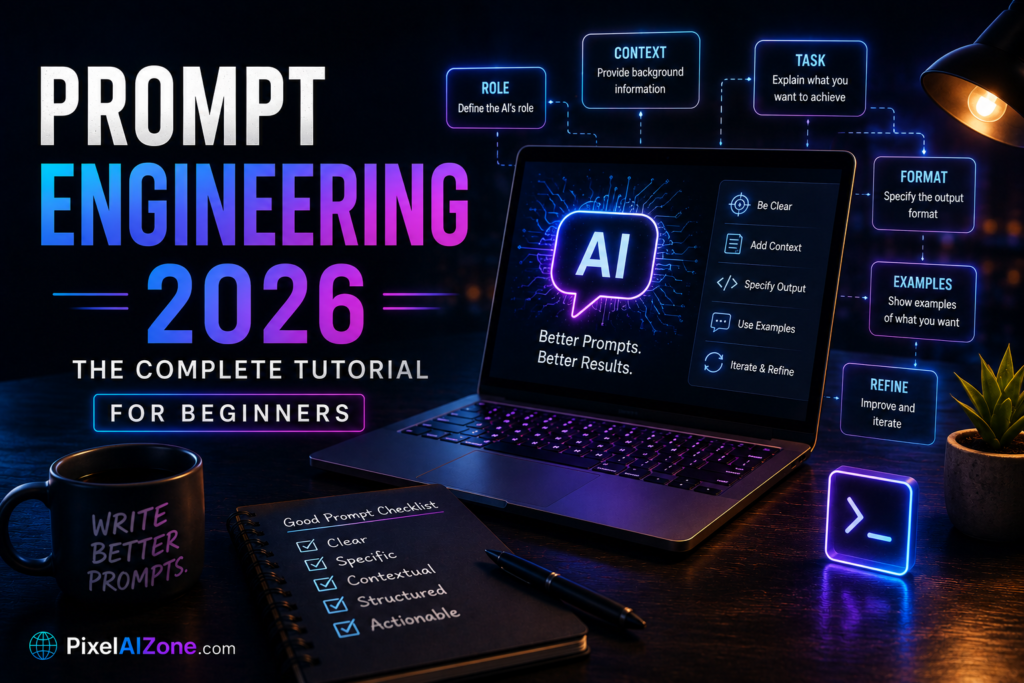
Prompt engineering for beginners requires understanding the four essential building blocks of any effective prompt .
1. Role (Who is the AI?)
Tell the AI who it is acting as. This sets the baseline behaviour and improves output quality .
Example: “You are a senior SEO copywriter focused on click-through rates” .
2. Context (What’s the situation?)
Provide background information, target audience, and relevant details . The more context you provide, the more tailored the output .
Example: “You are writing for developers building a blog on an existing Next.js app who want a clean CMS integration” .
3. Task (What do you want?)
Be specific about what you want the AI to produce . Specificity is the biggest single driver of output quality .
Example: “Write a 1,400-word product-focused SEO post: ‘Why Wisp Is the Best Headless CMS for Next.js Blogs'” .
4. Format (How should it look?)
Specify the output structure, length, tone, and constraints .
Example: “Format: Intro, numbered H2 steps, a ‘Common Mistakes’ H2, and a brief conclusion. Tone: Direct and technical” .
5 Core Prompt Engineering Techniques

Prompt engineering for beginners should start with these five proven techniques.
1. Zero-Shot Prompting
Zero-shot prompting relies on the model’s pre-trained knowledge to give accurate responses without examples . It works well for quick queries and general questions where deep guidance isn’t needed .
Example: “Explain the advantages of artificial intelligence in healthcare” .
2. Few-Shot Prompting
Few-shot prompting provides two to five examples along with the prompt to indicate the expected response . This gives the model an idea of what format, tone, and structure are expected . It works best for increasing precision in specific or complicated tasks .
Research from Min et al. (2022) found a surprising result: even randomly labelled examples often outperform zero-shot prompting — because the examples communicate structure and format, not just labels .
3. Chain-of-Thought Prompting
Chain-of-thought prompting instils step-by-step thought by the AI before it produces the final answer . This approach excels at solving complex problems, logical reasoning, and analysis . It enhances transparency and helps generate more accurate results .
Example: “Break down the process of SEO in a step-by-step manner” .
4. Role + Task + Format Pattern
This three-part structure is the single most reliable prompt pattern across all major models in 2026 . According to SuperPrompts research, this pattern “maps cleanly to how LLMs process instructions” — the persona sets baseline behaviour, the task narrows focus, and the format constrains the output .
5. Iterative Prompting
Iterative prompting improves prompts based on the AI’s output . Users continuously refine their prompts to get superior outputs . Almost every AI interaction benefits from at least one round of refinement. Review the output, identify what’s missing or off, adjust the prompt, and try again .
Common Mistakes to Avoid

Understanding what not to do is just as important as knowing what works .
Prompt Engineering by Use Case
Different tasks call for different prompt strategies .
For Blog and Article Writing
Role: “You are an SEO expert and technical writer” .
Context: “Write for an audience of [target audience]” .
Task: “Write a 1,500-word article that answers the question: ‘[QUERY]'” .
Format: “Include SEO-optimized title, introduction using primary keyword, H2 sections, and conclusion. Use a conversational tone, bullet points for steps, and cite sources only if available” .
For SEO Meta Tags
Role: “You are a senior SEO copywriter focused on click-through rates” .
Task: “For a post about [topic] with primary keyword [keyword], write 3 meta description options” .
Format: “Each must be under 160 characters, include the keyword, and end with an action phrase” .
For FAQ Sections
Task: “Based on the article about [topic], generate a 4-question FAQ targeting common search queries” .
Format: “Format as H3 questions with 2–3 sentence answers in plain prose. Prioritize questions that could trigger a featured snippet” .
For Keyword Placement Review
Task: “Review the following article. Confirm the primary keyword ‘[keyword]’ appears naturally in the first paragraph, the conclusion, and at least two H2 subheadings” .
Format: “Flag any forced usage” .
How to Build a Reusable Prompt Library
According to prompt engineering experts, building a prompt library “compounds over time” . Here’s how to start:
- Save your best prompts: When you get a great result, save the prompt and note what worked.
- Document the context: Include the role, task, format, and any constraints that produced the best output.
- Categorize by use case: Organize prompts by type — content writing, SEO, coding, analysis, etc.
- Iterate and improve: Regularly review and refine your saved prompts based on what you learn.
This approach transforms prompt engineering for beginners from trial and error into a systematic, repeatable process.
FAQ
Q: Do I need a technical background to learn prompt engineering?
A: No. Prompt engineering is about clear communication, not coding. Anyone can learn it .
Q: What’s the single most effective prompt engineering technique?
A: The Role + Task + Format pattern is the most reliable structure across all major models in 2026 .
Q: How can I tell if my prompt needs improvement?
A: If the AI’s output is vague, generic, or off-topic, your prompt is too vague. Add more role, context, task, and format details.
Q: Should I use one prompt or multiple prompts?
A: For complex tasks, use multiple prompts. Too many instructions in one prompt confuse the model . Split complex tasks into separate prompts.
Q: Is prompt engineering a skill worth learning in 2026?
A: Yes. Prompt engineering is the new coding . It’s one of the most in-demand AI skills and directly impacts AI output quality.
Final Thoughts
Prompt engineering for beginners is the essential starting point for anyone who wants to use AI effectively in 2026. The better your prompts, the better your results.
What you’ve learned:
- What prompt engineering is and why it matters
- The four building blocks of a strong prompt
- Five core prompting techniques (zero-shot, few-shot, chain-of-thought, role+task+format, iterative)
- Common mistakes and how to avoid them
- How to write prompts for different use cases
- How to build a reusable prompt library
Your next step:
- Start with the Role + Task + Format pattern — the most reliable prompt structure in 2026 .
- Practice with simple tasks before moving to complex ones.
- Save your best prompts and build your own library.
- Iterate and refine — every AI interaction benefits from at least one round of refinement .
“The difference is rarely the tool. The difference is how they ask” . Learn to ask well, and you’ll unlock the full power of AI.
Related Posts on Pixelaizone
- [Claude for Beginners: The Complete Tutorial to Anthropic’s AI Assistant in 2026]
- [How to Build AI Agents: A Step-by-Step Guide for Beginners (2026)]
What’s your biggest challenge with prompt engineering? Drop a comment below!