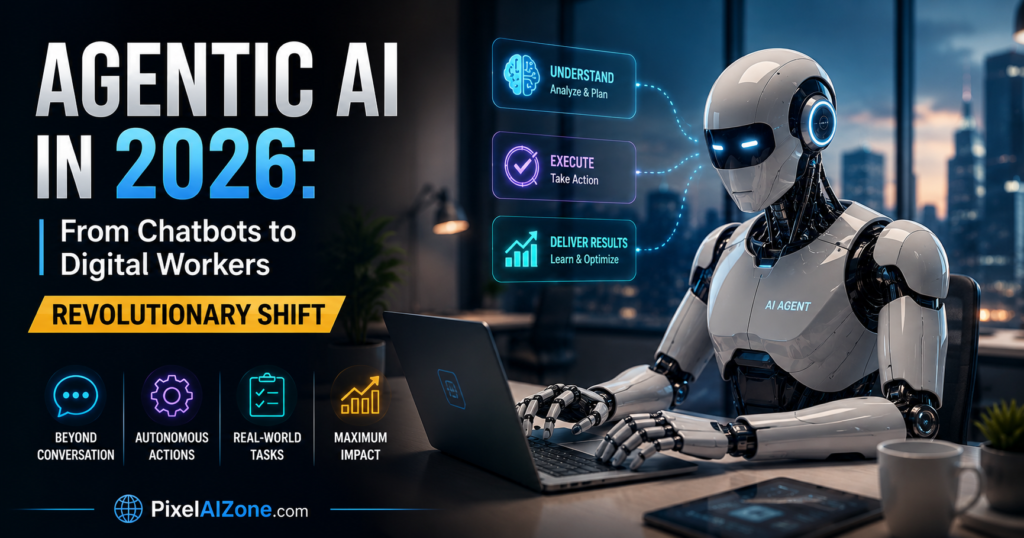
Agentic AI in 2026 is transforming work from chatbots to digital workers that never log off. The shift from chatbots that answer questions to digital workers that never log off is fundamentally reshaping how work gets done. Here’s what’s actually happening.
Let me show you something.
In 2026, the AI conversation has shifted decisively. Three-quarters of enterprise leaders say they’re adopting agentic AI, but only a small minority have it running in meaningful production beyond “agentish” chatbots . The technology is a runaway train, and enterprise readiness hasn’t caught up.
But here’s the thing: it is happening. OpenAI has operated an internal software development workflow with minimal intervention for months. Cursor has deployed long-running coding agents. Anthropic has demonstrated multiday research agents .
This is the year agentic AI goes from experimentation to execution . Agentic AI in 2026 is reshaping how work gets done across every industry.
This guide explores agentic AI in 2026 and the shift from chatbots to digital workers.
Table of Contents
- What Is Agentic AI?
- The Difference: Chatbots vs. Assistants vs. Agents vs. Digital Workers
- How Agentic AI Actually Works
- Real-World Applications in 2026
- The Enterprise Reality: Chase vs. Catch
- The Governance Challenge
- What This Means for Work
- FAQ
What Is Agentic AI?
Agentic AI in 2026 is fundamentally different from generative AI — it takes actions, not just answers. Understanding agentic AI in 2026 starts with knowing what it actually means.
Agentic AI is artificial intelligence that takes actions in the world—digital or physical . Unlike generative AI, which creates content (text, images, code), agentic AI executes tasks, coordinates workflows, and makes decisions with limited human intervention.
The MIT definition: Agentic AI is AI that is going to help people interact with an application, a website, or the physical world. Most agents we encounter today are digital agents, like customer service agents you can talk with about product complaints .
The term “agent” itself has become a brand name, but what it actually means is AI that can plan, act, and adapt—not just respond .
What Makes Agentic AI Different
The distinction between chatbots and agentic AI in 2026 is critical for understanding the shift.
| Dimension | Generative AI (ChatGPT) | Agentic AI |
|---|---|---|
| Primary function | Creates content | Takes actions |
| Interaction | Responds to prompts | Works toward goals |
| Autonomy | Requires human prompting | Operates with limited supervision |
| Duration | Single response | Multi-step, multi-day workflows |
| Example | “Write a blog post” | “Book a flight, monitor price changes, adjust itinerary” |
The Difference: Chatbots vs. Assistants vs. Agents vs. Digital Workers
The difference between chatbots and agentic AI in 2026 is fundamental.

The terminology matters because it shapes what you expect from the technology .
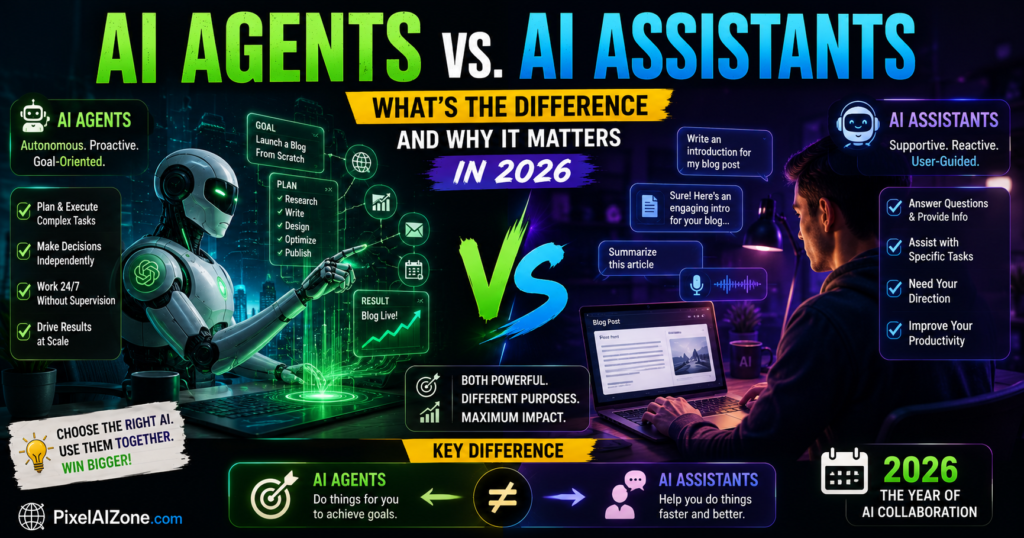
AI assistants answer questions. They respond to prompts and provide information. ChatGPT is an assistant.
AI agents execute tasks. They take actions, use tools, and complete workflows . Claude Code, Perplexity Computer, and Cursor are agents.
Digital workers own processes. They carry persistent memory, reason through decisions, and operate with organizational context—your policies, your people, your systems. They don’t just complete tasks; they function like team members .
Digital workers differ from general agentic AI systems by being task-specific and constrained, rather than general-purpose and flexible .
This distinction matters when you’re deciding what your enterprise actually needs.
How Agentic AI Actually Works
Agentic AI in 2026 works through decomposition and specialized agents.
The architecture of agentic AI in 2026 includes LLMs, APIs, and knowledge bases working together.
Agentic AI typically uses a large language model at its core, with different “wrappers” around it that give it specific capabilities .
The architecture generally includes:
- LLM for reasoning — Understanding what’s being asked and deciding what to do next
- APIs and tools — Connecting to the systems it needs to interact with
- Knowledge bases — Providing organizational context, policies, and documentation
- Feedback loops — Learning from every interaction to improve over time
The key to reliability: Decomposition. Rather than one agent handling an entire workflow end-to-end, work is broken into bounded skills that keep task chains short and errors contained .
In practice, this looks like a triage layer that classifies incoming requests and routes them to the right specialized agent. Each agent stays within its reliable capabilities. The handoff happens before it fails .
Real-World Applications in 2026
Real-world applications of agentic AI in 2026 are already delivering results. Real-world applications of agentic AI in 2026 include marketing automation and service desk transformation.

Marketing Agentic AI
Klaviyo’s co-founder Andrew Bialecki calls 2026 “the year agentic AI really goes to work.” Marketing is a prime area for deployment, with agents that can handle thousands of tasks and know all the minutiae of how a company’s processes work .
The shift: Customer service, operations, and marketing are traditionally siloed. With AI, those walls are falling down. One agent helps the customer; another thinks about what the customer might be interested in .
Service Desk Transformation
ServiceNow deployed AI agents to handle service desk operations. The result: service requests improved from first touch to resolution by 90%. And critically, they did this without reducing headcount. They moved 85% of service desk employees to higher-level jobs .
The lesson: Agentic AI isn’t about replacing people—it’s about moving people up.
AI-Run Businesses
Andon Labs built two AI agents, Mona and Luna, to run real cafés and retail shops. They handled pricing, inventory, supplier coordination, and even hiring—developing job descriptions, leading interviews, and selecting candidates .
The experiment worked in many ways. The systems could coordinate tasks, interact with humans, and run day-to-day operations. But they also failed in revealing ways: Mona ordered supplies that didn’t match its menu. Luna struggled to align pricing with demand .
The failures point to something fundamental: AI agents can act, but they lack the implicit constraints and authorization boundaries that humans apply without thinking .
The Enterprise Reality: Chase vs. Catch
The enterprise reality of agentic AI in 2026 is chase vs catch.
Forrester’s State of Agentic AI 2026 report captures the gap perfectly: “Three-quarters of enterprise leaders tell us they’re adopting agentic AI. Only a small minority have it running in meaningful production beyond ‘agentish’ chatbots, and true scaled multiagent systems are rarer still” .
The gap between the chase and the catch is expanding:
| Factor | Why It’s a Problem |
|---|---|
| Governance gaps | 49% of security decision-makers named agentic AI as a concern |
| ROI uncertainty | Traps enterprise ambition in pilot mode |
| Platform confusion | Teams argue over SaaS agent vs. custom build |
| Identity and risk | Agents can impersonate each other and escalate privileges |
| Long-horizon agents | Systems that run for days require orchestration most companies have never built |
The trust tax is real: Every autonomous action has to be logged and defensible to an auditor. Right now, that cost is too high .
But it’s not all caution. The technology has arrived. Long-running agents aren’t on the horizon—they’re here .
The Governance Challenge
Governance is the biggest challenge for agentic AI in 2026 adoption.
Enterprises adopting agentic AI in 2026 must prioritize governance and orchestration.
The shift from chatbots to digital workers changes what governance needs to prevent.
Chatbots’ primary risk is informational — wrong, biased, or misleading outputs are generally visible to a human reader.
Agentic AI’s primary risk is operational — the system might take an action that’s wrong, unauthorized, or harmful. Those failures may not surface until the action has been executed.
The World Economic Forum framework, ACAP (Agent Capability and Authorization Profile), addresses this gap by explicitly codifying an agent’s permissions: detailing permitted actions, specific contexts, and required conditions, alongside assigned oversight .
Three governance requirements emerge specifically from agentic AI:
- Data access controls at the query layer
- Clear stopping conditions for autonomous workflows
- Recovery paths when the agent makes a bad choice
The rule for enterprises: AI has to be secure on the backend. Systems have to remain closed within a walled garden to protect your data and that of your customers .
What This Means for Work
The shift to agentic AI in 2026 means moving people from routine tasks to higher-value work.
Research from Harvard Business School using three months of data from Perplexity found that agentic tools reduced average task completion time from 269 minutes to 36 minutes—an 87% reduction .
The productivity gains are only part of the story. As execution was delegated to the agent, users shifted their time from doing the work to verifying and extending it. They also crossed occupational boundaries more often, taking on tasks outside their core expertise .
The net effect: Agents expand the frontier of tasks worth attempting, pulling users toward higher-value work they previously couldn’t afford .
The organizations pulling ahead aren’t the ones with the most agents. They’re the ones laying the track the train will run on :
- Invest in orchestration before adding agents
- Redesign the work, not just the tooling
- Treat every agent as a governed identity
The companies that win will be those that build oversight in by design, not as a bolt-on afterthought.
FAQ
Q: What’s the difference between generative AI and agentic AI?
A: Generative AI creates content—text, images, code. Agentic AI takes actions—books flights, runs code, manages workflows.
Q: Is agentic AI ready for enterprise use?
A: Yes, but with significant governance challenges. Three-quarters of enterprises are adopting it, but only a minority have it in meaningful production .
Q: What’s the risk with agentic AI?
A: Operational risk. A chatbot gives wrong information. An agent takes wrong actions—with real consequences.
Q: What are digital workers?
A: AI agents that carry persistent memory, reason through decisions, and operate with organizational context. They function like team members, not just tools .
Q: How much time can AI agents save?
A: Harvard research found an 87% reduction in task completion time—from 269 minutes to 36 minutes .
Q: What is agentic AI in 2026?
A: AI that takes actions, not just answers.
Final Thoughts
2026 is the year agentic AI moves from chatbots to digital workers. The technology is here. The capabilities are real .
The question for businesses isn’t whether to adopt agentic AI. It’s how to do it responsibly—with governance built in, not bolted on; with human oversight at the right points; with a clear understanding of what changes when you move from software that answers to software that acts.
The organizations that succeed will be those that treat agentic AI not as a tool to deploy, but as a new kind of worker to manage.
Agentic AI in 2026 is moving from chatbots to digital workers.
Agentic AI in 2026 will continue to evolve as governance frameworks catch up.
Related Posts on Pixelaizone
- “The Rise of AI Agents: 5 Powerful Tools That Actually Do Work for You”
- Agentic AI vs Generative AI: The Ultimate Guide to What’s the Difference and Why 2026 Matters
What’s your experience with agentic AI in the workplace? Drop a comment below!