
Anthropic’s Claude has become the go-to AI assistant for writing, coding, and reasoning — and this comprehensive tutorial covers everything a beginner needs to know.
Claude for beginners is the essential starting point for anyone new to AI assistants in 2026. Claude for beginners starts with understanding what makes it different. Claude is not ChatGPT. It is a different kind of AI assistant — one that is rapidly becoming the favorite of developers, writers, and knowledge workers. Anthropic, the company behind Claude, was founded by former OpenAI employees who wanted to build AI systems that are fundamentally safer and more reliable. This Claude for beginners tutorial will take you from absolute beginner to confident user — no technical background required.
In 2026, Claude has become a major force. According to Stack Overflow’s 2026 survey, 42.8% of developers now use Claude Sonnet. More than 50% of Fortune 500 companies use Cursor (which is powered by Claude), and Salesforce reports 90% internal Claude adoption. Claude for beginners is more relevant than ever.
Table of Contents
- What Is Claude and Why Does It Matter?
- Claude vs ChatGPT: The Key Differences
- How to Get Started with Claude for Beginners
- The Four Ways to Use Claude
- How to Write Great Prompts for Claude
- Claude’s Advanced Features: Projects, Artifacts, and Skills
- Best Use Cases for Beginners
- Claude Pricing: Free vs Pro vs Max
- FAQ
What Is Claude and Why Does It Matter?

Claude is an AI assistant developed by Anthropic, a company founded by former OpenAI researchers who wanted to build AI systems that are helpful, honest, and harmless. Claude is designed for writing, research, analysis, and reasoning — and it has gained a reputation for producing more natural, human-sounding output than many competitors. Claude for beginners means understanding that this is not just another chatbot.
Claude Doesn’t Just Talk. It Builds.
As one beginner’s guide puts it: “Something just changed in how AI actually works. For the first time, you can build real things with a single prompt. Documents. Spreadsheets. Code. Tools. Websites. Automations. Full email workflows. Even complete ad campaigns. No coding. No technical background. No years of training. Just an idea, a few sentences, and Claude turns it into something real you can use today.” This is what Claude for beginners is all about.
Why Claude Stands Out
According to industry analysis, Claude has several distinct strengths that make it the preferred choice for many users. For Claude for beginners, these strengths are easy to understand and use.
Long Document Handling: Claude can process up to 200,000 tokens of context — roughly 150,000 words or a 500-page document. More importantly, Claude is better at actually using that context to remember details from earlier in the conversation and apply them consistently. Claude for beginners will find this incredibly useful for summarizing long documents.
Following Instructions Precisely: Claude respects your instructions. If you say “answer in 3 points maximum,” it does exactly that — no digressions, no unsolicited long-winded answers. Claude for beginners can trust that Claude will do exactly what you ask.
Code Generation: Claude leads the major coding benchmarks. For developers, it is the strongest general-purpose coding model available in 2026. Claude Fable 5 scores 80.0% on SWE-Bench Pro against GPT-5.6 Sol at 64.6%. Even for Claude for beginners, this means better quality outputs.
Honesty and Caution: Claude is more likely to admit uncertainty. If you ask it something it does not know, it will often say so rather than generating a plausible-sounding but incorrect answer. This is crucial for Claude for beginners who are learning to trust AI.
Natural Writing: Claude’s prose is smoother, its transitions are more natural, and it avoids the robotic phrasing that often plagues other AI output. For long-form content, reports, or creative writing, Claude’s output generally needs fewer edits before it is ready to share. Claude for beginners will appreciate how natural the writing sounds.
Claude vs ChatGPT: The Key Differences

According to the 2026 comparison data, here is how they stack up:
| Feature | Claude | ChatGPT |
|---|---|---|
| Context Window | 200K tokens (150,000 words) | 128K tokens |
| Code Generation | Best-in-class; leads major coding benchmarks | Good |
| Image Generation | ❌ Cannot generate images | ✅ Yes (DALL-E) |
| Natural Writing | More natural, human-sounding | Good, but more robotic |
| Following Instructions | Precise, no digressions | Sometimes wanders |
| Honesty | Admits uncertainty | More likely to hallucinate |
| Real-time Web Search | ✅ Yes (Research mode) | ✅ Yes |
| Free Tier | Limited messages | More generous |
Claude vs ChatGPT : Which AI Tool Is Better for Long-Form Content in 2026?
The bottom line from experts: “If your work is mostly writing, client documents, and code, Claude is the stronger daily driver. If you’re producing marketing visuals, doing web research, or living in Microsoft 365, ChatGPT earns its seat.” For Claude for beginners, choosing the right tool is the first step.
How to Get Started with Claude for Beginners
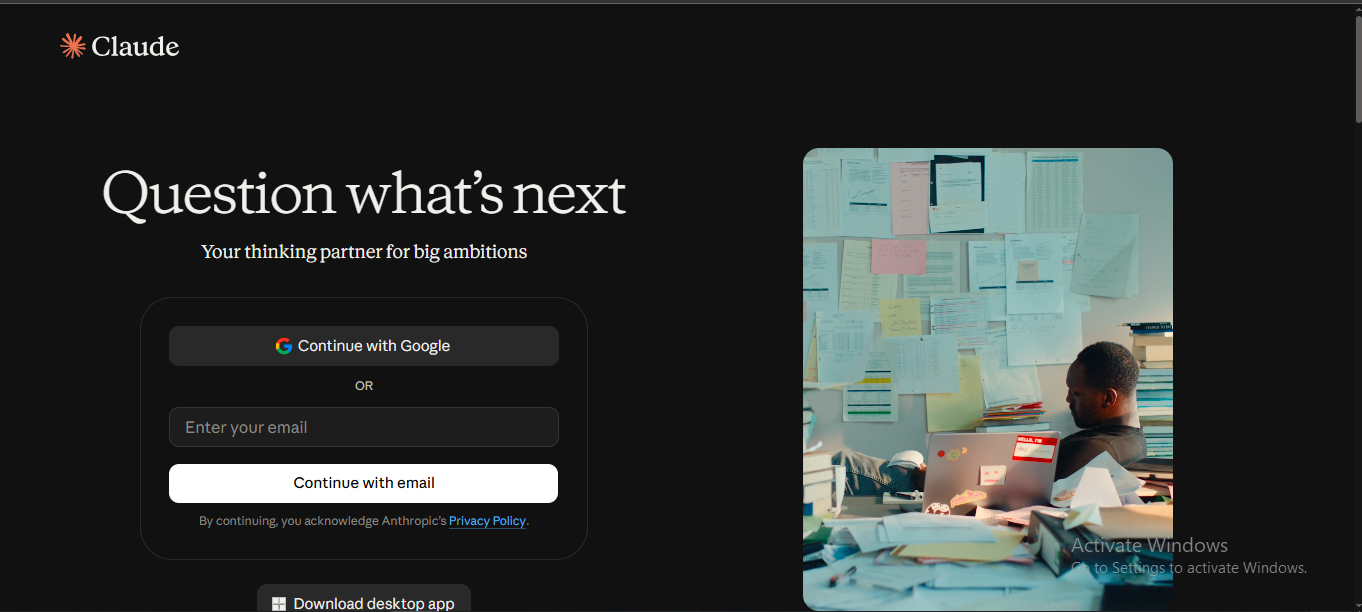
Getting started with Claude is simple and takes less than five minutes. You do not need a Claude account to start learning — DataCamp provides a built-in Claude experience so you can learn by doing from the very first lesson. Claude for beginners is designed to be accessible.
Step-by-Step Setup
Step 1: Create Your Account
- Go to claude.ai
- Click “Sign Up”
- Choose a sign-up method (Google account, Email, or Apple account)
- Complete the brief onboarding
Step 2: Start Your First Conversation
Once you are signed in, you will see a text input box. Try this prompt to get started:
“I’m new to AI assistants. Can you explain what you can help me with, and give me three specific examples of tasks I could try right now?”
Claude will respond with practical suggestions tailored to a beginner. Claude for beginners should start with simple tasks.
A few things to try next:
- Summarize this article for me: [paste an article]
- Help me write a professional email declining a meeting invitation
- Explain how compound interest works like I’m 15 years old
The Four Ways to Use Claude

There are four primary ways to access Claude, each suited to different needs. Claude for beginners should start with the desktop version.
1. Claude Desktop (Recommended for Beginners)
This is where most beginners should start. A desktop application (Mac, Windows) to chat with Claude. Clean interface, conversation history, and the ability to upload files.
Best for: Writing, document analysis, brainstorming, research, everyday tasks.
“2026 AI Writing Tools Comparison: Which One Actually Deserves Your Money? (Honest Comparison)”
2. Claude Mobile App
Claude is available on mobile for conversations on the go. The mobile app syncs with your claude.ai account, so your conversations carry over.
Best for: Quick questions while away from your computer, reading and discussing documents on your phone.
3. Claude Code (For Developers and Power Users)
Claude Code is a command-line tool that gives Claude access to your file system, terminal, and development tools. It can read and modify your files, execute shell commands, and work autonomously on complex tasks.
Requires: Claude Pro ($20/month).
11 AI Coding Tools You Should Use in 2026 (Beyond GitHub Copilot) – Game-Changing Guide
4. Claude API (For Building Products)
Programmatic access to Claude. You can integrate it into your applications, scripts, and automations.
Pricing: Pay-per-use. Claude Sonnet ~$2 per million tokens input, ~$10 per million tokens output.
How to Write Great Prompts for Claude

Most people use AI tools by typing whatever comes to mind and hoping for the best. According to DataCamp’s Claude 101 course, you should learn a three-part prompt framework that consistently produces better results. Claude for beginners will benefit greatly from this framework.
The Three-Part Prompt Framework
1. Role and Context
Tell Claude who it is acting as and what situation you are in.
Example: “You are a senior employment attorney at a US law firm. The context is a small company (50 employees) in California dealing with a first-time disciplinary situation.”
2. Specific Task
Be precise about what you want. Specificity is the biggest single driver of output quality.
Example: “Write a 1-page executive summary of the following technical report, for an audience of non-technical C-suite executives who will use it to make a budget decision.”
3. Format and Audience
Tell Claude how you want the output structured and who will read it.
Example: “Use bullet points. Target audience: board of directors. Keep it under 200 words.”
The 4D Framework for AI Fluency
DataCamp’s Claude 101 also teaches the 4D Framework for evaluating AI outputs:
| Skill | What It Means |
|---|---|
| Delegation | Knowing what to hand off to Claude |
| Description | Communicating clearly what you want |
| Discernment | Evaluating whether Claude’s output is useful |
| Diligence | Verifying important information |
Claude’s Advanced Features: Projects, Artifacts, and Skills

Once you are comfortable with basic prompting, Claude offers several advanced features. Claude for beginners can explore these once they master the basics.
Projects
Projects let you organize ongoing work with shared knowledge bases and custom instructions that persist across conversations. Free users can create up to five projects, while paid projects can use retrieval to scale their knowledge capacity.
Artifacts
Artifacts are interactive documents, code, or reports that Claude generates and saves in a dedicated workspace. You can create reports and dashboards, generate and edit code, publish or share artifacts outside your project, and reuse them across conversations.
Skills
Skills are reusable workflows that encode your team’s processes so Claude follows the same steps every time — without you having to explain them from scratch. Skills can automate repeatable tasks, enforce consistent formatting, and standardize outputs across your team.
Best Use Cases for Beginners
According to business use guides, the best starting use cases are ones where:
- Claude adds clear time savings
- The risk of errors is low (because a human reviews the output)
- The value is immediately measurable
| Department | What Claude Can Do |
|---|---|
| Legal | Summarize contracts, identify key obligations |
| Finance | Write narrative commentary for financial reports |
| Marketing | Generate variations of ad copy, write first drafts of blog posts |
| Human Resources | Draft job descriptions, summarize candidate applications |
| Operations | Summarize meeting notes into action items |
Claude Pricing: Free vs Pro vs Max
Claude offers several pricing tiers in 2026:
| Plan | Price | What You Get |
|---|---|---|
| Free | $0/month | Access to Claude Sonnet, limited daily messages |
| Pro | $20/month | Higher limits, access to Projects, MCPs |
| Max 5x | $100/month | Five times Pro usage capacity |
| Max 20x | $200/month | Twenty times Pro usage capacity |
Which plan should you choose? For Claude for beginners, the free plan is usually enough to start.
- Start with Free. The free tier gives you access to Claude Sonnet, which is excellent for most tasks.
- Pro ($20/month) is the plan most serious individual users choose. It unlocks Claude’s full power — including Projects and significantly higher usage limits.
- Max plans ($100-$200/month) are for power users and teams who use Claude extensively every day.
FAQ
Q: Do I need a technical background to use Claude?
A: No. Claude is designed for everyone. Claude for beginners has no prerequisites.
Q: Is Claude free?
A: Yes, Claude offers a free tier with access to Claude Sonnet and limited daily messages. Pro is $20/month for higher limits and advanced features.
Q: What’s the difference between Claude and ChatGPT?
A: Claude excels at long document analysis, natural writing, following instructions precisely, and code generation. ChatGPT has better image generation and a more mature plugin ecosystem.
Q: Can Claude generate images?
A: No. Claude does not have image generation capabilities. If you need AI-generated images, use ChatGPT with DALL-E or a dedicated image generation service.
Q: Does Claude have internet access?
A: Not by default. Claude Research adds web search capabilities, but the base Claude experience is offline.
Q: How much context can Claude handle?
A: Claude can process up to 200,000 tokens — roughly 150,000 words or a 500-page document.
Q: What are Artifacts and Projects?
A: Projects let you organize work with shared knowledge bases and custom instructions. Artifacts are interactive documents, code, or reports that Claude generates and saves in a dedicated workspace.
Final Thoughts
Claude for beginners is the essential starting point for understanding one of the most powerful AI assistants available in 2026. With 42.8% of developers now using it and Fortune 500 companies adopting it at scale, Claude is no longer a niche tool—it is a mainstream productivity platform.
What you’ve learned with Claude for beginners:
- What Claude is and why it matters
- The key differences between Claude and ChatGPT
- How to set up your Claude account
- The four ways to use Claude
- How to write effective prompts using the three-part framework
- Advanced features like Projects, Artifacts, and Skills
Your next step with Claude for beginners:
- Go to claude.ai and create your free account
- Try your first conversation with the sample prompt
- Practice the three-part prompt framework
- Explore Projects and Artifacts once you’re comfortable
- Consider upgrading to Pro when you hit the free tier limits
“The window to get ahead is open right now, and it’s measured in months, not years. Start today and learn how to make AI build, automate, and work for you.”
Related Posts on Pixelaizone
- [How to Build AI Agents: A Step-by-Step Guide for Beginners (2026)]
- [Agentic AI in 2026: From Pilots to Production Revolutionary Guide]
Have you tried Claude yet? Drop a comment below and let us know your experience!