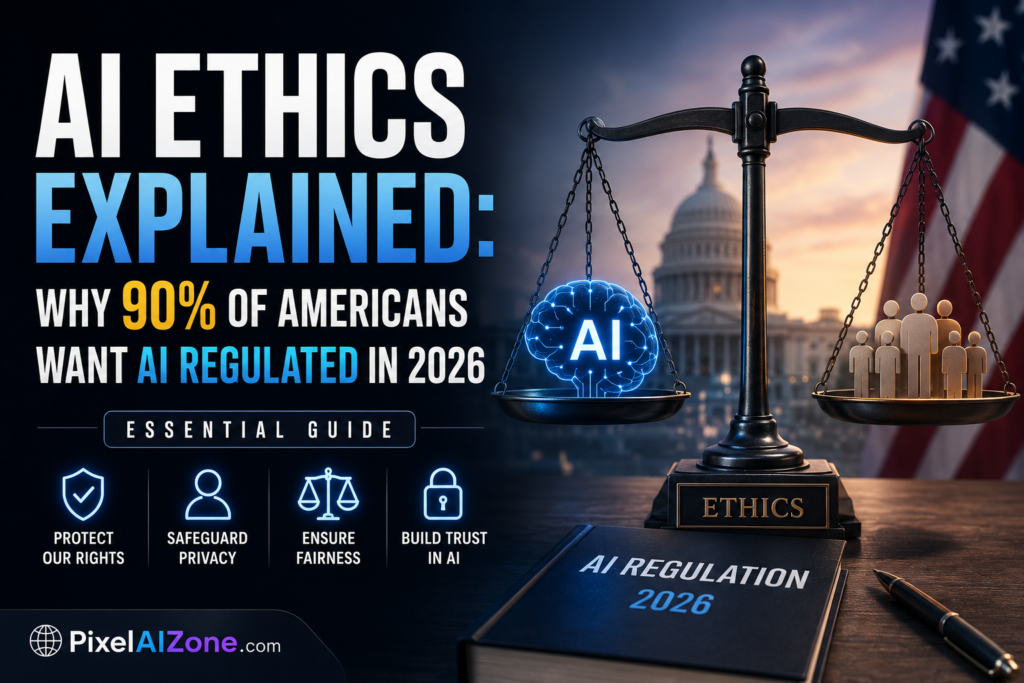
AI ethics is at the center of America’s debate about artificial intelligence regulation in 2026. From child safety to job security, Americans are sending a clear message: they want AI guardrails. Here’s what the data actually shows.
Let me show you something.
Nearly two-thirds of Americans now use AI regularly, and they want stronger oversight. But they’re conflicted on how far regulation should go, according to a new national survey from AI governance nonprofit Fathom shared exclusively with Axios .
90% say it’s important that AI products for kids should be verified as “safe” before they’re used . Another 90% say they are concerned about how large corporations collect and use their personal data .
This isn’t a fringe opinion. It’s a bipartisan consensus.
This guide explores AI ethics and why 90% of Americans want AI regulated.
AI ethics is the central issue driving the 2026 debate about artificial intelligence regulation.
Table of Contents
- The Numbers: What Americans Actually Want
- Trust and Accountability: The Organizing Principles
- The Trust Gap: Who Americans Trust to Lead
- Bipartisan Support: A Rare Political Consensus
- What’s Driving the Demand for Regulation
- The Global Context: America Is Not Alone
- What This Means for AI Development
- FAQ
AI Ethics: The Numbers Behind What Americans Want
The survey data reveals what Americans want from AI ethics and regulation.

The Fathom survey of 2,036 people, conducted by Forbes Tate Partners from January 29 to February 4, 2026, tested public opinion on AI governance with explicit tradeoffs . The results are striking:
| Principle | Support Level |
|---|---|
| AI products for kids verified as “safe” | 90% |
| Concern about corporate data collection | 90% |
| Accountability for AI-caused harms | 87% |
| Verifiable standards for AI systems | 86% |
| Trust and verification (total importance) | 86% |
| Support slowing frontier AI development | 83% |
| Retraining programs for displaced workers | 84% |
When tradeoffs were made explicit, support barely moved. Trust and verification held at 86%, accountability at 87% .
What this tells us: Americans don’t just want regulation in principle. They want regulation that delivers specific outcomes — safety for children, accountability when things go wrong, and independent verification of AI systems.
Trust and Accountability: The Organizing Principles
Trust and accountability are the organizing principles of AI ethics in America.
According to Fathom’s research, “trust and accountability are the organizing principles of public opinion on AI” . Child safety leads at 90% “very important,” followed by accountability for AI-caused harms, verifiable standards, and preserving human reasoning .
Key findings include:
- Accountability holds even with tradeoffs: When respondents were told accountability would create “liability risks for companies,” support dropped only slightly .
- Verification even if it slows innovation: Support for verifiable standards remained strong even when framed as potentially slowing innovation .
- Human reasoning must be preserved: Preserving human reasoning is a priority that cuts across party lines .
The study’s authors wrote: “Child safety, corporate accountability, and verifiable standards are Americans’ top priorities for a good future with AI. These priorities hold up across party lines, and even when the trade-offs are made explicit” .
The Trust Gap: Who Americans Trust to Lead
The trust gap in AI ethics shows Americans trust independent experts more than officials.

The AI ethics debate also reveals who Americans trust to lead regulation efforts.
Americans are deeply skeptical of both government and industry to oversee AI. Only 35% trust elected officials to govern AI .
Who Americans trust most:
| Entity | Trust Level |
|---|---|
| Independent experts | 71% |
| Tech companies | 61% |
| Federal agencies | 51% |
| Elected officials | 37% |
This hierarchy has held across all three waves of Fathom’s polling, and the trend is strengthening .
Americans trust the government to judge an AI model’s safety twice as much as they trust Anthropic . When asked who should have final authority over AI safety decisions, more than three times the number of Americans believe the US government should have final say than believe AI companies should (49% to 15%) .
The Skepticism of Tech Companies
Over 70% of Americans believe that major US technology companies wield too much power . According to a YouGov poll:
- 71% said tech companies have too much power
- 68% support enforcement of existing antitrust laws against tech companies
- 67% support stricter regulations
- Fewer than 20% trust major tech companies to manage the development and deployment of AI
Only 9% of respondents believed that AI companies’ proposals to regulate are genuine attempts to protect the public . 43% believe they are primarily designed to benefit the companies .
Bipartisan Support: A Rare Political Consensus
AI ethics enjoys rare bipartisan support across political lines.

The AI ethics consensus spans across party lines, making it a rare bipartisan issue.
In a polarized political climate, AI regulation stands out as a rare area of agreement.
Key bipartisan findings from Verasight’s survey of more than 1,600 Americans:
| Regulation | Overall | Democrats | Republicans |
|---|---|---|---|
| Public disclosure of safety testing | 89% | 90% | 88% |
| Independent third-party review | 89% | 91% | 87% |
| Government authority to block risky AI | 81% | 83% | 80% |
“Americans overwhelmingly support AI regulation, regardless of political identification” .
The AI stock transfer proposal: 69% of Americans support legislation requiring AI companies to transfer 50% of their stock to a fund owned by the American public — a proposal originally suggested by Senator Bernie Sanders .
What’s Driving the Demand for Regulation
Child safety and data privacy are key drivers of AI ethics concerns.

1. Child Safety
90% say it’s important that AI products for kids should be verified as “safe” before they’re used . This concern is bipartisan and deeply felt.
2. Data Privacy
90% of Americans are concerned about how large corporations collect and use their personal data . This reflects broader anxiety about surveillance and corporate power.
3. Job Security
The public decisively rejects a “let the market sort it out” approach to workforce disruption. Every workforce intervention tested received majority support, from retraining programs (84%) to a sovereign wealth fund sharing AI-generated wealth with the public (71%) .
4. Deepfakes and Misinformation
92.6% of global respondents expressed concern that deepfakes and AI-generated misinformation could erode the very foundations of social trust .
5. Accelerating AI Development
While 83% support slowing frontier AI development until risks are better understood, support drops sharply when slowing down requires the U.S. to give up control over its own AI decisions to international coordination .
The Global Context: America Is Not Alone
AI ethics is not just an American concern — it’s a global conversation.

AI ethics is driving a global conversation about how to balance innovation with safety and accountability.
The U.S. is part of a broader global conversation about AI governance.
Global survey findings from CGTN:
- 85.4% believe rapid AI development is creating new challenges for global security and governance
- 92.6% worry deepfakes and AI-generated misinformation could erode social trust
- 82.6% believe developing countries should play a greater role in shaping AI governance rules
- 87.5% hope the international community will work together to promote accessible, inclusive AI
U.S. trust in government to regulate AI is low globally. The U.S. recorded just 31% confidence in its government to regulate AI responsibly, compared to 81% in Singapore .
What This Means for AI Development
AI ethics will shape how companies develop and deploy artificial intelligence in the coming years.
The data sends a clear message to policymakers and companies: Americans want AI they can trust.
For Companies
- Trust and accountability are competitive advantages. Companies that embrace independent verification and clear accountability will build stronger customer relationships.
- Self-regulation is not enough. Only 9% of Americans believe AI companies’ regulatory proposals are genuine attempts to protect the public .
- Data privacy is non-negotiable. 90% are concerned about corporate data collection .
For Policymakers
The Fathom report identifies four takeaways:
- Build governance frameworks on the durable consensus around trust and accountability
- Frame trust and accountability as competitive advantages rather than constraints on innovation
- Act on workforce policy while public preferences remain flexible
- Give independent experts and civil society a meaningful seat at the oversight table
FAQ
Q: Do most Americans want AI regulated?
A: Yes. 90% support safety verification for AI products for kids. 89% support public disclosure of safety testing. 89% support independent third-party review .
Q: Is AI regulation a partisan issue?
A: No. Support for AI regulation is remarkably bipartisan. 90% of Democrats and 88% of Republicans support public disclosure of safety testing .
Q: Who do Americans trust to regulate AI?
A: Independent experts are the most trusted (71%), ahead of tech companies (61%), federal agencies (51%), and elected officials (37%) .
Q: Why don’t Americans trust tech companies on AI?
A: Over 70% believe tech companies have too much power. Only 9% believe AI companies’ regulatory proposals are genuine attempts to protect the public .
Q: What specific regulations do Americans support?
A: Safety verification for children’s AI products, accountability for AI-caused harms, verifiable standards, public disclosure of safety testing, and independent third-party review .
Q: What is AI ethics?
A: AI ethics focuses on trust, accountability, and safety.
Final Thoughts
The data is clear: Americans want AI regulation. Not as an abstract principle, but as concrete guardrails that protect children, hold companies accountable, and ensure independent oversight.
90% want safety verification for kids’ AI products. 89% support public disclosure of safety testing. 87% want accountability for AI-caused harms.
The message from the public is unmistakable: We want the benefits of AI — but not at any cost.
AI ethics will continue to shape the future of technology regulation in America.AI ethics will continue to evolve as technology advances and public opinion shifts.
Related Posts on Pixelaizone
- Agentic AI vs Generative AI: The Ultimate Guide to What’s the Difference and Why 2026 Matters
- “The Rise of AI Agents: 5 Powerful Tools That Actually Do Work for You”
- 11 AI Coding Tools You Should Use in 2026 (Beyond GitHub Copilot) – Game-Changing Guide
- The Best AI Image Generator in 2026: Midjourney vs Kling AI vs Adobe Firefly
- 5 Free AI Tools That Are Better Than ChatGPT for Specific Tasks
- Perplexity vs ChatGPT: Why Researchers Are Switching to Perplexity in 2026
- Claude vs ChatGPT : Which AI Tool Is Better for Long-Form Content in 2026?
- Google AI Mode vs ChatGPT: Which Search Engine Will Win in 2026? Complete Analysis
- AI in 2026: The Year Everything Changed Ultimate Guide (Revolutionary Insights)
- Why 39% of Americans Would Stop AI Development If They Could
- “2026 AI Writing Tools Comparison: Which One Actually Deserves Your Money? (Honest Comparison)”
- “Global AI Adoption Rankings 2026: The Ultimate Guide to Which Country Is Winning the AI Race”
- “Agentic AI Is Transforming Pakistan’s SMEs: 7 Powerful Ways to Stay Ahead”
Do you think AI should be regulated? Drop a comment below!