Generative AI creates content. Agentic AI takes action. Here’s what the shift means for your business in 2026. Agentic AI vs Generative AI is the most important technology distinction of 2026.
Let me show you something.
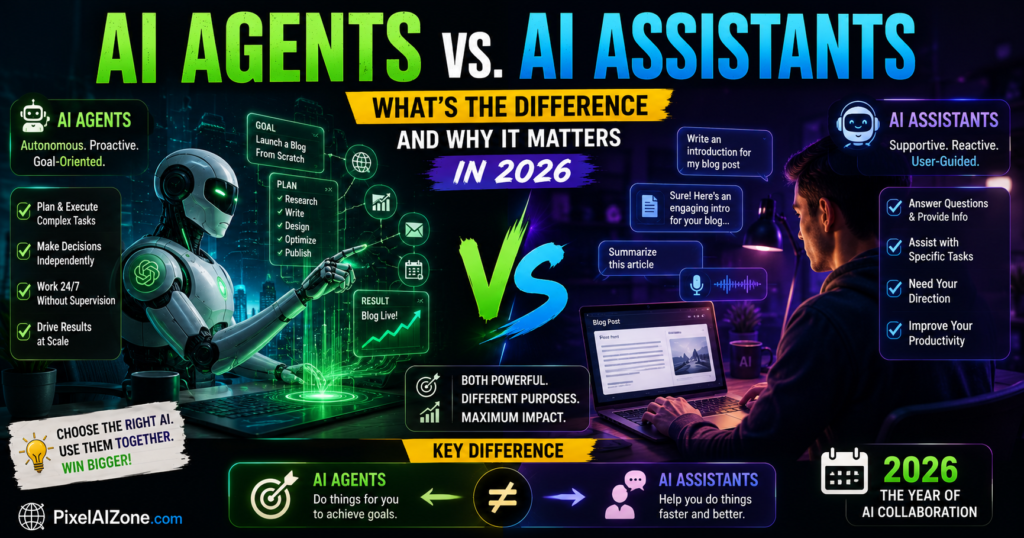
For the past few years, most organizations have used AI as a creative engine—drafting emails, generating images, summarizing documents, and writing code. That’s generative AI, and it’s been enormously useful .
But in 2026, something fundamental has shifted. AI is no longer just creating content—it’s now capable of executing tasks, planning multi-step workflows, and taking action across enterprise systems with minimal human intervention . This is agentic AI, and Gartner has declared it the “next step function” in enterprise AI evolution .
According to Gartner, agentic AI will autonomously resolve 80% of common customer service issues by 2029 . But the shift is already happening—77% of enterprises now have AI agents running in production .
Understanding Agentic AI vs Generative AI is essential for anyone navigating the 2026 AI landscape.
This guide compares Agentic AI vs Generative AI and explains why the shift matters for businesses.
Table of Contents
- What Is Generative AI?
- What Is Agentic AI?
- Key Differences at a Glance
- How They Work Together in Practice
- Why 2026 Is the Tipping Point
- The Governance Challenge
- FAQ
What Is Generative AI?
The Agentic AI vs Generative AI distinction is reshaping how enterprises approach automation.
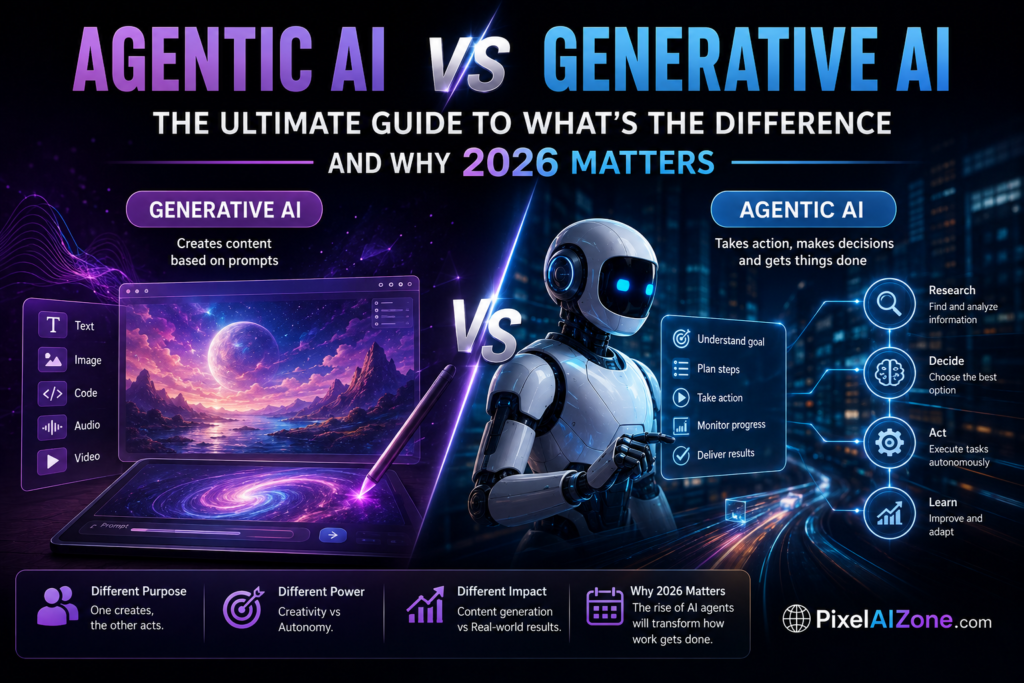
Generative AI is artificial intelligence that produces new content—text, images, audio, video, and code—by learning patterns from large datasets and generating outputs based on prompts .
Core characteristics:
- Pattern-based learning from large datasets
- Prompt-response interaction model—you ask, it answers
- Stateless—forgets context between sessions
- Content creation across multiple formats
Common business use cases:
- Marketing copy and content drafting
- Summarizing documents
- Writing code snippets
- Creating design concepts
- Answering questions from context
The key limitation: Generative AI doesn’t inherently understand goals beyond the current prompt. It creates; it doesn’t act. It waits for the next prompt like a smart assistant, but its ability ends after producing an output .
What Is Agentic AI?
When comparing Agentic AI vs Generative AI, the key difference is autonomy.
The Agentic AI vs Generative AI distinction comes down to autonomy and execution capability.
Agentic AI is artificial intelligence that autonomously pursues goals through multi-step reasoning and decision-making—without requiring continuous human direction .
Core characteristics:
- Goal-oriented behavior—you give it an objective, not a prompt
- Multi-step reasoning and planning—breaks complex goals into subtasks
- Autonomous task execution—takes actions in real systems
- Tool and API integration—connects to CRMs, databases, and external systems
- Persistent memory—retains context across sessions
Common business use cases:
- Sales operations: An agent connects to a CRM, identifies deals that need follow-up, drafts personalized outreach for each, and queues the messages for review .
- Customer support: An agent identifies an order, checks tracking data, updates the system, issues compensation if policy allows, and notifies the customer—escalating only edge cases to a human .
- Software development: An agent analyzes a codebase, identifies affected files, generates code changes, runs tests, fixes failed builds, and repeats the process until the implementation is complete .
- Data analysis: An agent takes a natural language question about business performance, translates it to queries across multiple data sources, runs them, synthesizes the results, and produces a cited summary .
The practical test: An AI assistant responds to a request and stops. An agent pursues a goal, takes actions toward it, and adapts based on what happens .
Key Differences at a Glance
The Agentic AI vs Generative AI comparison reveals different risk profiles and governance needs.

How They Work Together in Practice
Agentic AI vs Generative AI are not competing technologies — they work together.

In practice, Agentic AI vs Generative AI work together — the agent handles reasoning and calls generative models for content.
Agentic AI and generative AI are not competing technologies. In practice, agentic systems use generative AI as a component .
Here’s how it works: The agent handles the reasoning, planning, and orchestration, and calls a generative model whenever it needs to produce content along the way .
Common enterprise pattern:
- An agent monitors an incoming customer support queue
- It identifies complaints that meet specific criteria
- It retrieves relevant account data
- It decides on the appropriate resolution
- It calls a generative model to draft the response email
- The agent decides when to send it, to whom, and what to do next based on the customer’s reply
Another example: An agentic AI system begins by researching a target audience and identifying relevant keywords. It then uses generative AI to write email copy, create social media posts, and draft ad copy. After generating the content, the agent can schedule the campaign, monitor its performance, and refine future content based on engagement metrics .
Why 2026 Is the Tipping Point
2026 is the year Agentic AI vs Generative AI became operationally viable at scale. 2026 is the year when Agentic AI vs Generative AI became a practical distinction for enterprises.

The concept of agentic AI isn’t new, but 2026 is when it became operationally viable at scale. Several factors converged :
- Improved multi-step reasoning: Recent model improvements significantly reduced failure rates in complex task decomposition and long-horizon planning .
- Enterprise-ready frameworks: Mature orchestration platforms now manage tool integration, memory, monitoring, and fallback mechanisms .
- Real-world deployment at scale: Organizations moved beyond pilots into operational rollouts in customer support, IT automation, and internal operations .
- Regulatory clarity: Governments and industry bodies began outlining compliance expectations for autonomous AI systems .
- Ecosystem maturity: Standardized APIs, monitoring tools, and security frameworks make integration more predictable .
As MIT computer scientist Phillip Isola explains, what we think of now as agentic AI refers to large language models using tools to interact with digital and physical systems .
The Governance Challenge
The governance challenge in Agentic AI vs Generative AI is different — informational risk vs operational risk.
The difference between generative and agentic AI isn’t just architectural. It changes what can go wrong and what governance needs to prevent .
Generative AI’s primary risk is informational: The model might produce content that’s wrong, biased, or misleading. Those failures are generally visible—a human reads the output and can identify when something is off before acting on it .
Agentic AI’s primary risk is operational: The system might take an action that’s wrong, unauthorized, or harmful. Those failures may not surface until the action has been executed and its consequences have propagated .
Red Hat captures this shift directly: generative AI has an “informational” primary risk profile while agentic AI has an “operational” one. That distinction is what governance programs need to respond to when deploying agents .
Three governance requirements emerge specifically from agentic AI:
- Data access controls at the query layer
- Clear stopping conditions for autonomous workflows
- Recovery paths when the agent makes a bad choice
FAQ
Q: What’s the difference between generative AI and agentic AI?
A: Generative AI creates content—text, images, code—in response to prompts. Agentic AI pursues goals, plans multi-step tasks, takes actions through tools, and iterates toward a goal without constant human direction .
Q: Can agentic AI replace generative AI?
A: No. Agentic AI uses generative AI as a component. The agent handles reasoning and orchestration, and calls a generative model whenever it needs to produce content .
Q: Why does the distinction matter for businesses?
A: The risk profiles are different. Generative AI’s primary risk is informational (wrong outputs). Agentic AI’s primary risk is operational (wrong actions in real systems) .
Q: What are examples of agentic AI?
A: Sales operations agents that connect to CRM and draft outreach, customer support agents that resolve issues end-to-end, and software development agents that write and test code .
Q: Is agentic AI ready for enterprise use?
A: Yes. Enterprises are moving beyond pilots into operational rollouts. 77% of enterprises now have AI agents running in production .
Q: What is the governance challenge with agentic AI?
A: Organizations are deploying agents faster than they can govern them. “Agent sprawl” is increasing complexity, technical debt, and security risk .
Q: What is Agentic AI vs Generative AI?
A: Generative creates content, Agentic takes action.
Final Thoughts
Generative AI changes how organizations interact with software. Agentic AI changes what software is permitted to do on behalf of users, moving people from direct execution towards supervision, approval, and exception handling .
The question for 2026 is no longer “Can the model answer well?” It’s become, “Can this system be trusted with real data, real infrastructure, real identity, and real consequences?”
The future belongs to systems that combine both approaches—generative AI for creation, agentic AI for execution. The organizations that succeed will be those that treat AI not just as a tool, but as a capability that requires careful governance, clear boundaries, and human oversight .
The future belongs to systems that combine Agentic AI vs Generative AI approaches. Agentic AI vs Generative AI will continue to evolve, but understanding the difference is key for 2026 and beyond.
Related Posts on Pixelaizone
- “The Rise of AI Agents: 5 Powerful Tools That Actually Do Work for You”
- 11 AI Coding Tools You Should Use in 2026 (Beyond GitHub Copilot) – Game-Changing Guide
- The Best AI Image Generator in 2026: Midjourney vs Kling AI vs Adobe Firefly
- 5 Free AI Tools That Are Better Than ChatGPT for Specific Tasks
- Perplexity vs ChatGPT: Why Researchers Are Switching to Perplexity in 2026
- Claude vs ChatGPT : Which AI Tool Is Better for Long-Form Content in 2026?
- Google AI Mode vs ChatGPT: Which Search Engine Will Win in 2026? Complete Analysis
- AI in 2026: The Year Everything Changed Ultimate Guide (Revolutionary Insights)
- Why 39% of Americans Would Stop AI Development If They Could
- “2026 AI Writing Tools Comparison: Which One Actually Deserves Your Money? (Honest Comparison)”
- “Global AI Adoption Rankings 2026: The Ultimate Guide to Which Country Is Winning the AI Race”
- “Agentic AI Is Transforming Pakistan’s SMEs: 7 Powerful Ways to Stay Ahead”
- “Alibaba’s Accio Work in Pakistan 2026: The Ultimate AI Export Revolution for SMEs”
- “ChatGPT Hits 1 Billion Users: What Comes Next for the AI Giant? (Revolutionary Milestone)”
Which type of AI are you using in your business? Drop a comment below!