For writers creating deep, thoughtful content, the decision between Claude and ChatGPT has become one of the most important workflow choices in 2026.
Let me show you something.
If you manage social media, you have almost certainly opened both ChatGPT and Claude, pasted in the same prompt, and wondered which one to actually pay for . Scroll Reddit and you will see the same debate on repeat: people cancelling ChatGPT for Claude, then bumping into Claude’s usage limits and missing ChatGPT .
In 2026, both models have improved dramatically, but they serve fundamentally different purposes. The “which is smarter” question is dead. Both models are good enough that the right question is which one does the specific thing you need better .
This is a practical Claude vs ChatGPT comparison, built around the jobs you actually do: writing long-form content, holding a brand voice, and doing it without blowing your budget.
The debate of Claude vs ChatGPT is reshaping how writers choose their AI tools in 2026. The Claude vs ChatGPT decision is one of the most important choices for content creators in 2026.
Table of Contents
- The Quick Answer: Which Tool Is Better for Long-Form Writing?
- What Each Tool Is Built For
- Claude vs ChatGPT for Writing: Long-Form vs Short-Form
- Brand Voice and Consistency
- Long-Form Drafts and Structured Explanations
- Brainstorming, Angle Generation and Ideation
- Context Window and Document Handling
- Research Capabilities
- The Limits of Both Tools
- FAQ
The Quick Answer: Which Tool Is Better for Long-Form Writing?
Understanding Claude vs ChatGPT starts with knowing what each tool is built for.

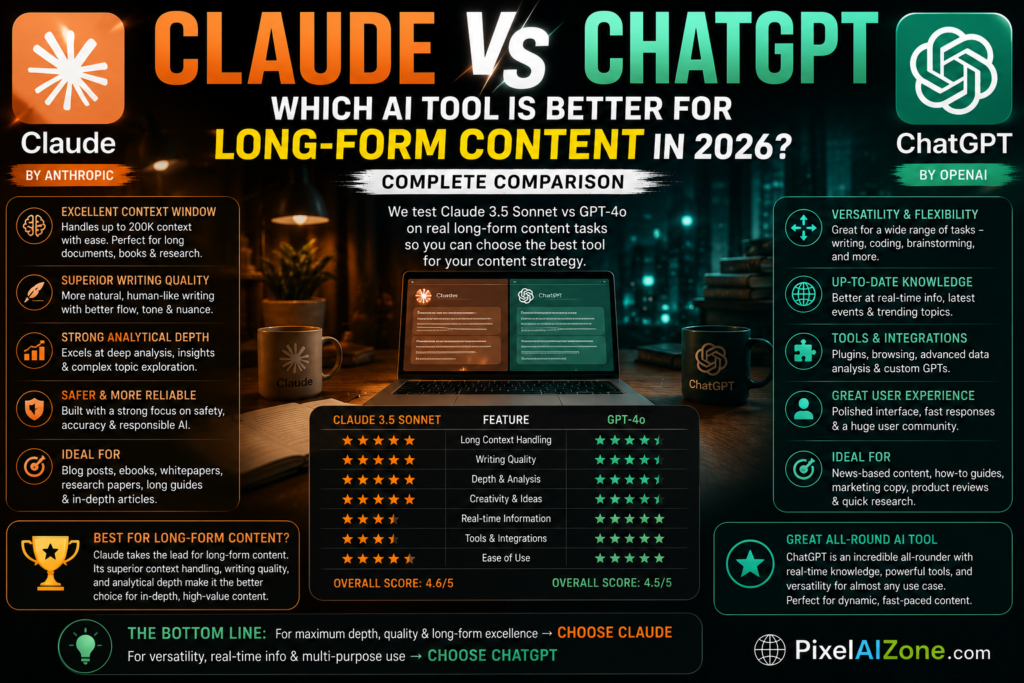
The honest verdict is this: Claude wins for long-form writing, while ChatGPT wins for short-form and brainstorming.
According to independent 2026 benchmarking, Claude’s Sonnet 5 is superior for writing quality and following instructions outright, whereas OpenAI’s GPT-5.4 came in as a close second .
For long-form writing, articles, newsletters, threads, and captions with a story, Claude usually wins. Its copy has rhythm and restraint, flows like full sentences instead of bullet points dressed up as paragraphs, and needs less editing to remove the AI tone .
For short-form punch — hooks, headlines, one-line captions, and fast volume — ChatGPT often wins. Ask it for thirty caption options and you get thirty usable ones in seconds .
One famous test framed it perfectly: ask both for a quick punchy post, and ChatGPT delivers the snack you asked for while Claude serves a beautiful three-course meal you did not order . Great writing, wrong format.
What Each Tool Is Built For
In the Claude vs ChatGPT comparison, each tool serves a different purpose.

The Claude vs ChatGPT comparison is incomplete without understanding their core strengths.
ChatGPT has grown into an everything app. As of 2026, its paid plans bundle native image generation, video, voice, custom GPTs, and a large library of connectors . For a writer, that matters because you can draft and revise without leaving the window.
Claude is narrower on purpose. It is built around reasoning and writing rather than a wide feature surface. It does not generate images or video inside the chat . What it does instead is write, and it tends to write copy that needs less cleanup before it sounds like a person wrote it .
| Tool | Best For | Core Strength |
|---|---|---|
| Claude | Long-form writing, nuanced prose | Natural tone, consistency, context retention |
| ChatGPT | Short-form, brainstorming, versatility | Speed, volume, broad feature set |
Claude vs ChatGPT for Writing: Long-Form vs Short-Form
For long-form writing, Claude vs ChatGPT shows a clear winner.

The Claude vs ChatGPT debate often comes down to writing style and format preferences.
The Claude vs ChatGPT comparison shows distinct strengths in different writing scenarios.
This is where the two genuinely differ, and the split is sharper than most people expect.
Claude for Long-Form Writing
Claude is widely recognized for producing natural, polished writing with a consistent tone, making it a strong choice for long-form articles, reports and professional communication . For example, if you ask both models to write a 1,500-word blog post, Claude typically delivers smoother transitions and requires fewer stylistic edits .
The LLM Stats writing leaderboard for 2026 ranks Claude Opus 4.6 as the best AI model for writing, with a score of 31.9, praised for long-form coherence — voice and structure stay consistent over thousands of tokens . Claude Opus 4.6 is described as “the natural-prose benchmark for long-form writing” .
ChatGPT for Short-Form and Brainstorming
ChatGPT, on the other hand, excels at generating outlines, brainstorming ideas, rewriting content and producing quick first drafts . Its structured approach makes it especially useful when you need to move from idea to draft quickly .
Many heavy users notice that Claude, for all its writing strength, can feel a little narrow when you want to explore wide, generating the “right” answer rather than twenty directions. ChatGPT tends to throw out more raw options to pick from .
The workflow that works: brainstorm broad in ChatGPT, then take the best angle into Claude to write it well . Use ChatGPT to widen, Claude to deepen .
Brand Voice and Consistency
Brand voice is another area where Claude vs ChatGPT differ significantly.

Holding one voice across many posts is the hardest part of scaled content. Both tools help in different ways.
ChatGPT lets you build a custom GPT loaded with your brand guidelines, so anyone on the team can use the same configured assistant . Claude leans on its large context and Projects, where you keep brand guidelines, examples, and rules in one place and have every chat draw from them .
In practice, ChatGPT’s custom GPTs are easier to share across a team, while Claude’s large context holds a nuanced voice more faithfully within a session .
If you run a team: the shareability of custom GPTs is handy. If you are a solo writer protecting a delicate brand voice: Claude’s consistency tends to win .
Long-Form Drafts and Structured Explanations
Context window is a key factor in Claude vs ChatGPT decisions.

Context retention and controlled voice are key when you’re trying to convey a line of thought over a few pages of writing. Claude has earned recognition for its ability to follow a brief with relative precision and hold a controllable voice over longer text .
When outputs load smooth paragraphing and coherence on the front-end, you’ll inevitably save time on writing tasks like:
- Blogs
- Newsletters
- Whitepapers and eBooks
- Explainer articles
- Summaries
Claude’s context window is the most-cited reason developers and writers switch, with the API tier going up to 1 million tokens for long codebases, contracts, and book-length documents .
Brainstorming, Angle Generation and Ideation

ChatGPT has solid abstract reasoning and complex logical foundations. These capabilities are indispensable when you need to ideate multiple directions, hooks and concepts that differentiate you from competitors .
Here, ChatGPT delivers:
- Topic angles
- Campaign ideas
- Headline variations
Some writers may prefer ChatGPT for its ideation and refinement loops because, particularly now that 81% of marketers report using AI in their marketing processes, the writing premium has shifted to originality and value-add perspectives .
Context Window and Document Handling
Document handling is another key difference in Claude vs ChatGPT. Document analysis is where Claude vs ChatGPT really diverge in capability.

Context window refers to how much information an AI model can process within a conversation. This is critical for long-form content creation.
| Feature | Claude | ChatGPT |
|---|---|---|
| Context Window | Up to 1M tokens (API) | Up to 400K tokens |
| Normal Use | ~150,000 words | ~96,000 words |
| Document Handling | Superior for long documents | Good for everyday use |
Claude supports significantly larger context windows, making it well suited for reviewing contracts, books, research papers and extensive documentation without losing context . ChatGPT also supports large context windows on paid plans, which is more than sufficient for most everyday business tasks, but Claude generally handles larger documents more comfortably .
Research Capabilities
Research capabilities are another factor in the Claude vs ChatGPT comparison.
The biggest difference lies in how the two models gather and process information.
ChatGPT can browse the web to retrieve current information, making it useful for researching recent news, industry updates and evolving topics .
Claude shines when working with documents you provide. Whether it’s a lengthy PDF, annual report, policy document or research paper, Claude is particularly effective at identifying themes, summarizing key findings and answering questions based on uploaded content .
Best for: ChatGPT for live research, Claude for document analysis .
The Limits of Both Tools
Understanding the limits of Claude vs ChatGPT helps manage expectations.

Neither tool is perfect. Both have well-documented flaws, despite their benefits.
Common limitations include:
The complaint about Claude is consistent: **usage limits on the $20 Pro plan.** Heavy users report hitting caps mid-task and having to wait or switch tools, and there is no middle tier between Pro at $20 and Max at $100 .
ChatGPT’s $20 Plus plan tends to feel more generous on limits for the same money . So the community pattern is clear: people love Claude’s writing and tone, and leave or supplement it because of the limits .
FAQ
Q: Is Claude better than ChatGPT for long-form writing?
A: Yes, for most long-form writing tasks. Claude is widely recognized for producing natural, polished writing with a consistent tone, making it a strong choice for long-form articles, reports and professional communication . The 2026 writing leaderboard ranks Claude Opus 4.6 as the best AI model for writing .
Q: Which AI tool is better for brainstorming?
A: ChatGPT is better for brainstorming. It tends to throw out more raw options to pick from. A common workflow is to brainstorm broad in ChatGPT, then take the best angle into Claude to write it well .
Q: Can I use both Claude and ChatGPT?
A: Yes. The common 2026 setup is ChatGPT for ideation, images, and quick questions, and Claude for the serious writing, editing, long-document analysis, and agentic file work. At about $20 each, running both is roughly $40 a month .
Q: Which tool has better context handling?
A: Claude has better context handling, with up to 1 million tokens on the API tier and approximately 150,000 words in normal use, compared to ChatGPT’s 400K tokens and approximately 96,000 words .
Q: Which is cheaper for the main paid plan?
A: Both start at $20 a month. The difference shows up at the edges — ChatGPT offers a cheaper $8 Go tier, while Claude offers more generous free tier limits .
Q: Which is better in Claude vs ChatGPT for long-form?
A: Claude wins.
Q: Which tool wins in Claude vs ChatGPT for long-form?
A: Claude takes the lead.
Final Thoughts
Match the tool to the length . Claude for the long pieces, ChatGPT for the short, snappy ones.
The choice between Claude and ChatGPT ultimately converges into what is the one thing you want the AI sidekick to automate, which saves a lot of your time .
If you can run both at $20 each, that is what a lot of writers actually do . There is no single winner, only the right fit for your workflow.
The Claude vs ChatGPT choice ultimately depends on your workflow. Understanding the Claude vs ChatGPT difference helps you choose the right tool for your workflow.
Related Posts on Pixelaizone
- Google AI Mode vs ChatGPT: Which Search Engine Will Win in 2026? Complete Analysis
- AI in 2026: The Year Everything Changed Ultimate Guide (Revolutionary Insights)
- Why 39% of Americans Would Stop AI Development If They Could
- “2026 AI Writing Tools Comparison: Which One Actually Deserves Your Money? (Honest Comparison)”
- “Global AI Adoption Rankings 2026: The Ultimate Guide to Which Country Is Winning the AI Race”
- “Agentic AI Is Transforming Pakistan’s SMEs: 7 Powerful Ways to Stay Ahead”
- “Alibaba’s Accio Work in Pakistan 2026: The Ultimate AI Export Revolution for SMEs”
- “ChatGPT Hits 1 Billion Users: What Comes Next for the AI Giant? (Revolutionary Milestone)”
- The ‘Cheating Fruit’ AI Trend: Why 10 Million People Are Watching Strawberries Cheat
- “AI Agents Are Changing How the World Shops 2026 — Here’s How (Revolutionary Shift)”
- “1 in 4 People Now Use AI Every Day — Here’s What They’re Actually Doing (Shocking Insights)”
- “AI Has Crossed the Behavioural Threshold in 2026: Essential Guide to the Shocking Shift from Experimentation to Dependence”
- “The AI Trust Paradox 2026 Revealed : Why 74% of People Use AI Daily But Don’t Trust It (Powerful Insights)”
Which AI writing tool are you using in 2026? Drop a comment below!