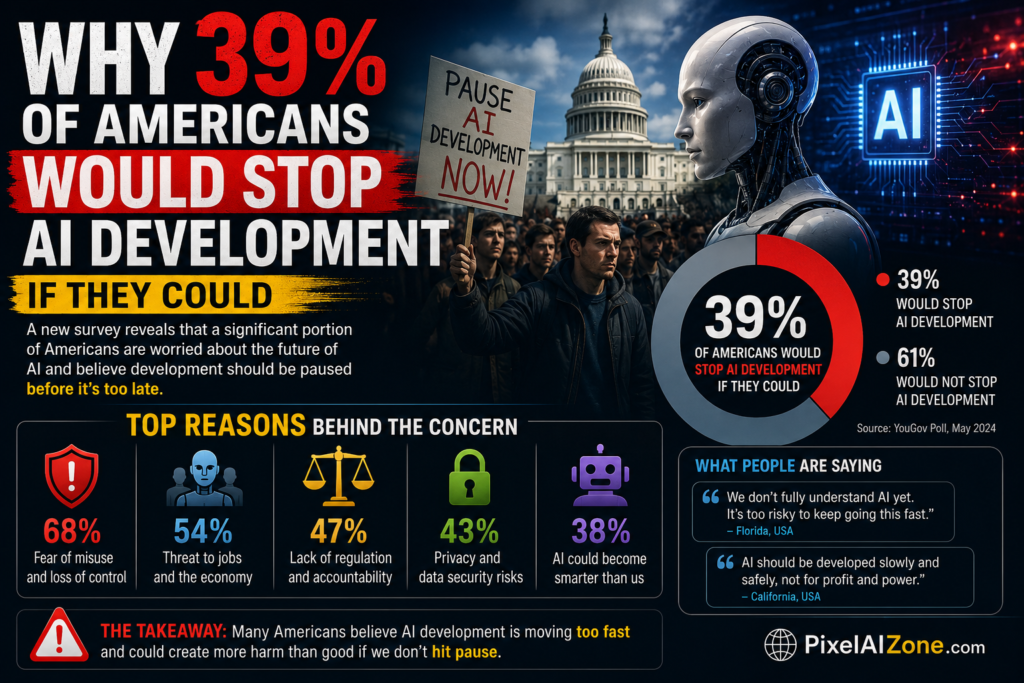
A new survey reveals deep unease about artificial intelligence, with nearly four in ten Americans willing to halt its development entirely.
Why 39% of Americans would stop AI development if they could is a question that reveals deep unease about the technology.
Let me show you something.
A 2026 survey conducted by CloudResearch found that 39% of Americans would press a button to permanently stop all AI development — or would seriously consider it . This isn’t just a fringe opinion. It represents a significant portion of the population that views AI not as a tool for progress, but as an existential threat.
Even among those who wouldn’t halt development, 44% worry about unchecked AI progress, and 46% say they trust an AI tool less if its answers are influenced by advertisers . These numbers reveal a fundamental trust gap — people are using AI, but they don’t fully trust it.
This unease isn’t irrational. According to the UN Secretary-General, “AI is advancing at runaway speed” and “an experiment is being run on our own societies — without a plan and without consent” . When global leaders express concern about a technology’s trajectory, it’s worth paying attention.
Why 39% of Americans would stop AI development is a question that reveals deep unease about the technology.
Table of Contents
- The Numbers: What the Survey Found
- Why Americans Want to Pause AI Development
- The Trust Gap: Using AI Without Trusting It
- Who Wants to Stop AI Development?
- The Political and Policy Response
- Global Context: America Is Not Alone
- What Happens If AI Development Slows?
- FAQ
The Numbers: What the Survey Found
The survey data shows why 39% of Americans would stop AI development — and it’s not just fear.

The CloudResearch survey of 1,008 U.S. adults revealed some striking statistics about American attitudes toward AI:
| Finding | Percentage |
|---|---|
| Would permanently stop all AI development | 39% |
| Worry about unchecked AI development | 44% |
| Trust an AI tool less if influenced by advertisers | 46% |
Why 39% of Americans would permanently stop AI development if they could is a question that reveals deep unease about technology that is reshaping society faster than anyone can keep up.
These figures align with broader research. A Gallup poll found that 49% of Americans view AI as a unique threat to humanity, while the other half see it as just another technological advancement . The country is evenly divided on whether AI represents progress or peril.
Key insight: People who use AI regularly are more likely to trust it. 71% of daily generative AI users view AI as just another technological advancement, compared to only 35% of non-users . Familiarity breeds comfort, not fear.
Why Americans Want to Pause AI Development
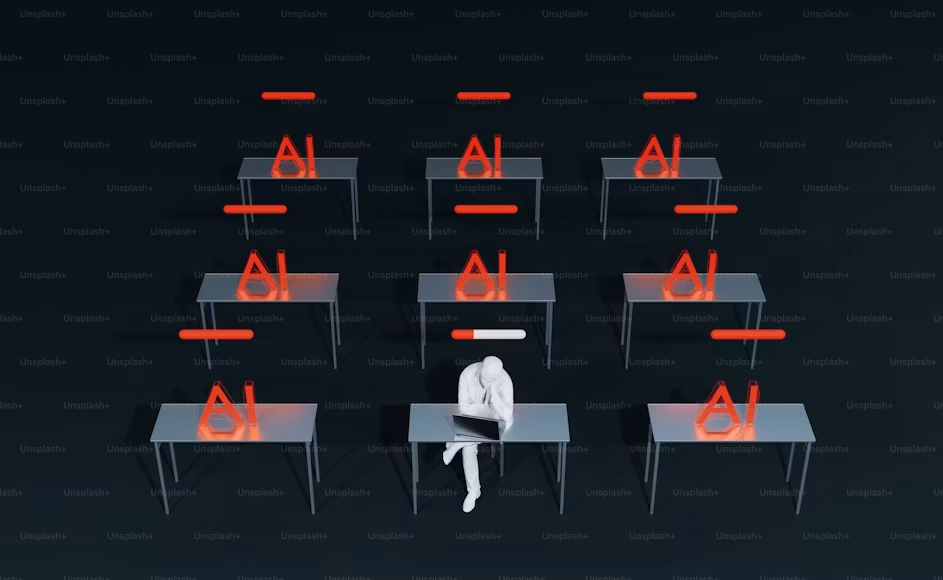
Job displacement is a key reason why 39% of Americans would stop AI development.
The data clearly shows why 39% of Americans would stop AI development — and it’s not just about jobs.
1. Job Displacement Fears
59% of Americans believe AI will reduce the need for humans to perform important or creative tasks . This isn’t about automation replacing factory workers — it’s about AI taking over jobs once thought to require uniquely human skills.
The UN Secretary-General warned that AI could “reshape economies, transform the world of work, sway elections and tilt the balance of security” . When a technology has that much power, it’s natural for people to feel uneasy.
2. The “Vibe-Coding” Problem
UN Secretary-General António Guterres coined a phrase that captures the danger: “vibe-coding.” This is the tendency to “let the AI do it. Don’t look too closely. Seems to work? Good enough” .
His warning was stark: “Vibe-coding can do wonders — but we cannot vibe-code the truth. We cannot vibe-code the future of humanity” .
This resonates with Americans who worry that society is sleepwalking into an AI-dominated future without fully understanding the consequences.
3. Misinformation and Truth Erosion
“A machine-enabled lie can now persuade as effectively as the truth — and authentic evidence can be dismissed as fake,” Guterres warned . A society that cannot agree on what is real cannot defend itself.
This concern is particularly acute in the United States, where the information ecosystem is already polarized and fragile.
4. Concentration of Power
The computing power, data, and talent behind the most advanced AI systems are concentrated in “a handful of companies and in a handful of countries” . Most nations “have had no say in decisions that will shape their futures.”
The UN Secretary-General cautioned that “when power imbalances are hard-wired into technology, inequality becomes part of the code” . Many Americans share this concern about Big Tech’s influence over the future.
The Trust Gap: Using AI Without Trusting It
The trust gap explains why 39% of Americans would stop AI development.

Despite widespread use of AI, trust remains fragile.
Americans Are Divided on AI’s Impact
A Gallup poll found that 49% of Americans believe AI poses a unique threat to humanity, while the same percentage see it as “just the latest in a long line of technological advancements” .
The trust gap is another factor in why 39% of Americans would stop AI development.
Key finding: A clear majority (64%) plan to “resist using AI in their own lives for as long as possible” rather than embracing it . This suggests that many Americans are using AI because it’s becoming unavoidable — not because they want to.
The Data Leader Trust Problem
The trust issue extends to professionals. A survey of 114 data and analytics leaders found that only 51% trust AI-generated insights .
Barriers to trust include:
- Security and governance concerns (58% of leaders say this is their biggest challenge)
- AI hallucinations (33% are concerned about inaccurate information)
- Lack of ability to verify results (31% cite this as a problem)
Only 31% of AI projects make it past the pilot stage, often due to governance challenges and inaccurate outputs .
The Transparency Demand
Both Americans and Canadians are clear about what they want from companies using AI :
| Demand | Americans |
|---|---|
| Companies should review AI for harms before release | 77% |
| Companies should explain AI use in plain language | 74% |
| Companies should listen to customer input on AI deployment | 72% |
| AI should be regulated | 90% |
The message is clear: 90% of Americans want AI regulated, with clear expectations for accountability and oversight .
Who Wants to Stop AI Development?
Misinformation concerns drive why 39% of Americans would stop AI development.
Misinformation is another critical reason why 39% of Americans would stop AI development.
The Young and the Educated
43% of 18-29 year olds use generative AI daily or weekly — the highest rate of any age group . These same young people are often the most vocal about needing safeguards.
The Familiar and the Skeptical
Daily generative AI users (71%) are much more likely to view AI positively than non-users (35%) .
The “Stop the AI Race” Movement
The protest group “Stop the AI Race” has demonstrated outside Anthropic, OpenAI, and xAI offices in San Francisco, calling for a conditional pause on advanced AI development .
Organizers believe “building AI can automate AI research, and can self-improve, like a danger to the human race, especially human extinction” . Notably, “it’s not only me and other researchers saying this, it’s the lab CEOs themselves that the risk is real.”
The Political and Policy Response
Political responses reflect why 39% of Americans would stop AI development.

Congressional Action
In March 2026, Senator Bernie Sanders and Representative Alexandria Ocasio-Cortez introduced the AI Data Center Moratorium Act .
What it would do:
- Ban AI exports to countries without adequate safeguards
- Slow the “global race to see which country is the first to eliminate hundreds of millions of jobs”
- Stop “the first to build an AI that destroys the planet”
Sanders said: “We cannot sit back and allow a handful of billionaire Big Tech oligarchs to make decisions that will reshape our economy, our democracy and the future of humanity” .
The State vs. Federal Debate
A bipartisan group of over 100 local communities have enacted moratoriums on data centers, with 12 states pushing forward with statewide proposals .
80% of Americans believe the government should maintain rules for AI safety and data security, including 88% of Democrats and 79% of Republicans .
State lawmakers have strongly opposed federal efforts to preempt state AI laws, with one letter arguing that “states are closest to the communities already experiencing AI harms — from deepfakes and targeted scams to automated systems that entrench bias” .
The UN Perspective
The UN is pushing for a global governance framework. Guterres noted that “the internet took 15 years to reach a billion people. AI got there in two” . “We may be the last generation able to set the terms on which humanity and machines coexist. The door is still open. But it will not stay open long” .
Global Context: America Is Not Alone

China’s Global Leadership But Trust Deficit
A Public First poll covering over 18,000 people across 15 countries found that respondents from 11 nations acknowledge China’s AI leadership . However, US AI models were considered more trustworthy than those developed in China, with the US ranking second (+16) in net trust and China placing 10th (-8) .
China is the top performer in global AI adoption according to the WIN World AI Index 2026, with 92% adoption .
Widespread Support for AI Pause
The Public First survey found “clear support from a majority in nearly every country for a pause on AI development” .
What Happens If AI Development Slows?
There are valid concerns on both sides of the debate.
The Case for Caution
UN Secretary-General Guterres warned that “some lines, once crossed, cannot be uncrossed” . He has called for:
- Common methods to evaluate and verify risks
- Global standards for AI safety
- Human oversight in high-stakes decisions
- An AI Child Safety Pledge requiring companies to prove systems accessible to children are safe
The Case for Continued Development
The same technology, “built with purpose,” is already changing lives for the better :
- A mother in a rural clinic has her scan read in minutes, and her cancer caught in time.
- A child keeps learning beyond the classroom with a tutor that never tires.
- A smallholder farmer plants with the same forecasts as the biggest agribusiness.
“AI could compress decades of development into years,” Guterres noted. “It could become the great equalizer of the twenty-first century” .
FAQ
Q: Why do 39% of Americans want to stop AI development?
A: They worry about job displacement, misinformation, loss of human control, and the concentration of power in a few tech companies.
Q: Is AI really a threat to humanity?
A: The UN Secretary-General warns that “some lines, once crossed, cannot be uncrossed” and that AI systems are “writing code, acting online and making choices with less and less human oversight” .
Q: Does using AI make people trust it more?
A: Yes. 71% of daily generative AI users view AI positively, compared to 35% of non-users . Familiarity breeds comfort.
Q: What regulations are being proposed?
A: The AI Data Center Moratorium Act would pause data center expansion until national safeguards are in place . 90% of Americans want AI regulated .
Q: Will AI destroy jobs?
A: 59% of Americans believe AI will reduce the need for humans to perform important or creative tasks .
Q: Why would 39% of Americans stop AI development?
A: Fear of job loss and misinformation.
Final Thoughts
The 39% figure isn’t just a statistic — it’s a warning. Nearly four in ten Americans are so concerned about AI that they’d halt its development if given the chance.
This isn’t irrational fear. The UN Secretary-General warned about “vibe-coding” — letting AI make decisions without proper oversight. He described children being “deceived by machines posing as friends” and “steered toward self-harm” .
But the solution isn’t simply to stop. The same technology is catching cancer early, tutoring children, and helping farmers thrive. The choice isn’t between progress and safety — it’s between “governing by design and drifting by default” .
Americans are demanding a middle path: regulation, transparency, and human oversight. 90% want AI regulated. 77% want companies to review AI for harms before release .
The message from the public is clear: We want the benefits of AI — but not at any cost.
Understanding why 39% of Americans would stop AI development is essential for the future.
Understanding why 39% of Americans would stop AI development is key to shaping responsible AI policy.
Related Posts on Pixelaizone
- “2026 AI Writing Tools Comparison: Which One Actually Deserves Your Money? (Honest Comparison)”
- “Global AI Adoption Rankings 2026: The Ultimate Guide to Which Country Is Winning the AI Race”
- “Agentic AI Is Transforming Pakistan’s SMEs: 7 Powerful Ways to Stay Ahead”
- “Alibaba’s Accio Work in Pakistan 2026: The Ultimate AI Export Revolution for SMEs”
- “ChatGPT Hits 1 Billion Users: What Comes Next for the AI Giant? (Revolutionary Milestone)”
- The ‘Cheating Fruit’ AI Trend: Why 10 Million People Are Watching Strawberries Cheat
- “AI Agents Are Changing How the World Shops 2026 — Here’s How (Revolutionary Shift)”
- “1 in 4 People Now Use AI Every Day — Here’s What They’re Actually Doing (Shocking Insights)”
- “AI Has Crossed the Behavioural Threshold in 2026: Essential Guide to the Shocking Shift from Experimentation to Dependence”
- “The AI Trust Paradox 2026 Revealed : Why 74% of People Use AI Daily But Don’t Trust It (Powerful Insights)”
- “Pakistan’s Rs 283 Billion AI Programme 2026: A Game-Changing Opportunity for the Nation”
- Why Your AI Content Is Invisible: 9 Ways to Stand Out in 2026
- “The $1.3 Billion AI Ad Market: What It Means for Your Business (Game-Changing Trends)”
Do you think AI development should be paused? Drop a comment below!