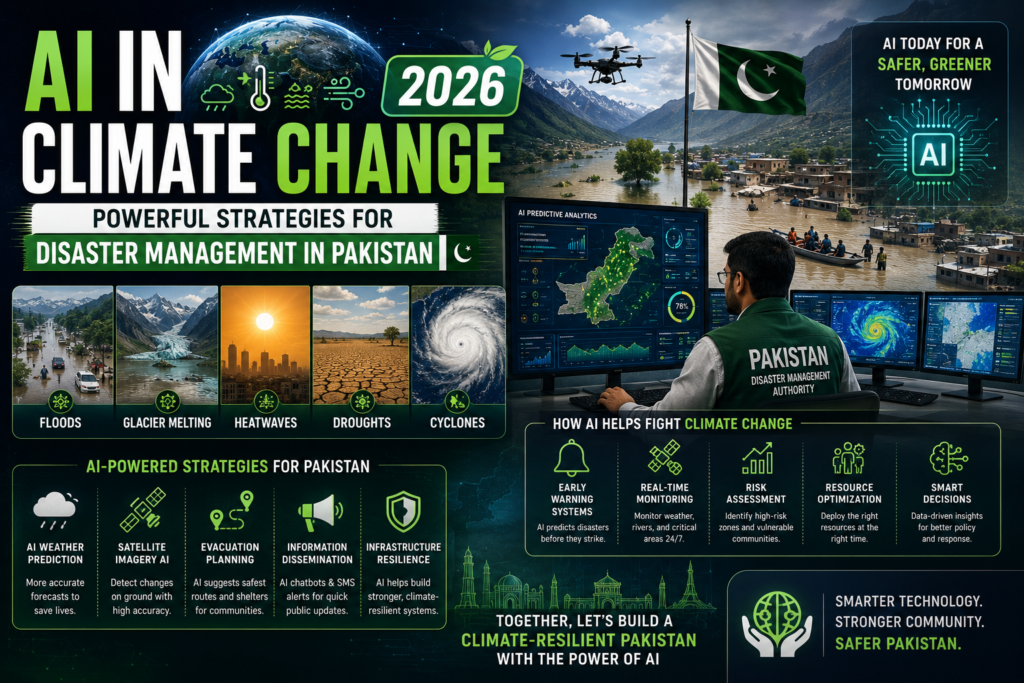
From flood prediction to smog monitoring — here’s how artificial intelligence is helping Pakistan tackle its most urgent climate challenges.
AI in climate change is transforming how Pakistan predicts and responds to natural disasters.
Let me show you something.
Pakistan is one of the most climate-vulnerable countries in the world. Recurrent and devastating climate disasters — from lethal heatwaves and glacial lake outburst floods to violent monsoon downpours — have become a lingering threat to the country’s ecological stability and socio-economic development .
According to the Pakistan Vulnerability Report, 20 districts have been identified as highly vulnerable to climate risks, including 18 in Balochistan and two in Khyber Pakhtunkhwa . These vulnerability assessments allow policymakers to clearly identify where the risks lie and design targeted interventions.
But there’s hope. Artificial intelligence is emerging as a powerful tool to predict, prevent, and respond to these climate disasters. From AI-powered early warning systems to smart smog monitoring, Pakistan is building a technology-driven defense against climate change.
This guide explores AI in climate change and how it’s being used for disaster management in Pakistan.
AI in climate change is no longer a futuristic concept — it’s saving lives in Pakistan right now.
Table of Contents
- Pakistan’s Climate Vulnerability in 2026
- Government Leadership on AI for Climate
- AI-Powered Early Warning Systems
- China-Pakistan Meteorological Cooperation
- AI for Flood Prediction and Drought Forecasting
- AI and the Smog Crisis
- AI for Inclusive Disaster Alerts
- Research and Innovation in Pakistan
- Challenges and the Way Forward
- FAQ
AI in Climate Change: Understanding Pakistan’s Vulnerability
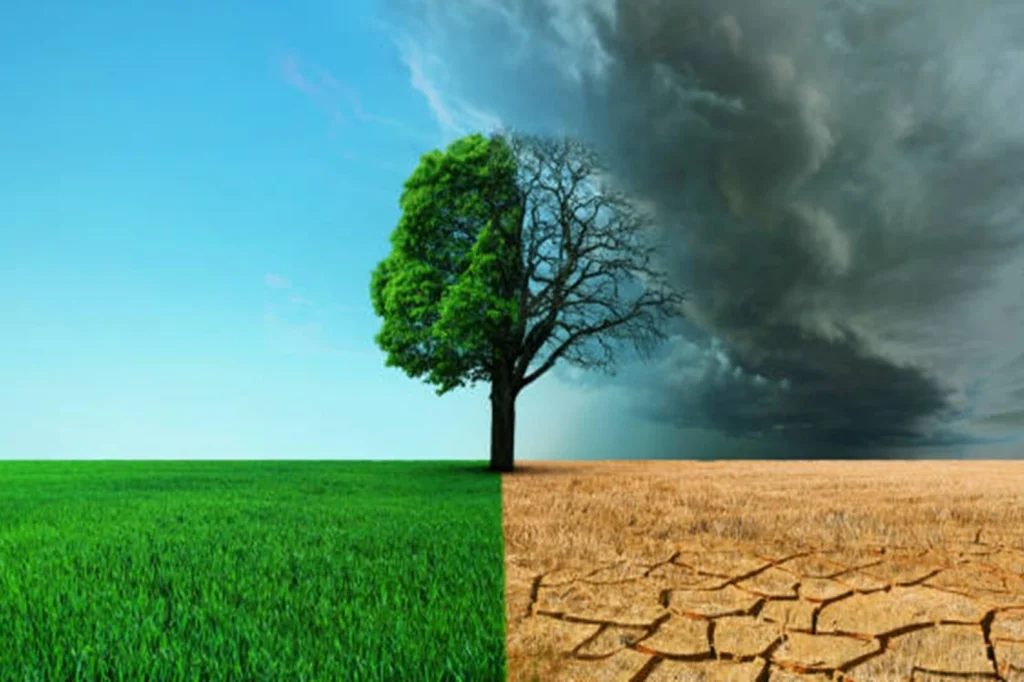
Pakistan faces escalating climate risks that have intensified drastically in recent years, triggering a surge of extreme weather worldwide . The country is particularly hard-hit by:
- Glacial lake outburst floods (GLOFs) — as mountain glaciers melt, dangerous lakes form that can burst and flood downstream communities
- Monsoon floods — devastating rainfall that displaces millions
- Droughts — particularly in semi-arid and coastal desert regions
- Heatwaves — extreme temperatures affecting agriculture and public health
- Smog — toxic air pollution choking urban centers
According to federal minister Dr. Musadik Malik, Pakistan faces serious challenges due to sparse and fragmented data, which complicates effective policymaking . AI-driven modelling can address these gaps by offering targeted interventions, particularly in climate-vulnerable regions .
Understanding AI in climate change starts with recognizing Pakistan’s unique vulnerabilities.
AI in Climate Change: Government Leadership in Pakistan

Federal Minister for Climate Change and Environmental Coordination Dr. Musadik Malik has been a vocal advocate for using AI in climate governance. Speaking at the National Artificial Intelligence Workshop in February 2026, he highlighted that the most significant application of AI lies in its predictive and preventive capabilities .
Key points from the minister:
However, the minister also cautioned against overreliance on AI, warning it could weaken human judgement and critical thinking if not used responsibly . He also noted that AI agents could reshape employment patterns, stressing the need for careful integration and timely reskilling .
AI in Climate Change: Early Warning Systems in Pakistan

One of the most promising applications of AI in Pakistan is early warning systems. According to COMSATS Executive Director Ambassador Dr. Muhammad Nafees Zakaria, AI technologies have profound applications in climate change-related early warning and mitigation systems .
Key features of AI-powered early warning systems in Pakistan:
| Feature | How It Works |
|---|---|
| Cloud-based open platform | Data accessible across regions |
| AI models for severe weather identification | Algorithms detect patterns in weather data |
| Real-time monitoring | Dynamic systems replace static hazard maps |
| Multi-hazard integration | Combines data from multiple sources |
The China-Pakistan Joint Research Center on Earth Sciences (CPJRC) is also working on transitioning from static hazard maps to dynamic real-time monitoring systems . Researchers emphasized the need for high-quality spatial and temporal datasets to develop accurate AI-based predictive models .
AI in climate change is making early warning systems more accurate and accessible.
AI in Climate Change: China-Pakistan Cooperation

A significant development in Pakistan’s AI-powered climate resilience is the China-Pakistan meteorological cooperation. According to Prof. Cheng Xizhong, Senior Research Fellow at the Charhar Institute, this cooperation has emerged as a pragmatic and effective solution .
Highlights of China-Pakistan cooperation:
| Initiative | Impact |
|---|---|
| MAZU multi-hazard early warning system | Cloud-based platform incorporating Fengyun satellite data and AI modeling |
| Accurate early warnings | Heatwaves, flash floods, agricultural hazards |
| Full-cycle agricultural services | Safeguards food security and farmers’ incomes |
| Low-cost, modular design | Replicable model for other developing countries |
The China Meteorological Administration has been working with the Pakistan Meteorological Department since 2023 to develop a Cloud-based Early Warning System . This system features AI models, severe weather identification algorithms, and early warning information dissemination tools, enabling swift and effective tracking of meteorological disasters .
According to PMD expert Sohail Babar Cheema, “With the Cloud-based Early Warning System, we are able to increase the accuracy of weather forecasting using advanced technologies like AI” .
International cooperation is accelerating AI in climate change efforts in Pakistan.
AI for Flood Prediction and Drought Forecasting
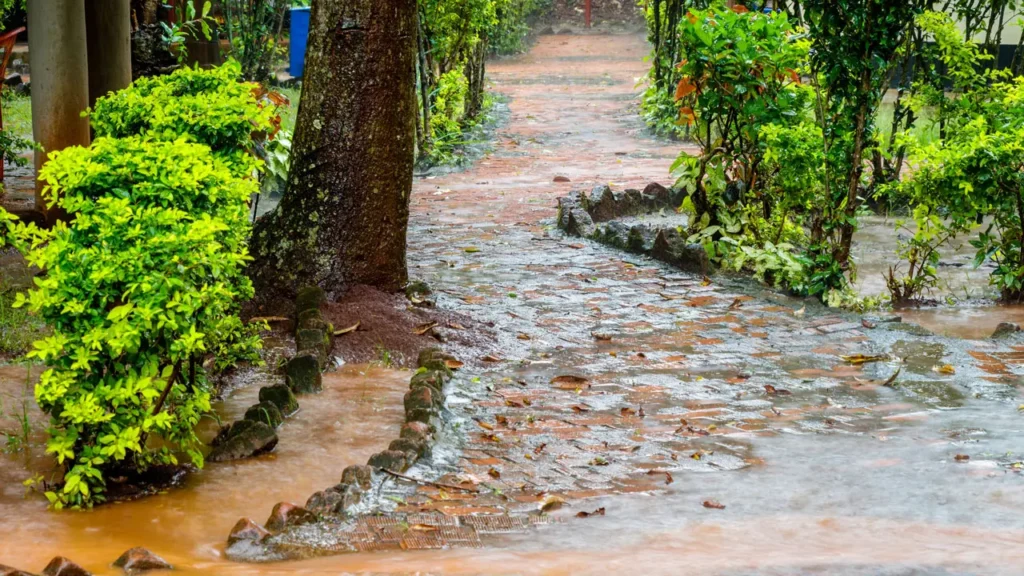
Flood Prediction
Machine learning is playing an increasingly important role in flood prediction across Pakistan. A 2025 study published in the Journal of Hydrology: Regional Studies developed a novel framework called the District-level Flood Risk Assessment Model (D-FRAM) .
Key findings from the flood risk research:
| Model | Performance |
|---|---|
| XGBoost | Highest accuracy (AUC = 0.95, accuracy = 0.89) |
| Random Forest | High accuracy and generalizability |
| Support Vector Machine (SVM) | Good performance for high-risk zone identification |
The study identified Sujjawal, Jacobabad, Kashmore, and Jaffarabad as the most flood-prone areas . Sindh province was classified as having the largest proportion of “very high” flood susceptibility land (50.3%), while Balochistan’s Sibi, Kech, and Mastung districts showed high vulnerability related to poor health facilities, education, and technology access . Nationally, flood risk peaks in August, coinciding with the monsoon season .
Drought Forecasting
Drought is one of the gravest climate-related hazards for Pakistan’s agro-dependent regions where socio-economic stability and food security are under threat from increasing hydro-climatic variability .
A study published in Environmental Research (June 2026) analyzed advanced drought risk forecasting models that integrate multi-scale Standardized Precipitation Indices (SPI), climatic zoning, and deep learning models .
Key findings on drought prediction:
| Model | Best Use |
|---|---|
| CNN-LSTM | Best for long-term drought prediction |
| BiLSTM | More efficient for short-term predictions |
| SPI-9 and SPI-12 | Best for modeling long-term drought trends |
The research found that intensity and duration of droughts are increasing at a high pace in semi-arid and coastal desert regions . Deep learning models significantly outperform traditional baseline methods, learning non-linear climatic dynamics and providing actionable lead-time drought risk management data .
The proposed prediction system supports anticipatory governance by informing crop planning, irrigation decisions, groundwater regulation, and drought-contingency planning .
POSTECH AI Study on Pakistan’s Flood-Drought Cycle

A study from Pohang University of Science and Technology (POSTECH) using AI forecasting revealed a disturbing pattern for Pakistan’s future :
The upper Indus River could experience major floods and severe droughts approximately every 15 years. Surrounding rivers could face the same extreme events even more frequently, roughly every 11 years .
This projection is a clear call to action, urging the Pakistani government to adopt tailored water management strategies for each river basin . Professor Jonghun Kam stated that this new AI technology will be crucial for producing reliable climate data not only for Pakistan but also for other climate-vulnerable and data-poor regions .
AI and the Smog Crisis
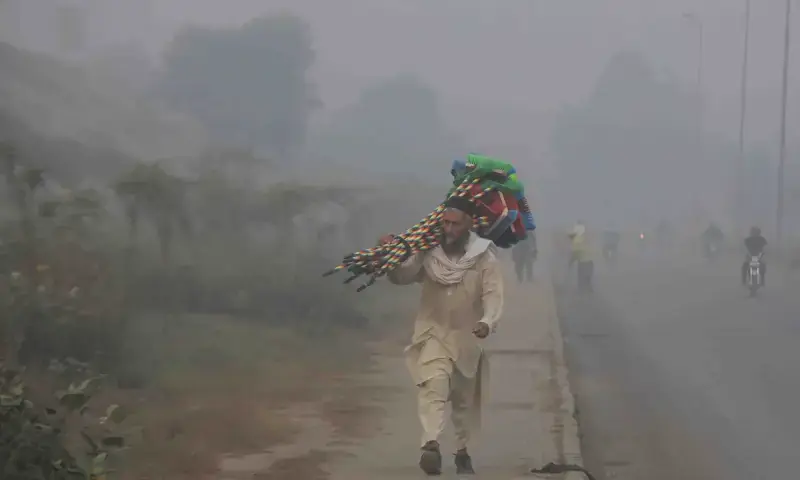
Pakistan’s smog crisis has become a defining environmental challenge, and AI is now at the center of the response.
AI-Powered Smog Monitoring System
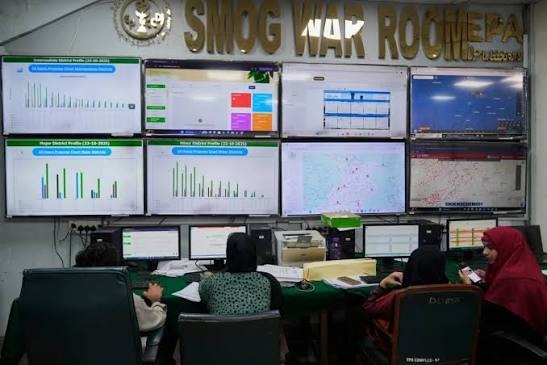
In Punjab, 100 AI-powered air-quality monitoring stations have been established across the province, feeding into a 24-hour “smog war room” . The system integrates satellite feeds, ground sensors, and international databases .
Key features of Punjab’s AI smog system:
According to Marriyum Aurangzeb, Punjab’s environment minister, the system has helped reduce stubble burning by 65% in a year, and 95% of factories in Punjab’s industrial belt now operate under emission-control systems .
AI in climate change is also helping Pakistan fight its growing smog crisis.
AI-Guided Anti-Smog Guns
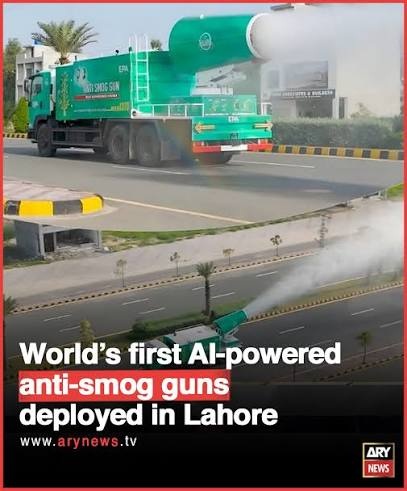
Another innovation is the deployment of AI-guided anti-smog guns across Lahore, programmed to activate automatically when particulate levels exceed safe limits . Early pilot tests showed a 70% improvement in air quality in Lahore’s Kahna area within hours of operation .
Liquid Tree with AI Monitoring

In June 2026, Punjab introduced Pakistan’s first EPA-certified “Liquid Tree” — a bio-artificial tree that absorbs carbon dioxide and releases oxygen . Over 100 species of microalgae were collected from across Pakistan, from Karachi to Khyber Pakhtunkhwa, and the most effective species was identified in Sukkur, Sindh .
The system is equipped with an AI-based monitoring system that provides real-time data on the amount of carbon dioxide being absorbed and the volume of oxygen being released . In the first phase, Liquid Trees will be installed at major shopping malls .
Limitations of Technology
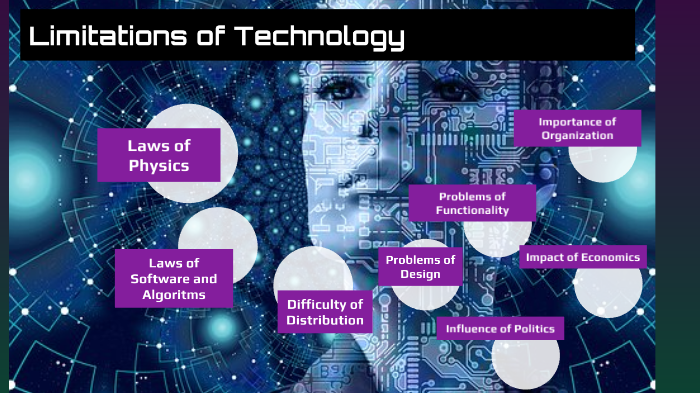
Despite these innovations, experts caution that technology alone cannot solve Pakistan’s deep-rooted pollution crisis . According to Imran Saqib Khalid, a climate governance expert:
“Air pollution is a complex issue but it has been addressed elsewhere in the world. It will take time and effort — there is no silver bullet solution. It cannot be done through surface-level measures such as smog guns and smog towers.”
Environmentalists acknowledge that the government’s approach shows more coordination than previous efforts but still lacks long-term impact . Real progress requires cleaner fuels, modern refineries, and a shift away from outdated industrial practices .
AI for Inclusive Disaster Alerts
A major step towards inclusive disaster preparedness was launched in April 2026 — an AI-driven sign language alert system to ensure that nearly 1.5 million people with disabling hearing loss receive timely emergency information .
Key features of the SUNO system:
The initiative was spearheaded by ConnectHear, with support from GSMA and Ufone . British High Commissioner Jane Marriott noted that the initiative demonstrates how inclusive and locally led AI-driven solutions could strengthen disaster preparedness and ensure equal access to life-saving information .
Research and Innovation in Pakistan

COMSATS and Disaster Risk Reduction
The Commission on Science and Technology for Sustainable Development in the South (COMSATS) has been actively involved in AI and climate change research. COMSATS has 25 Centres of Excellence, with 11 specializing in environmental expertise and 6 dedicated scientific institutes with expertise in AI, IoT, data analytics, and digital technology . These technologies have profound applications in climate change-related early warning and mitigation systems .
Machine Learning for Flood Prediction Research
Multiple research groups are working on flood prediction using machine learning. A 2025 study explored the application of machine learning techniques to enhance flood prediction accuracy for the years 2025 to 2030 . Four machine learning models were trained: Decision Tree, Random Forest, Linear Regression, and Support Vector Machine (SVM). Results showed that Random Forest and SVM outperform the other models in terms of both accuracy and generalizability .
Academic Research on Climate Modeling
Traditional climate models often struggle with complex terrains like Pakistan’s steep mountains and narrow valleys . Researchers trained AI models by comparing past river flow data with actual observations, dramatically improving the accuracy of predictions for extreme weather events .
Academic research on AI in climate change is expanding across Pakistani universities.
Challenges and the Way Forward
Key Challenges
The Path Forward
1. Strengthen Data Collection and Integration
The most immediate path to impact is improving data availability. Dr. Malik emphasized that AI could help address Pakistan’s challenges related to fragmented and limited data .
2. Expand Early Warning Systems
The China-Pakistan cooperation on early warning systems provides a scalable model . The MAZU system’s low-cost, modular design could be replicated across other regions .
3. Invest in Research and Development
Continued research on AI for drought forecasting , flood risk mapping , and climate modeling is essential.
4. Build Institutional Capacity
COMSATS highlighted the importance of strengthening capacity for disaster risk reduction and early warning systems .
5. Balance Technology with Policy
Experts emphasize that technology alone cannot solve Pakistan’s deep-rooted environmental problems. Systemic reforms, including cleaner fuels, modern refineries, and a shift from outdated industrial practices, are necessary .
6. Inclusive Disaster Preparedness
The AI-powered sign language alert system represents a model for inclusive disaster management that should be expanded .
Despite progress, AI in climate change faces challenges like data gaps and funding constraints.
FAQ
Q: What is Pakistan doing with AI for climate change?
A: Pakistan is using AI for early warning systems, flood and drought prediction, smog monitoring, and inclusive disaster alerts .
Q: How does China help Pakistan with AI and climate?
A: China has provided AI-powered early warning systems, meteorological equipment, and training to Pakistan through the China-Pakistan Joint Research Center on Earth Sciences .
Q: What AI tools are used for flood prediction in Pakistan?
A: Machine learning models including XGBoost (accuracy 0.95), Random Forest, and Support Vector Machines are used .
Q: Can AI predict droughts in Pakistan?
A: Yes. Deep learning models like CNN-LSTM and BiLSTM are being used to predict drought dynamics across different climatic regions .
Q: How is Pakistan using AI to fight smog?
A: Punjab has established 100 AI-powered air-quality monitoring stations, a 24/7 smog war room, AI-guided anti-smog guns, and an AI-powered Liquid Tree .
Q: What is the Liquid Tree introduced by Punjab?
A: A bio-artificial tree that uses algae to absorb carbon dioxide and release oxygen, equipped with an AI-based monitoring system .
Q: Is AI enough to solve Pakistan’s climate crisis?
A: No. Experts caution that technology alone cannot solve deep-rooted problems. Cleaner fuels, modern refineries, and systemic reforms are also needed .
Q: How is AI in climate change helping Pakistan?
A: AI in climate change helps predict floods, monitor smog, and issue early warnings.
Final Thoughts
Pakistan is building a comprehensive AI-powered defense against climate change. From early warning systems to smog monitoring and inclusive disaster alerts, AI is being integrated into every layer of climate governance.
What’s clear:
- AI is being used to predict disasters before they happen — and that’s saving lives
- AI is being used to prepare for disasters when they do happen — with early warnings reaching more people
- AI is being used to respond to disasters faster — with real-time monitoring and coordination
- AI is being used to protect vulnerable communities — with sign language alerts and accessible warnings
The National Artificial Intelligence Workshop in 2026 brought together policymakers and experts to chart this path forward . The result is a commitment to using AI as a watchdog that integrates multiple technologies and monitoring systems to enable early identification and intervention before damage occurs .
The question isn’t whether AI will help Pakistan face its climate crisis. It’s how effectively we can deploy it, how responsibly we can manage it, and how inclusively we can share its benefits.
The future of AI in climate change in Pakistan depends on how effectively we deploy these technologies.
Related Posts on Pixelaizone
- “AI Agents in 2026: The Ultimate Guide to How Autonomous Systems Are Changing Work”
- “AI in Pakistan Education 2026: A Complete Guide to the Future of Learning (Amazing Transformation)”
- Hostinger Review 2026: Why This is the Best Hosting for Small Businesses & Beginners
- The Future of Work in 2026: How AI Is Reshaping Jobs, Skills, and Careers
- 2026 AI Trends for Small Businesses: What’s Actually Working Right Now
- AI Side Hustles 2026: 7 Easy Ways to Earn Extra Income with Artificial Intelligence
- “AI Productivity Hacks 2026: 7 Ways to Work Smarter, Not Harder”
- “How to Build an AI-Powered Business in 2026 (No Coding Required) – The Ultimate Guide”
- “AI Agents vs AI Assistants: The Ultimate Guide to Understanding the Critical Difference in 2026”
- “AI Content Creation 2026: How to Write Blog Posts That Actually Rank (Proven Tips)”
- ChatGPT vs Gemini in 2026 (Powerful AI Comparison Guide)
- Top 10 Powerful Work From Home Jobs for Students in 2026
- How to Start a Blog and Make Money in 2026 (Ultimate Beginner Guide)
- Ultimate Guide: Best AI Tools for Content Creators in 2026
- Ultimate Guide: Best Web Hosting for Beginners in 2026
- Ultimate Guide: Best Freelancing Skills to Learn in 2026 for Beginners
- Free AI Tools For Students In 2026
What role do you think AI should play in climate action? Drop a comment below!