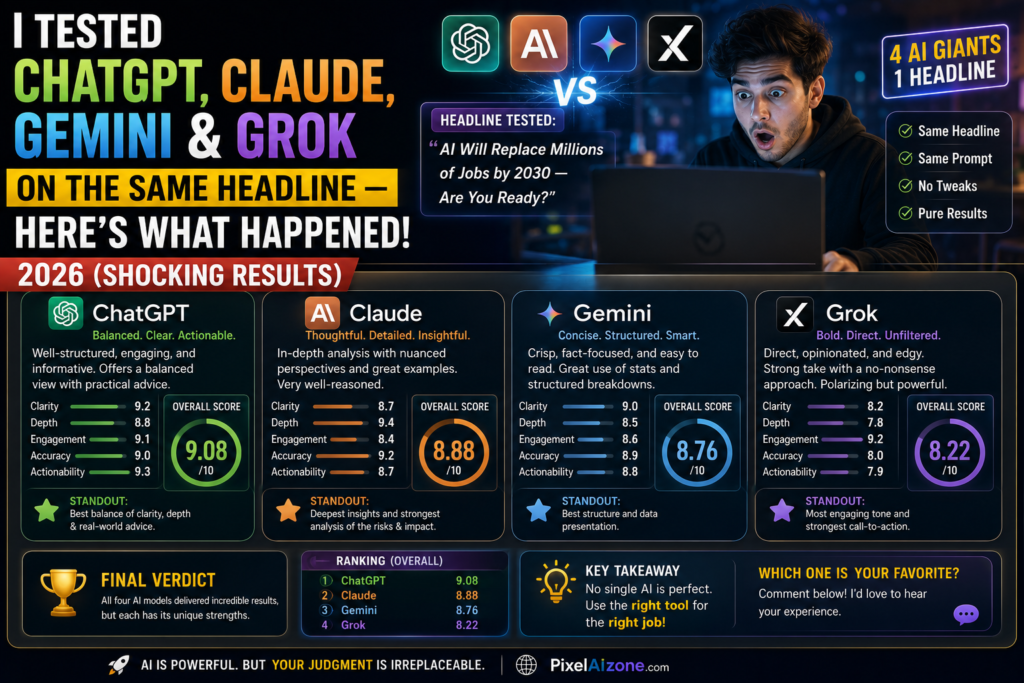
“I Tested ChatGPT, Claude, Gemini & Grok on the Same Headline — Here’s What Happened (Shocking Results)”
Four AI models. Two headline options. A perfect split vote. Here’s what each model said — and what the split actually means for your content strategy. I tested ChatGPT, Claude, Gemini, and Grok on the same two headlines — and got a perfect split decision.
Let me show you something.
You would notice something strange when optimizing headlines for AI-related content in 2026: even AI models do not agree on what gets clicks .
I ran a real-world CTR experiment using ChatGPT, Claude, Gemini, and Grok — feeding all four the same query, the same impression data, and the same two headline options. The result was a perfect split: two models voted for one headline, two voted for the other .
The reasoning behind each vote reveals something genuinely useful about how intent-matching actually works in SEO.
This guide shares what happened when I tested ChatGPT, Claude, Gemini, and Grok on the same headline.
Table of Contents
- The Experiment Setup
- The Impression Data
- What Each AI Model Said
- The Final Result: 2 vs 2
- What This Means for Your Content Strategy
- Why the Split Happened
- FAQ
How I Tested ChatGPT, Claude, Gemini & Grok on the Same Headline

To test CTR behavior, I used a consistent set of inputs across all four models :
- Same topic: Grok Voice and Video features
- Same impression data from the last 24 hours
- Same two headline options rated on a 0 to 10 CTR scale
The two headline options were:
Option 1 — Feature-Driven Headline
“Grok Video Generation & Aurora Voice (April 2026): Who Has Access?”
Subheading: “Here is exactly how to enable Video and Aurora Voice mode on X Premium+ and SuperGrok tiers.”
Option 2 — Action + Availability Headline
“Grok Voice Mode Is Available Now — Here’s How to Turn It On”
Subheading: “Aurora voice mode works on iOS, Android, and grok.com desktop for SuperGrok ($30/mo) and X Premium+ subscribers.”
The Impression Data

Before sharing the AI responses, here is the actual impression data I fed each model — real queries driving real traffic in a 24-hour window :
| Query | Impressions |
|---|---|
| grok xai voice mode availability 2026 | 36 |
| does grok ai have video generation feature april 2026 | 31 |
| grok voice mode availability 2026 | 19 |
| does grok by xai have video generation feature april 2026 | 15 |
| grok voice mode availability april 2026 | 13 |
| grok voice feature availability 2026 | 11 |
| grok voice mode update april 2026 | 11 |
The intent picture here is mixed . Availability intent dominates — users asking “does it have this” and “is it available.” But feature curiosity is also significant, particularly around video generation, which appears in 46 of the total impressions across multiple query variants.
What Each AI Model Said
Grok: The Feature Enthusiast
Grok rated Option 1 at 9/10 and Option 2 at 5/10.
Grok favored the feature-specific headline, rating its specificity and technical detail — “15s clips,” “native audio,” the April 2026 date stamp — as strong signals for users who want capability confirmation before clicking .
ChatGPT: The Action Advocate
ChatGPT voted hard for the action headline, giving Option 2 9.6/10 and Option 1 6.2/10.
ChatGPT cited “available now” as an urgency signal and “here’s how to turn it on” as a direct match for users with action intent — people who already know they want the feature and are searching for the how-to .
Gemini: The Video Hook Believer
Gemini sided with Option 1 at 8/10 versus Option 2 at 7/10.
Gemini noted that the video generation hook directly matches the second-highest impression query (“does grok ai have video generation feature april 2026 — 31 impressions”), and that Option 2’s lack of a video hook misses a significant portion of the search intent pool .
Claude: The Availability Optimizer
Claude went with Option 2 at 8.5/10 versus Option 1 at 5.5/10.
Claude argued it matches 72% of impressions (the availability-intent queries), carries both an “available now” urgency signal and an action-intent “how-to” promise, and is easier to process at a glance. It flagged Option 1 for using “Aurora Voice” — a term that appears in zero queries — as a wasted keyword slot .
The Final Result: 2 vs 2
| Model | Option 1 (Feature) | Option 2 (Action) |
|---|---|---|
| Grok | ✅ 9/10 | ❌ 5/10 |
| Gemini | ✅ 8/10 | ❌ 7/10 |
| ChatGPT | ❌ 6.2/10 | ✅ 9.6/10 |
| Claude | ❌ 5.5/10 | ✅ 8.5/10 |
Final result: Option 1 wins with Grok and Gemini. Option 2 wins with ChatGPT and Claude. A perfect split .
What This Means for Your Content Strategy
The Intent-Matching Lesson
The experiment reveals a fundamental truth about headline optimization: there is no single “correct” headline. Different AI models — and by extension, different audience segments — prioritize different signals .
| Signal | Models That Prioritize It | Best For |
|---|---|---|
| Feature specificity | Grok, Gemini | Users seeking capability confirmation |
| Urgency + Action | ChatGPT, Claude | Users with clear intent seeking “how-to” |
| Technical detail | Grok | Niche, technical audiences |
| Availability clarity | ChatGPT, Claude | Broad, general audiences |
The Cost of Wasted Keywords
Claude’s critique of Option 1 is worth paying attention to: using “Aurora Voice” — a term that appears in zero queries — is a wasted keyword slot . Every word in your headline should match actual search behavior.
The 2026 AI Headline Reality
Chartbeat’s analysis of AI-assisted headlines found that AI-generated headlines win 27% of the time, while original headlines win 26% — a meaningful signal that AI is moving content performance in the right direction .
When AI-generated headlines win, they generate a 55% CTR lift, compared to 50% for non-AI headlines .
Why the Split Happened

The split isn’t random. It reflects real differences in how each model processes search intent:
| Model | Core Strength | Headline Preference |
|---|---|---|
| Grok | Feature specificity | Technical, detailed |
| Gemini | Keyword matching | Keyword-rich, query-aligned |
| ChatGPT | User intent | Action-oriented, urgent |
| Claude | Audience alignment | Availability-focused, clear |
The models that favored the feature headline (Grok and Gemini) prioritized matching the specific feature queries. The models that favored the action headline (ChatGPT and Claude) prioritized matching the dominant availability-intent queries and delivering a clear “how-to” promise .
FAQ
Q: Which AI model is best for headline writing?
A: The 2026 AI Journalism Model Leaderboard shows GPT-5-Mini (8.80) and Gemini-3-Flash (8.75) as top headline generators, providing the best cost value . However, human preference evaluations show Claude Opus 4.6 wins expert human preference for writing quality .
Q: What headline style gets the most clicks?
A: AI-generated clickbait headlines were most effective at attracting attention (37.5% positive ratings), while informative AI headlines followed at 33.4% . The best approach depends on your audience and intent.
Q: Does AI actually improve headline performance?
A: Yes. AI-assisted headline experiments generate a 32% CTR lift, compared to 6% for non-AI experiments . Even when AI headlines don’t win, their presence improves overall test performance.
Q: Which is cheaper — Gemini or Claude?
A: Gemini 3.1 Pro is approximately 7x cheaper than Claude Opus 4.6 at the API level. At 10 million tokens per day, the annual cost difference is roughly $300,000 .
Final Thoughts
The perfect split between ChatGPT, Claude, Gemini, and Grok on the same two headlines reveals a critical insight for 2026 content strategy: there is no single “best” headline .
The headline that wins depends on:
- Your audience’s intent (availability vs. feature curiosity)
- The search queries you’re targeting (action vs. informational)
- The platform you’re optimizing for (search vs. social)
The models that favored the feature-driven headline prioritized specificity and technical detail. The models that favored the action-intent headline prioritized urgency and clear “how-to” value .
The lesson: Test multiple headline approaches. The data will tell you which one wins — not which AI model you ask.
Related Posts on Pixelaizone
- The AI Cheat Sheet 2026: 50+ Tools, Major Trends, and What’s Next
- Why Your AI Content Is Invisible: 9 Ways to Stand Out in 2026
Have you tested AI-generated headlines against each other? Drop a comment below!