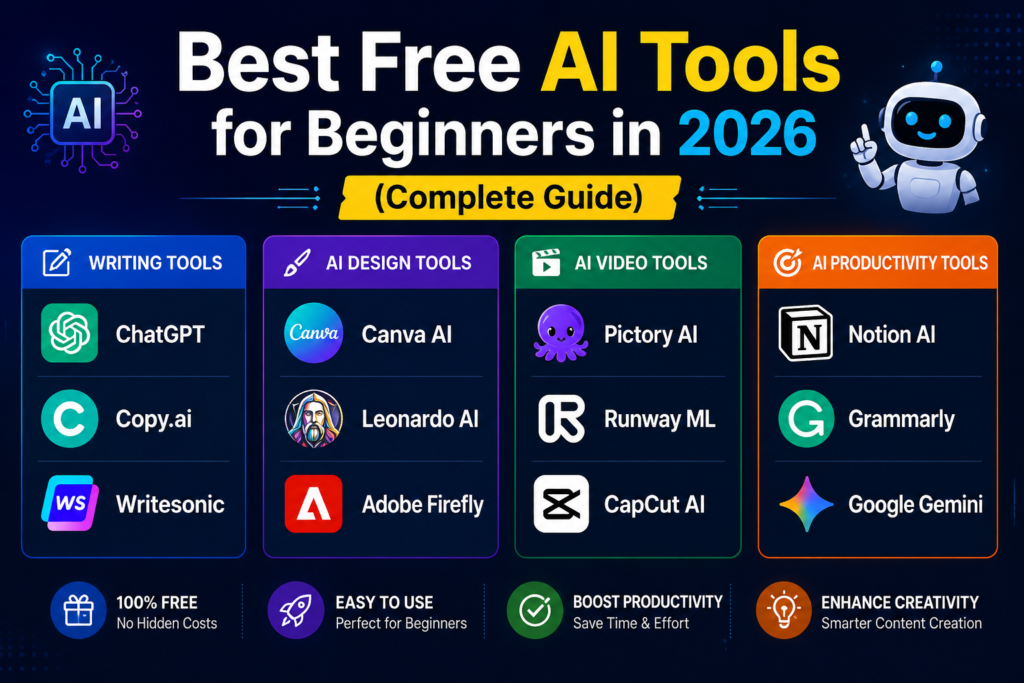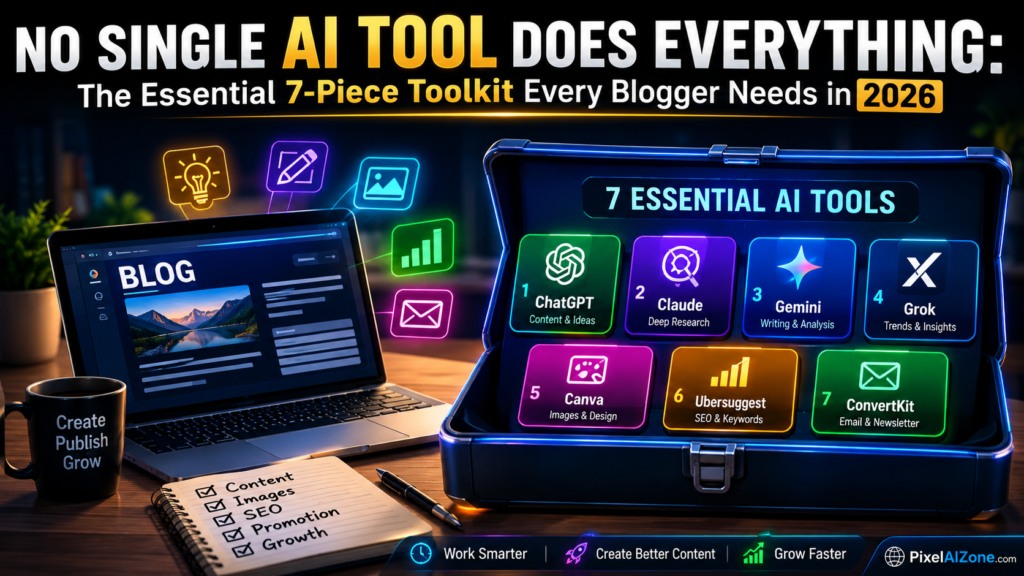
After testing dozens of AI tools across multiple platforms, one truth stands out: the most productive bloggers don’t rely on one tool — they build a workflow where each tool does what it does best. No single AI tool does everything well. That’s why every productive blogger needs a 7-piece toolkit.
Let me show you something.
The biggest mistake bloggers make is searching for a single “best AI tool.” After testing dozens of AI tools while building SmileAIReviewHub, I’ve found that no single tool does everything well . The best setup combines several AI tools, each with a specific role .
In 2026, the AI landscape has matured to the point where generalists and specialists have clearly defined roles. The combination of multiple tools is far more powerful than relying on one platform alone .
No single AI tool does everything well — that’s why the 7-piece toolkit exists. Here is the 7-piece toolkit every blogger needs in 2026.
This guide explains why no single AI tool does everything and shows you the 7-piece toolkit every blogger needs in 2026.
Table of Contents
- ChatGPT: The Brainstorming and Planning Engine
- Claude: The Long-Form Content Specialist
- Perplexity AI: The Research Assistant
- Canva AI: The Visual Content Creator
- Grammarly: The Final Polish
- Surfer SEO: The Optimization Layer
- Notion AI: The Organization Hub
- The 2026 Blogging Workflow: Putting It All Together
- FAQ
ChatGPT: Why No Single AI Tool Does Everything
Understanding why no single AI tool does everything starts with ChatGPT’s strengths and limits.
No single AI tool does everything, which is why ChatGPT is best for brainstorming and planning.
Best for: Brainstorming, outlining articles, improving readability, and solving complex writing problems.
ChatGPT remains my first choice for the early stages of content creation. It’s the Swiss Army knife of AI tools — versatile enough to handle almost any task, even if it’s not the absolute best at any single one .
What it does well:
- Article planning and outlining
- Research assistance
- Editing and SEO-friendly rewriting
- Generating multiple headline options
How to use it in your workflow:
I use ChatGPT to turn raw ideas into structured outlines. Instead of staring at a blank page, I start by asking ChatGPT for 5-10 headline options, then pick the best one and build an outline around it.
The limitation: ChatGPT is a generalist. It’s great for getting started, but it isn’t the strongest tool for long-form writing where natural tone and context retention matter more.
Claude: The Long-Form Content Specialist
Claude proves why no single AI tool does everything — it specializes in long-form writing.
Best for: Long-form writing, maintaining a natural tone, and handling very large documents.
Where ChatGPT is a generalist, Claude is a specialist. It excels at long-form writing and maintaining a natural tone that doesn’t sound like AI-generated text . It also handles very large documents better than many alternatives .
What it does well:
- In-depth blog posts
- Documentation and content refinement
- Maintaining consistent tone across long pieces
- Processing large documents
How to use it in your workflow:
Once I have an outline from ChatGPT, I move to Claude for the actual writing. Claude’s ability to hold context across long pieces makes it ideal for 1,500-2,500 word articles. The writing tends to be more natural, with rhythm and flow that requires less editing.
The limitation: Claude is a pure writer. It doesn’t have the same breadth of features as ChatGPT, but it doesn’t need to — it does one thing exceptionally well.
Perplexity AI: The Research Assistant
Perplexity is another reason why no single AI tool does everything — it’s for research.

No single AI tool does everything, so Perplexity handles research while other tools handle writing.
Best for: Fact-checking, gathering recent information, and finding cited sources.
Instead of opening multiple Google tabs, I often use Perplexity to gather recent information with cited sources . It’s a research-first tool that provides direct answers backed by real sources.
What it does well:
- Fact-checking claims
- Finding recent references
- Gathering cited information
- Research with source transparency
How to use it in your workflow:
During the research phase, I use Perplexity to find current data, statistics, and references. The citations make it easy to verify claims and build a reference list for the article.
The limitation: Perplexity is for research, not writing. It’s a separate tool in the workflow, not a replacement for ChatGPT or Claude.
Canva AI: The Visual Content Creator
Canva AI shows why no single AI tool does everything — it handles visuals, not writing.

No single AI tool does everything, so Canva AI handles visuals while other tools handle writing and research.
Best for: Creating blog graphics, featured images, infographics, and social media visuals.
Creating blog graphics and social media images has become much faster with Canva’s AI features . You don’t need to be a designer to create professional-looking images.
What it does well:
- Featured images
- Infographics and data visualizations
- Social media visuals
- Templates for blog banners
How to use it in your workflow:
Once the article is written, I generate a featured image and social media graphics using Canva AI. The drag-and-drop interface and templates make it accessible even for non-designers.
The limitation: Canva AI is for visuals, not writing. It’s a complementary tool in the overall workflow.
Grammarly: The Final Polish
Grammarly demonstrates why no single AI tool does everything — it’s for polishing, not creating.
No single AI tool does everything, which is why Grammarly is essential for polishing content created by other tools.
Best for: Proofreading, grammar checking, and clarity refinement.
Even with AI-generated content, grammar and clarity still matter. Grammarly helps polish the final draft . Nothing screams “amateur” like a blog post full of spelling mistakes and bad commas .
What it does well:
How to use it in your workflow:
After the content is generated and structured, I run it through Grammarly as a final check. The free version catches 90% of critical errors, which is enough for a blog post .
The limitation: The free version is sufficient for most bloggers — the paid “Premium” version is rarely necessary .
Surfer SEO: The Optimization Layer
Surfer SEO is another example of why no single AI tool does everything — it’s for optimization.

Best for: SEO-focused content optimization, keyword research, and on-page analysis.
Surfer SEO is one of the strongest tools for SEO-focused content, with keyword research, optimization tools, and an AI content editor to help rank higher on Google .
What it does well:
- On-page SEO optimization
- Keyword research
- Content structure recommendations
- Competitor analysis
How to use it in your workflow:
Before publishing, I run the article through Surfer SEO to identify keywords I’ve missed, check heading structure, and ensure the content is optimized for search engines.
The limitation: Surfer SEO is a specialist tool for SEO. It doesn’t write content — it helps you optimize what you’ve already written.
Notion AI: The Organization Hub
Notion AI completes the picture of why no single AI tool does everything — it’s for organization.

Best for: Organizing ideas, managing content calendars, and tracking research notes.
Notion AI is perfect for organizing ideas, content calendars, and research notes . It’s the glue that holds the workflow together.
What it does well:
- Content calendar management
- Research note organization
- Idea tracking and categorization
- Team collaboration
How to use it in your workflow:
I use Notion to track article ideas, store research notes, and manage the editorial calendar. It provides a single source of truth for the entire content operation.
The limitation: Notion is for organization, not writing. It doesn’t replace any of the writing tools — it coordinates them.
The 2026 Blogging Workflow: Putting It All Together
The most productive bloggers build an AI workflow where each tool does what it does best. The combination is far more powerful than relying on one platform alone .
Here’s the workflow that works for me:
| Stage | Tool | What It Does |
|---|---|---|
| 1. Research | Perplexity | Gather cited information |
| 2. Brainstorming | ChatGPT | Create outline and headline options |
| 3. Writing | Claude | Expand and refine into polished content |
| 4. Visuals | Canva AI | Generate featured image and graphics |
| 5. Optimization | Surfer SEO | On-page SEO and keyword analysis |
| 6. Proofreading | Grammarly | Final polish and grammar check |
| 7. Organization | Notion AI | Content calendar and research tracking |
This workflow isn’t about using more tools — it’s about using the right tools at the right time. Each tool has a specific role, and no single tool does everything well .
FAQ
Q: Do I need to pay for all seven tools?
A: No. ChatGPT has a free tier, Claude has a free tier, Perplexity has a free tier, Canva has a free tier, Grammarly has a free tier, Notion has a free tier, and Surfer SEO has a free trial. You can build this entire workflow without spending anything.
Q: Can I replace some of these tools with all-in-one platforms?
A: Yes, but the quality will vary. No single tool does everything well . The reason the toolkit approach works is that each tool is optimized for a specific task.
Q: Which is the most important tool?
A: It depends on the task. ChatGPT is best for brainstorming and planning. Claude is best for long-form writing. Perplexity is best for research. The combination is what makes the toolkit effective .
Q: Can I use this workflow for short-form content?
A: Yes. The same workflow works for shorter pieces. You can skip steps that aren’t needed for shorter content.
Q: What if I’m on a tight budget?
A: Start with the free tiers of ChatGPT, Perplexity, Claude, Canva, and Grammarly. This covers the core workflow of research, writing, visuals, and proofreading without spending anything.
Q: Is it true that no single AI tool does everything?
A: Yes, each tool has a specific role.
Final Thoughts
The biggest mistake bloggers make is searching for a single “best AI tool.” In reality, the most productive bloggers build an AI workflow where each tool does what it does best .
The 2026 toolkit approach:
- Research with Perplexity
- Brainstorm with ChatGPT
- Write with Claude
- Design with Canva AI
- Optimize with Surfer SEO
- Proofread with Grammarly
- Organize with Notion AI
No single AI tool does everything, but the right combination of seven tools creates a powerful workflow. The combination is far more powerful than relying on one platform alone . And the workflow continues to evolve as new models are released . No single AI tool does everything — the toolkit approach is the most productive strategy.
Related Posts on Pixelaizone
- The AI Cheat Sheet 2026: 50+ Tools, Major Trends, and What’s Next
- Why Your AI Content Is Invisible: 9 Ways to Stand Out in 2026
What’s your preferred AI toolkit for blogging? Drop a comment below!