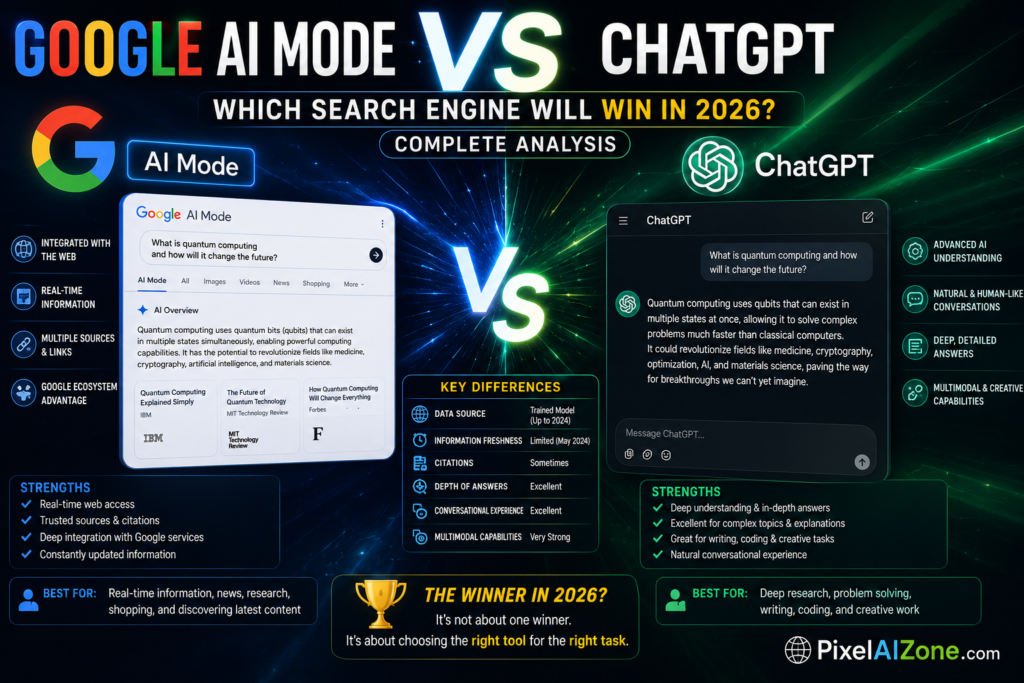
Two AI search giants are battling for the future of how we find information. Here’s what the data reveals about which one is pulling ahead — and why it matters for you.
Let me show you something.
In 2026, the search landscape has fundamentally changed. People no longer just type keywords into a search box — they’re asking questions, uploading images, and expecting conversational answers. Two platforms are leading this shift: Google’s AI Mode and OpenAI’s ChatGPT.
But here’s the thing: Google AI Mode vs ChatGPT is not a straightforward comparison. They operate differently, they have different strengths, and they’re being used for different purposes.
According to Previsible’s 2026 State of AI Discovery Report, which analyzed 6.77 million AI-driven sessions across 166 websites, the battle is unfolding across two distinct surfaces. Google’s AI Mode and AI Overviews represent more AI-influenced traffic than every standalone LLM combined .
The debate of Google AI Mode vs ChatGPT is reshaping how we think about search in 2026.
Google AI Mode vs ChatGPT is one of the most important technology battles of 2026.
Table of Contents
- The Lay of the Land: Two Different Approaches
- Traffic and Reach: The Numbers Game
- Citation Sources: Where Each Engine Gets Its Information
- Advertising: The Monetization Question
- Task Execution: From Answering Questions to Getting Things Done
- Which Engine Should You Optimize For?
- FAQ
The Lay of the Land: Two Different Approaches
Understanding Google AI Mode vs ChatGPT starts with knowing their different approaches.
The comparison between Google AI Mode vs ChatGPT reveals two fundamentally different strategies.
Google’s Approach: AI as a Search Enhancement
Google is embedding AI into its existing search infrastructure. AI Mode, which launched in early 2025, is a conversational search experience that sits alongside traditional search results . Google’s AI Overviews now have over 25 billion monthly active users, and AI Mode has surpassed 10 billion monthly active users .
Google’s strategy is clear: use AI to make search more powerful, not replace it. The company is leveraging its dominance in search, with Search, Gmail, Android, Chrome, and YouTube each having over 3 billion users .
OpenAI’s Approach: AI as a Standalone Destination
ChatGPT, by contrast, is a standalone AI assistant. Users go to ChatGPT specifically for AI-powered answers. According to Previsible’s study, ChatGPT carries 92.4% of trackable standalone referral traffic among AI platforms . Gemini has grown 3.2x and Claude has grown 64x, but ChatGPT remains the dominant standalone player .
Traffic and Reach: The Numbers Game
The numbers reveal a lot about Google AI Mode vs ChatGPT and which platform is winning.
In the debate of Google AI Mode vs ChatGPT, the numbers tell an interesting story.
| Platform | Scale | Monthly Users |
|---|---|---|
| Google AI Overviews | Already integrated into Search | 2.5 billion+ |
| Google AI Mode | New conversational search experience | 1 billion+ |
| ChatGPT | Standalone AI assistant | ~1 billion |
| Gemini App | Google’s standalone AI app | 900 million |
Google’s AI Overviews reach 25 billion+ monthly active users by being embedded directly into standard Google Search results . However, when it comes to standalone platforms, ChatGPT leads with 92.4% of referral traffic, while Gemini is the second most visible model .
Google Remains the Center of AI Discovery
According to Previsible’s report, AI discovery happening inside Google (through AI Overviews and AI Mode) represents more AI-influenced traffic than every LLM assistant combined . This means that if you want to be visible in AI-powered search, optimizing for Google’s AI surfaces is currently more impactful than optimizing for standalone LLMs.
However, ChatGPT leads standalone LLMs by a significant margin. The smart strategy, according to Previsible’s CPO David Bell, is to “start by becoming a source Google’s AI results want to cite, then win ChatGPT as the leading standalone surface” .
Citation Sources: Where Each Engine Gets Its Information
Citation sources show a major difference between Google AI Mode vs ChatGPT.

The citation overlap between Google AI Mode vs ChatGPT is remarkably low.
Here’s where the Google AI Mode vs ChatGPT comparison gets really interesting. Research reveals that different AI engines draw from almost completely different sources when answering the same questions.
Citation Overlap Is Remarkably Low
A study by Yotpo found that less than 7% of cited sources overlap between ChatGPT and either Google AI Mode or Gemini . This means a brand visible on one engine can be nearly invisible on the others.
| Engine Comparison | Citation Overlap |
|---|---|
| ChatGPT vs Gemini | ~6.7% |
| ChatGPT vs Google AI Mode | ~6.3% |
| Gemini vs Google AI Mode | ~12.6% |
When a shopper asks the same question on ChatGPT versus Google AI Mode, they are getting answers drawn from almost entirely different websites. Each engine is running its own editorial process, deciding independently which sources to cite .
How SEO Translates to AI Citations
Another study by CiteLens, which analyzed 320 queries across four AI engines, found that Google’s AI Mode drew 93% of its citations from Google’s top-10 organic results, and Perplexity drew 89% . For these engines, classic SEO is the entry ticket.
ChatGPT, however, told a completely different story. Only 30% of ChatGPT’s citations came from Google’s top-10. In fact, 70% of the sources ChatGPT recommended ranked in neither Google’s nor Bing’s top-10 . ChatGPT is operating on a completely independent signal.
This means that Google AI Mode is more predictable if you have strong SEO, while ChatGPT is more mysterious — it follows its own retrieval logic .
Advertising: The Monetization Question
Advertising strategies highlight another key difference in Google AI Mode vs ChatGPT.

The advertising landscape for Google AI Mode vs ChatGPT is where the differences are most stark.
Google AI Mode: Traditional Ad Carousels
Google continues to serve ads in its AI Mode results. Across an analysis of nearly 850,000 AI search queries, Google’s AI averaged 3.53 ad items per ad-bearing answer . It behaves much like a carousel, with room for several brands in the same response.
ChatGPT: Single Ads and Strict Policies
ChatGPT averages only 1.06 ad items per ad-bearing answer, typically showing just one sponsored slot in the large majority of cases . There is no row of three and no shopping carousel.
More significantly, regulated verticals are blocked on ChatGPT but not on Google AI Mode. ChatGPT serves zero ads in Legal, Pharma, Banking, and Nonprofit categories. Google’s AI, by contrast, served ads in those same US verticals, with Legal running at 5.62% .
Ad Volume by Category
According to Adthena’s analysis, the hottest categories for ChatGPT ads are:
| Category | Ad Frequency |
|---|---|
| Logistics | 12.41% |
| Home & Garden | 11.99% |
| Beauty & Cosmetics | 10.03% |
Retail & Fashion is the commercial center of gravity, accounting for 39% of all US ad items .
Task Execution: From Answering Questions to Getting Things Done
Task execution capabilities show how Google AI Mode vs ChatGPT are competing for user attention.
The battle of Google AI Mode vs ChatGPT extends beyond answers to action. Both platforms are now helping users complete tasks.
Google AI Mode: App Integrations
In July 2026, Google announced that AI Mode now lets users link and interact with apps including Instacart, Canva, and YouTube Music .
Examples include:
- Creating a grocery list and adding ingredients directly to your Instacart cart
- Designing flyers with Canva templates
- Curating playlists and saving them to YouTube Music
Google is expanding AI Mode beyond answering questions and into completing tasks across the apps people use regularly . The company is working with a range of partners to launch more app integrations soon.
ChatGPT: Search and Organization
In July 2026, ChatGPT also rolled out a major search upgrade, allowing users to find old chats, projects, documents, and images all from one place . Available across web, iOS, and Android, this search capability covers every ChatGPT plan, including free accounts .
Additionally, OpenAI increased the custom instructions character limit for paying users from 1,500 to 5,000 characters .
Which Engine Should You Optimize For?
The smart strategy in Google AI Mode vs ChatGPT is to optimize for both platforms.
The answer depends on your goals and audience.
Optimize for Google AI Mode If:
- You already have strong SEO. Google AI Mode draws 93% of its citations from Google’s top-10 organic results .
- You want scale. Google AI Overviews reach 2.5 billion+ monthly active users, and AI Mode is growing fast .
- You’re in regulated sectors. Google serves ads in Legal, Pharma, Banking, and Nonprofit categories .
Optimize for ChatGPT If:
- You want standalone visibility. ChatGPT carries 92.4% of trackable standalone referral traffic .
- You need brand presence across different ecosystems. ChatGPT operates on a completely independent signal from Google .
- You’re in Logistics, Home & Garden, or Beauty. These are the hottest ad categories on ChatGPT .
The Smart Strategy:
The best approach in the Google AI Mode vs ChatGPT battle is not to choose one. According to Previsible’s research, “start by becoming a source Google’s AI results want to cite, then win ChatGPT as the leading standalone surface” .
You need to treat each engine as its own channel . That means tracking citation presence across all three major engines (ChatGPT, Gemini, and Google AI Mode) independently, understanding where the gaps are, and building content that earns its place on every surface .
FAQ
Q: Which is bigger: Google AI Mode or ChatGPT?
A: Google AI Mode has over 1 billion monthly active users, but it’s part of Google Search. ChatGPT has roughly 1 billion monthly active users as a standalone product. Google’s AI Overviews, which are in standard search results, have 25 billion+ monthly active users .
Q: Does SEO help with ChatGPT visibility?
A: Not directly. ChatGPT draws only 30% of its citations from Google’s top-10 results. Most sources are not found through Google or Bing rankings .
Q: Which engine is better for advertising?
A: Google AI Mode offers more ad slots (carousel format) and serves regulated verticals. ChatGPT shows single ads and blocks legal, pharma, and banking categories .
Q: Can I be visible on both engines?
A: Yes, but it requires separate strategies. Google AI Mode responds to traditional SEO. ChatGPT requires different approaches to earn citations .
Q: Which engine will win in 2026?
A: Both are thriving in different ways. Google wins on scale and integration with existing user habits. ChatGPT wins on standalone mindshare and referral traffic. The future likely involves both serving different purposes .
Q: Which is better — Google AI Mode vs ChatGPT?
A: Both serve different purposes.
Final Thoughts
The battle of Google AI Mode vs ChatGPT is not a zero-sum game. Both are growing, both are innovating, and both are serving different needs.
Google AI Mode is bringing AI to the world’s largest search engine, making it easier for billions of users to get answers without changing their habits. ChatGPT is building a new kind of destination where AI is the primary experience.
The data is clear: Google’s AI surfaces represent more AI-influenced traffic than every LLM combined, while ChatGPT leads standalone platforms with 92.4% of referral traffic .
The winner? Users who get better answers. And businesses that optimize for both.
The battle of Google AI Mode vs ChatGPT is not a zero-sum game — both are thriving.
Google AI Mode vs ChatGPT is a battle that benefits users and businesses alike.
Related Posts on Pixelaizone
- AI in 2026: The Year Everything Changed Ultimate Guide (Revolutionary Insights)
- Why 39% of Americans Would Stop AI Development If They Could
- “2026 AI Writing Tools Comparison: Which One Actually Deserves Your Money? (Honest Comparison)”
- “Global AI Adoption Rankings 2026: The Ultimate Guide to Which Country Is Winning the AI Race”
- “Agentic AI Is Transforming Pakistan’s SMEs: 7 Powerful Ways to Stay Ahead”
- “Alibaba’s Accio Work in Pakistan 2026: The Ultimate AI Export Revolution for SMEs”
- “ChatGPT Hits 1 Billion Users: What Comes Next for the AI Giant? (Revolutionary Milestone)”
- The ‘Cheating Fruit’ AI Trend: Why 10 Million People Are Watching Strawberries Cheat
- “AI Agents Are Changing How the World Shops 2026 — Here’s How (Revolutionary Shift)”
- “1 in 4 People Now Use AI Every Day — Here’s What They’re Actually Doing (Shocking Insights)”
- “AI Has Crossed the Behavioural Threshold in 2026: Essential Guide to the Shocking Shift from Experimentation to Dependence”
- “The AI Trust Paradox 2026 Revealed : Why 74% of People Use AI Daily But Don’t Trust It (Powerful Insights)”
Which AI search engine do you use more often? Drop a comment below!