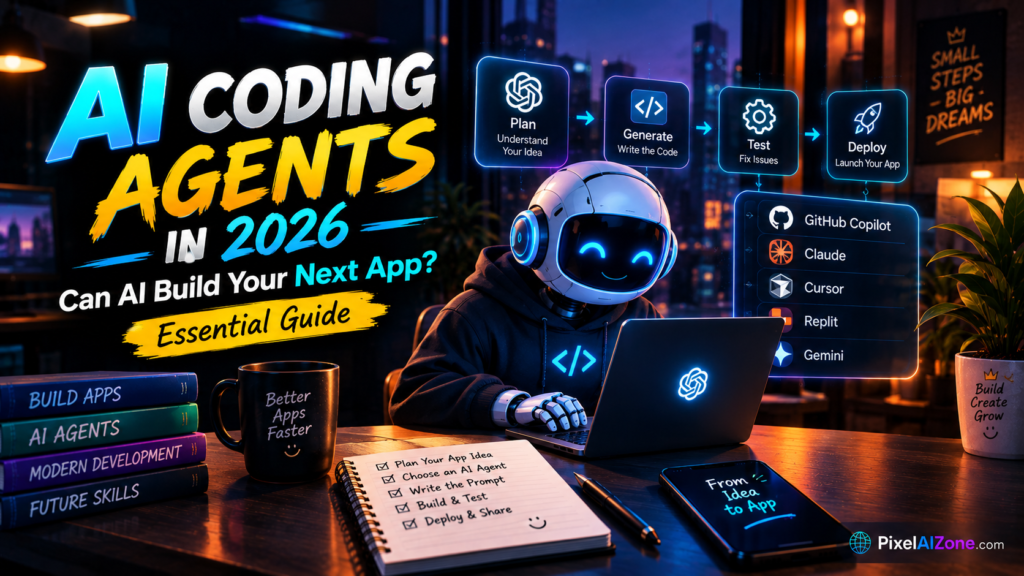
The promise of “describe your app, get working software” is closer than ever — but the reality is more nuanced. Here’s what AI coding agents can and cannot do in 2026.
Let me show you something.
In January 2026, Anthropic CEO Dario Amodei predicted the world might be only six to 12 months away from AI models capable of performing all software engineering tasks end-to-end . Shortly after, Boris Cherny, head of Claude Code at Anthropic, admitted that 100% of his own code is now AI-generated .
AI coding agents have arrived. Tools like Claude Code, Cursor, and GitHub Copilot can now take a high-level instruction and execute a sequence of development tasks on their own — reading a codebase, writing code, installing dependencies, running tests, and opening a pull request .
But can AI actually build your next app? The answer is: yes, with caveats.
Table of Contents
- What Are AI Coding Agents?
- The Reality Check: What the Data Shows
- What AI Coding Agents Do Well
- Where AI Coding Agents Struggle
- The Best AI Coding Agents in 2026
- How to Use AI Coding Agents Effectively
- FAQ
What Are AI Coding Agents?

AI coding agents are systems that take a high-level instruction and execute a sequence of development tasks autonomously . Unlike inline AI autocomplete that suggests one line at a time, agents follow an agentic loop: they gather context, take action, verify the result, and repeat until the task is complete .
Key characteristics:
- Reads and understands your codebase
- Writes and edits code across multiple files
- Installs dependencies and runs tests
- Opens pull requests
- Iterates until the task is done
According to Stack Overflow’s 2025 Developer Survey, 84% of developers are already using or plan to use AI in their processes, with 50.6% of professional developers reporting daily use .
The Reality Check: What the Data Shows
The data on AI coding agents in 2026 reveals a more nuanced picture than the hype suggests.
What Works
A production study of app.build, a framework for prompt-to-app generation, deployed in production and generated 3,000+ user applications during four months of operation. With structured validators and code execution isolation, the framework achieved a 73.3% viability rate for end-to-end app-building tasks .
A task-stratified analysis of 7,156 pull requests from five AI coding agents found that task type is a dominant factor in acceptance rates, with a 29-point gap between task types. OpenAI Codex achieves consistently high acceptance rates ranging from 59.6% to 88.6% across nine task categories .
What Doesn’t Work (Yet)
A benchmark called NL2Repo-Bench evaluated long-horizon repository generation. The results: current coding agents still lack the robustness, long-horizon planning ability, and cross-file consistency required to generate a complete repository from scratch. Even the best-performing systems struggle to construct end-to-end runnable software purely from natural-language specifications .
The gap is real. AI coding agents are powerful tools, but they’re not yet autonomous software engineers.
What AI Coding Agents Do Well

Based on the data, here’s where AI coding agents excel:
| Task Type | Best Agent | Acceptance Rate |
|---|---|---|
| Documentation | Claude Code | 92.3% |
| Features | Claude Code | 72.6% |
| Bug fixes | Cursor | 80.4% |
| Testing | OpenAI Codex | 59.6%–88.6% |
| Small utilities | Replit Agent | High viability |
What this means: AI coding agents are excellent for incremental work — adding features, fixing bugs, writing documentation, and building small utilities. They’re less reliable for large-scale, from-scratch projects.
Where AI Coding Agents Struggle

The research reveals consistent failure patterns:
1. Fragmented Business Logic
According to Gartner’s peer community analysis, AI coding agents “struggle more when critical logic is fragmented across systems, embedded in undocumented operational behavior, or heavily dependent on tribal knowledge” .
The signal: If your project has critical business logic spread out all over the place and not centralized, generative AI will not be able to make sufficient sense of that .
2. Heavy Tribal Knowledge
“Codebases where understanding depends on stuff that was never written down” are a bad fit. “Agents only see what you give them. If senior engineers carry a lot in their heads, agents work around it badly” .
3. Large-Scale Repository Generation
The NL2Repo-Bench results show that “as task difficulty increases, the performance of nearly all models declines substantially” . Performance degrades significantly on harder tasks requiring long-horizon reasoning and multi-module coordination.
4. Production Reliability
The app.build study notes that “production reliability and code generation reproducibility remain the blocking issues. Ongoing improvements of foundational models alone do not reliably translate into deployable software” .
The Best AI Coding Agents in 2026
Here’s a comparison of the leading AI coding agents:
Key insight from the research: “No single agent performs best across all task types” . The best strategy is often to use multiple agents for different workflows.
How to Use AI Coding Agents Effectively

Based on the research and real-world deployments, here’s how to get the most from AI coding agents:
1. Build Context Infrastructure
“Agents only see what you give them.” If your codebase has undocumented knowledge, agents will work around it badly . Invest in documentation and centralized logic.
2. Use Structured Planning
The Feature-Driven Human-In-The-Loop (FD-HITL) framework shows that “ad hoc prompting approach is not appropriate for large-scale project generation.” Instead, decompose projects into independently testable features and use incremental, iterative development .
3. Expect to Iterate
Documented productions averaged 3 generations per usable shot . Overgeneration is the plan, not a failure.
4. Keep Humans in the Loop
The research is clear: “Expertise has always been marked by a deep knowledge of software qualities” . Engineers are uniquely positioned to bring discipline to projects by anticipating where errors can be introduced and guiding the AI back toward intended solutions .
5. Start with Bounded Tasks
Don’t try to generate an entire app from scratch. Start with bounded tasks — adding a feature, fixing a bug, writing documentation — and expand as you build trust in the agent’s reliability.
FAQ
Q: Can AI coding agents build a complete app from scratch?
A: Not reliably. The NL2Repo-Bench results show that even the best-performing systems struggle to construct end-to-end runnable software purely from natural-language specifications . AI coding agents work best for incremental tasks.
Q: What tasks do AI coding agents handle best?
A: Documentation (92.3% acceptance), features (72.6%), and bug fixes (80.4%) . Small utilities and prototypes also work well .
Q: What are the biggest failure modes?
A: Fragmented business logic, heavy tribal knowledge, large-scale repository generation, and production reliability .
Q: Which AI coding agent is best?
A: “No single agent performs best across all task types” . Claude Code leads in documentation and features, Cursor in bug fixes, and OpenAI Codex in testing. Using multiple agents is a common strategy.
Q: Is vibe coding safe for production software?
A: Experienced developers strategically control agent behavior rather than “vibing.” They do not let agents drive software design or implementation, especially for production software .
Final Thoughts
The question “can AI build your next app?” has a nuanced answer in 2026. AI coding agents are powerful tools that can handle incremental tasks with impressive reliability. They can write documentation, add features, and fix bugs at rates that rival human developers.
But they’re not yet autonomous software engineers. They struggle with fragmented logic, tribal knowledge, and large-scale repository generation. The AI coding agents that work best are used with human oversight, structured planning, and realistic expectations.
What you’ve learned:
- AI coding agents follow an agentic loop of planning, acting, and verifying
- Production deployments achieve 73.3% viability for prompt-to-app generation
- Task type is the dominant factor in agent success rates
- Fragmented logic and tribal knowledge are the biggest failure modes
- The best strategy uses multiple agents for different workflows
Your next step:
- Start with a bounded task (add a feature, fix a bug)
- Choose the right agent for that task type
- Build context infrastructure (documentation, centralized logic)
- Expect to iterate and review output
- Keep humans in the loop for critical decisions
The AI coding agents are ready. The question is whether your workflow is.
Related Posts on Pixelaizone
- [Best AI Tools for Bloggers in 2026: Write, Research and Rank Faster]
- [How to Create Cinematic AI Videos Without Professional Editing Skills]
Have you tried AI coding agents yet? Drop a comment below!