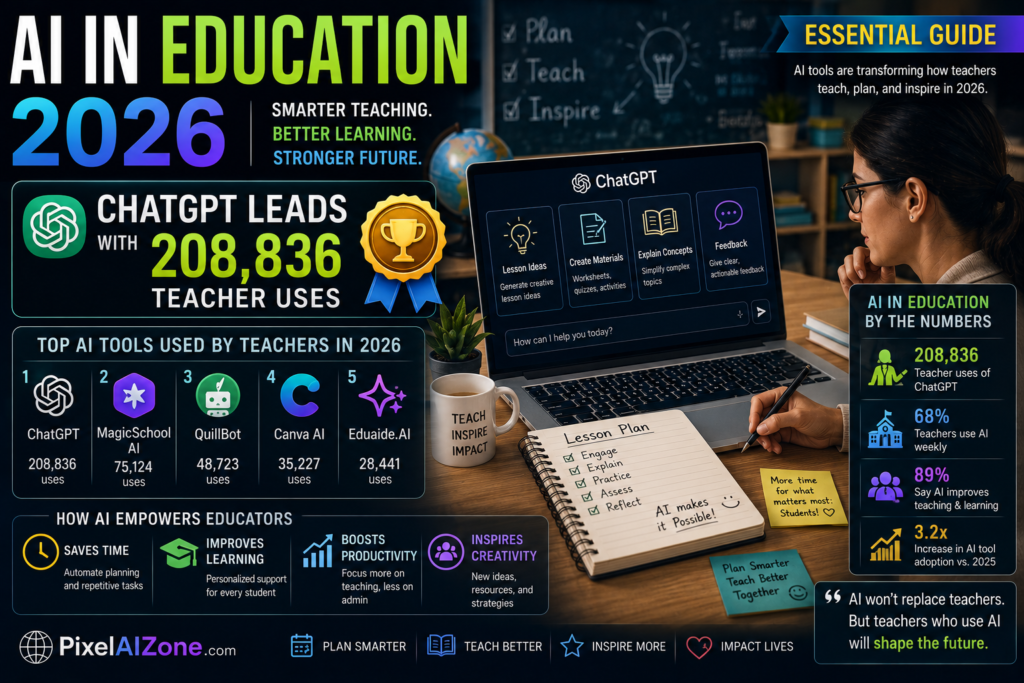
From lesson planning to personalized instruction, teachers are embracing AI tools at unprecedented rates — and ChatGPT is leading the way. AI in education is transforming classrooms, with ChatGPT leading at 208,836 teacher uses in 2026.
Let me show you something.
According to official data from Malaysia’s Ministry of Education, ChatGPT has emerged as the most widely used AI tool among teachers, with 208,836 recorded uses as of June 30, 2026 . Google Gemini follows with 175,765 uses, and NotebookLM with 130,099 uses .
This isn’t just a Malaysian phenomenon. According to a 2025 Gallup-Walton Family Foundation survey, 60% of teachers now use AI tools for their work, with three in ten using them at least weekly . Teachers report saving roughly six hours per week — the equivalent of six full school weeks annually .
The data is clear: AI in education has moved from novelty to near-routine in teachers’ professional lives. AI in education is reshaping how teachers plan, teach, and assess students.
This guide explores AI in education and how teachers are adopting AI tools in the classroom.
Table of Contents
- The Numbers: Who’s Leading the AI Education Market
- How Teachers Are Actually Using AI
- The “Training Gap” Problem
- OpenAI’s Education Play: Free Tools and Partnerships
- The Classroom Reality: What Teachers Say
- What’s Next: OpenAI’s Education Plugins
- FAQ
AI in Education: The Numbers Behind Teacher Adoption
The numbers show AI in education is growing rapidly with ChatGPT leading adoption.

The AI-in-education market was valued at $7 billion in 2025** and is projected to reach between **$41 billion and $137 billion by 2030-2035 . This growth reflects the rapid integration of AI into classrooms worldwide.
Teacher AI usage data (2026):
| Tool | Teacher Uses |
|---|---|
| ChatGPT | 208,836 |
| Google Gemini | 175,765 |
| NotebookLM | 130,099 |
Source: Malaysia’s Ministry of Education, June 30, 2026
Student adoption is even more striking:
- 92% of students are using AI tools globally
- 87% of schools have integrated AI into at least one area of instruction
- Over 200 million 18-24 year olds use ChatGPT weekly
But here’s the problem: while teachers are using AI tools, 69% receive no formal guidance on how to apply AI effectively . A May 2026 Gallup follow-up confirmed that fewer than one in five teachers have received any kind of formal AI guidance at work .
How Teachers Are Actually Using AI
AI in education helps teachers save six hours per week on routine tasks.

According to Teacher Tapp research surveying over 10,000 teachers, AI use is highly task-focused and selective :
| Task | Teacher Usage |
|---|---|
| Lesson planning | 54% |
| Creating quizzes | 50% |
| Test materials | 45% |
| Letters to parents | 41% |
| School reports | 39% |
| Live lesson delivery | 11% |
Primary vs. Secondary teachers use AI differently :
| Task | Primary Teachers | Secondary Teachers |
|---|---|---|
| Lesson planning | 61% | — |
| Report writing | 55% | — |
| Quizzes | — | 64% |
| Test materials | — | 54% |
Most teachers rely on general-purpose tools such as ChatGPT, Gemini, or Copilot, rather than education-specific tools . This matters because the teacher layer is where the enterprise contract battle is being fought .
The “Training Gap” Problem
The training gap remains a challenge in AI in education adoption.

Despite widespread adoption, the training gap is real:
| Challenge | Percentage |
|---|---|
| Teachers with no formal AI guidance | 69% |
| Teachers who have received any formal AI guidance | <20% |
| Non-users citing reliability concerns | 56% |
| Non-users citing cheating/plagiarism concerns | 46% |
Sources: Gallup-Walton Family Foundation, Teacher Tapp
Among non-users, the reasons are clear :
- 56% cite concerns about reliability of information
- 46% cite cheating and plagiarism
- 46% worry about pupil overreliance
- 35% believe it will not save time because outputs need checking
Notably, only 19% of non-users report lacking confidence in learning how to use AI . The hesitation is professional concern, not technical fear.
OpenAI’s Education Play: Free Tools and Partnerships
OpenAI’s free tools are accelerating AI in education across classrooms. AI in education is being accelerated by partnerships with teacher organizations and free tools.
OpenAI is winning the classroom distribution war .
ChatGPT for Teachers (Free)
In November 2025, OpenAI launched “ChatGPT for Teachers” — a free workspace with education-grade privacy and admin controls, available to verified U.S. K-12 educators . Not freemium. Free .
American Federation of Teachers Partnership
OpenAI signed a 5-year partnership with the American Federation of Teachers to equip 400,000 K-12 educators . This effectively bypasses the traditional enterprise sales cycle and goes straight to the bottom-up adoption engine .
The Enterprise Model
While teachers get free access, OpenAI’s enterprise model runs at approximately $60 per user per month with a 150-seat minimum and annual contract . The free teacher adoption layer creates a pipeline to future enterprise revenue.
New Education Plugins (August 2026)
OpenAI’s new education plugins are making AI in education more accessible to teachers and students.
On August 4, 2026, OpenAI introduced three new education plugins :
| Plugin | Purpose |
|---|---|
| K-12 Educator | Lesson planning, differentiated resources, interactive visuals, practice tests |
| College Educator | Syllabus updates, multimedia assessments, LMS integration |
| College Student | Personalized study guides, flashcards, quizzes, interactive explanations |
The plugins combine role-specific instructions with approved applications and common academic workflows . Users can work with selected course materials, documents, calendars, and other connected tools without repeatedly providing context .
The goal: Reduce the “capability overhang” — where AI capabilities exceed most users’ ability to utilize them .
The Classroom Reality: What Teachers Say
Teacher of the Year: Sarah Dully (Rhode Island)
Sarah Dully, Rhode Island’s Teacher of the Year, uses ChatGPT to keep lessons relevant and engaging :
“ChatGPT helps her adapt. She uses it to refresh examples, rebuild handouts, draft sentence starters, simplify directions, sharpen rubrics, and make alternate versions of the same assignment for students who need different first steps.”
For Pi Day, while her class was reading Catcher in the Rye, she asked ChatGPT for tenth-grade math problems tied to the novel and called the activity “Catcher in the Pi” .
India’s Quiet Transformation
In India, the shift is happening rapidly across urban schools :
At Bodhi International School (Jodhpur):
- Teachers were trained on ChatGPT, along with modules from OpenAI Academy
- Training focused on lesson design, differentiated instruction, assessments, and research support
At Delhi Public School Bangalore North:
- Teachers use ChatGPT to test multiple ways of explaining concepts before class
- Worksheets are more structured and examples are sharper
At Suncity World School:
- Teachers explore AI tools for lesson outlines, question banks, worksheets, and differentiated learning material
The common theme: AI is making teachers more prepared, not less relevant.
What’s Next: OpenAI’s Education Plugins
The new education plugins (released August 4, 2026) are designed to make AI workflows more accessible without extensive prompting skills .
Key features:
| Feature | Benefit |
|---|---|
| Role-specific instructions | No complex prompting needed |
| Approved applications | Works within institutional security |
| Common academic workflows | Templates for routine tasks |
| Institutional control | Schools control data access and plugin availability |
Data protection: All interactions stay within the organization’s data boundaries. Student data is never used to train public AI models .
FAQ
Q: Which AI tool do teachers use most in 2026?
A: ChatGPT leads with 208,836 teacher uses, followed by Google Gemini (175,765) and NotebookLM (130,099) .
Q: How many teachers use AI tools?
A: 60% of teachers now use AI tools, with three in ten using them weekly and saving roughly six hours per week .
Q: Why don’t some teachers use AI?
A: Among non-users, 56% cite reliability concerns, 46% cite cheating/plagiarism concerns, and only 19% lack confidence .
Q: What is ChatGPT for Teachers?
A: A free workspace for verified U.S. K-12 educators with education-grade privacy and admin controls .
Q: What are the new OpenAI education plugins?
A: Three role-specific plugins for K-12 educators, college educators, and college students, launched August 4, 2026 .
Q: Is student data safe with these tools?
A: Yes. Student data is encrypted, never used to train AI models, and stays within the organization’s data boundaries .
Final Thoughts
The data is clear: ChatGPT has become the dominant AI tool in education, with 208,836 teacher uses and counting .
What the numbers tell us:
- 60% of teachers now use AI
- 92% of students use AI globally
- Teachers save six hours per week using AI
- But 69% receive no formal guidance
The real story is not just adoption — it’s the gap between adoption and training. OpenAI is closing that gap with free teacher tools, education plugins, and partnerships with organizations like the American Federation of Teachers .
The bottom line: AI in education is no longer a future prediction. It is happening now, in classrooms around the world, and ChatGPT is leading the way. AI in education will continue to grow as adoption and training gaps are addressed.
AI in education is no longer a future prediction — it’s happening now.
Related Posts on Pixelaizone
- Google Gemini Classroom 2026: 5 Powerful AI Study Tools Every Student Should Try
- “AI in Pakistan Education 2026: A Complete Guide to the Future of Learning (Amazing Transformation)”
What do you think about AI in education? Drop a comment below!