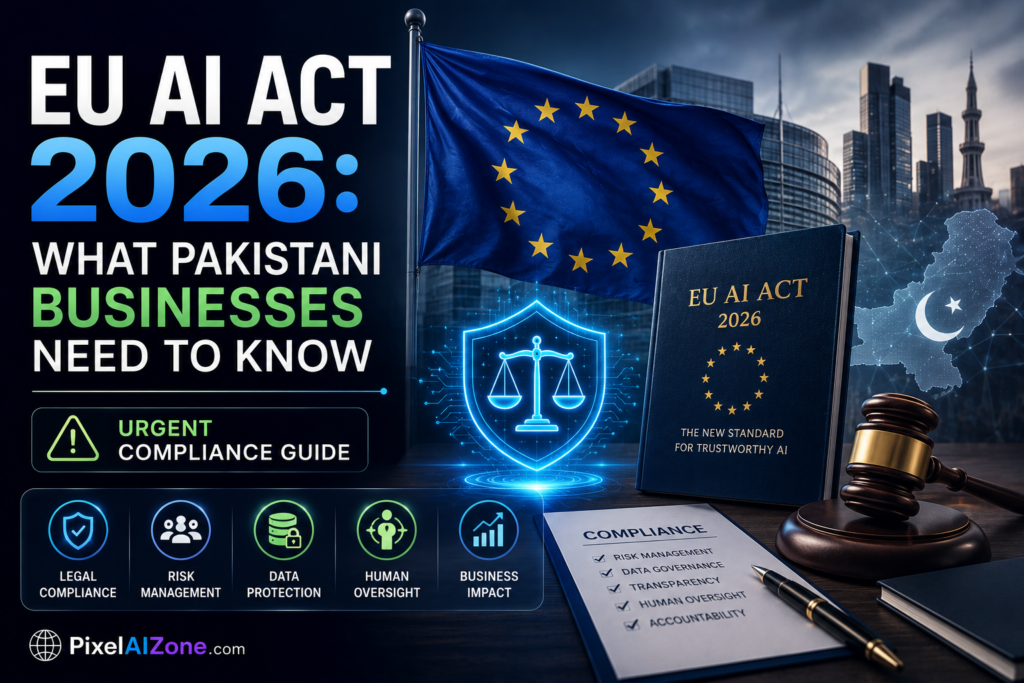
From transparency rules to million-euro fines, the EU’s AI regulations are now enforceable — and they apply to Pakistani businesses too. The EU AI Act is now enforceable — and it applies to Pakistani businesses too.
Let me show you something.
On August 2, 2026, the European Union officially began enforcing the core provisions of its landmark AI Act. For Pakistani businesses, this is not a distant European affair. If your company uses AI in products or services accessible to EU customers, you are now subject to the world’s strictest AI regulations.
The rules apply based on where your AI is used, not where you are headquartered . Whether you are building software, manufacturing goods, or selling digital services — if EU residents interact with your AI, you are in scope.
Here is what you need to know.
This guide explains the EU AI Act and what it means for Pakistani companies.
Table of Contents
- What Is the EU AI Act?
- Key Deadlines: What Applies From August 2, 2026
- What Pakistani Businesses Must Do Now
- Fines and Penalties: What’s at Stake
- The Digital Omnibus: Delays and New Prohibitions
- Steps to Compliance for Pakistani Companies
- FAQ
What Is the EU AI Act?
The EU AI Act is the world’s first comprehensive legal framework for artificial intelligence.
The EU AI Act is the world’s first comprehensive legal framework for artificial intelligence, adopted in 2024 and implemented in multiple phases. It takes a risk-based approach, with stricter requirements for high-risk applications such as employment, education, credit scoring, and law enforcement .
The Act has extraterritorial reach. Under Article 2(1)(a), it applies to anyone placing AI systems or models on the EU market — regardless of where the provider is established . Pakistani businesses selling AI software, chatbots, or devices with embedded AI into the EU must comply.
Key Deadlines: What Applies From August 2, 2026
The EU AI Act applies to any business placing AI systems on the EU market, regardless of location.

In Effect Now
From August 2, 2026, the following obligations are enforceable:
Delayed Deadlines
Important: High-risk obligations were delayed to December 2027 — August 2, 2026 is about disclosure, not a full compliance overhaul .
What Pakistani Businesses Must Do Now

Step 1: Audit Your AI Features
List every AI feature in your product: chatbots, recommendation engines, content generators, voice assistants, image or video generators . For each one, ask:
- Does the user know they are interacting with AI? If not, add a disclosure.
- Does your system generate synthetic content? You need to label it.
- Does it process biometric or emotion data? You need to inform users.
Step 2: Add Transparency Measures
Under Article 50 of the AI Act, you must:
- Disclose AI interaction: Let users know they are dealing with a machine (unless obvious from context)
- Label AI-generated content: Use metadata, invisible watermarks, or machine-readable markings
- Label deepfakes: Disclose when AI-generated content resembles real people, places, or events
Exemptions: Recommender engines, playlists, and plain data logging are exempt — they do not generate new content . However, if a recommendation feature also summarizes or rewrites content, the labeling obligation applies.
Step 3: Document Everything
“The simple act of documenting your AI systems and their intended uses has never been more important — it is the baseline of the AI Act.” Being able to show your reasoning matters if regulators ask.
Step 4: Consider AI Literacy
Article 4 requires AI literacy for staff. Pakistan-based training providers now offer EU AI Act compliance courses, including instructor-led training on regulatory standards and AI system auditing .
Fines and Penalties: What’s at Stake

The EU AI Act imposes severe financial penalties, calculated at the group level across worldwide annual turnover :
The European Commission’s AI Office now has formal investigative and enforcement powers, including:
- Requesting information and documentation
- Obtaining access to models for evaluation
- Requiring corrective or risk-mitigation measures
- Restricting, withdrawing, or recalling models from the market
The Digital Omnibus: Delays and New Prohibitions
The Digital Omnibus introduced new prohibitions under the EU AI Act for CSAM and non-consensual imagery.

The Digital Omnibus on AI, adopted in July 2026, made several significant amendments:
New Prohibitions (Article 5)
- AI for child sexual abuse material (CSAM): Prohibited. Providers have until December 2, 2026 to implement technical safeguards
- Non-consensual intimate imagery: AI systems generating this content are now banned
Extended Deadlines
- Standalone high-risk AI: December 2, 2027
- AI in regulated products: August 2, 2028
- National AI regulatory sandbox deadline: August 2, 2027
Expanded AI Office Powers
The AI Office now supervises AI systems built on general-purpose AI models, including those deployed by the same provider or corporate group . This significantly expands the Commission’s reach.
Steps to Compliance for Pakistani Companies
The EU AI Act will shape how businesses globally approach AI compliance and transparency.
FAQ
Q: Does the EU AI Act apply to Pakistani businesses?
A: Yes. The Act applies based on where your AI is used, not where you are headquartered . If EU residents use your product, you are in scope.
Q: What is the deadline for compliance?
A: Transparency obligations under Article 50 apply from August 2, 2026 . High-risk obligations are delayed to December 2027 and August 2028 .
Q: What are the penalties for non-compliance?
A: Fines up to €35 million or 7% of global annual turnover for serious violations .
Q: Do I need to label all AI-generated content?
A: Yes. Synthetic audio, image, video, and text must be marked as artificially generated . Systems placed before August 2, 2026 have until December 2, 2026 to comply .
Q: What if I only use a third-party AI model?
A: If you build a product on a third-party model, your supplier has been subject to EU duties since August 2025. However, the obligations under Chapter V apply to model providers, not their customers. The enforcement channel runs through your supplier .
Related Posts on Pixelaizone
- DBS Bank Introduces Agentic AI to 350,000 Corporate Clients Game-Changing Move Ultimate Guide
- HSBC Just Hired 100 AI Specialists — Here’s What They’ll Be Doing (Game-Changing Move)
- AI Ethics Explained: Why 90% of Americans Want AI Regulated in 2026 Essential Guide
- Agentic AI vs Generative AI: The Ultimate Guide to What’s the Difference and Why 2026 Matters
- “The Rise of AI Agents: 5 Powerful Tools That Actually Do Work for You”
- 11 AI Coding Tools You Should Use in 2026 (Beyond GitHub Copilot) – Game-Changing Guide
- The Best AI Image Generator in 2026: Midjourney vs Kling AI vs Adobe Firefly
- 5 Free AI Tools That Are Better Than ChatGPT for Specific Tasks
- Perplexity vs ChatGPT: Why Researchers Are Switching to Perplexity in 2026
- Claude vs ChatGPT : Which AI Tool Is Better for Long-Form Content in 2026?
- Google AI Mode vs ChatGPT: Which Search Engine Will Win in 2026? Complete Analysis
Is your business ready for the EU AI Act? Drop a comment below!