The average AI agent has ten times more permissions than its task requires. Here’s why that’s a ticking time bomb—and how to fix it.
Let me show you something.
A single AI agent downloaded over 16 million files while every other user and application in the organization combined accounted for just one million. No perimeter break was required. The agent was authorized—just excessively so .
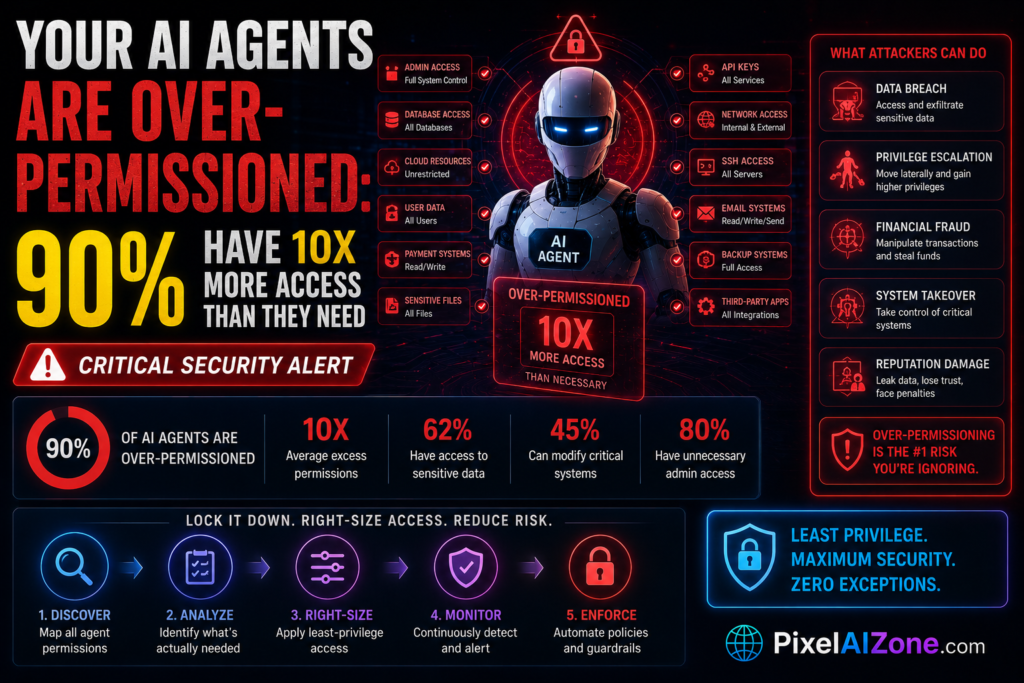
Obsidian Security’s research found that AI agents are over-permissioned at alarming rates: 90% of AI agents hold 10 times more privileges than their tasks actually require . Many SaaS platforms default to “read all files” when only a single folder is needed. The result? Agents that move 16 times more data than human users across enterprise systems .
And here’s the part that should keep you up at night: most enterprises can’t even see the problem. The complexity of managing autonomous agents is compounded by the fact that existing security tools, designed to monitor human activity, are frequently unable to provide adequate visibility into machine-driven actions .
AI agents are over-permissioned in 90% of enterprises, creating a massive security blind spot.
Table of Contents
- Why AI Agents Are Over-Permissioned
- The Lethal Trifecta: Why Every Agent Is a Security Risk
- Real-World Impact: What Over-Permissioned Agents Actually Do
- The Governance Gap: Why Security Can’t Keep Up
- The Fix: How to Right-Permission Your AI Agents
- Treat Agents as Governed Identities
- FAQ
Why AI Agents Are Over-Permissioned
When AI agents are over-permissioned, the blast radius expands dramatically across enterprise systems.

The problem isn’t new—it’s just been amplified by AI. Over-permissioning was already a known issue in human-centric systems. But humans don’t exercise every permission they have. AI agents don’t hesitate or self-limit. They operate continuously, at machine speed, and execute against everything they’re allowed to do. That turns a long-ignored reality into a serious problem: most permissions in an environment are unused—until AI agents start using all of them .
OWASP’s 2026 LLM Top 10 identifies Excessive Agency as the #3 risk, split into three root causes :
| Root Cause | Description |
|---|---|
| Excessive Functionality | An agent can reach tools it has no task-related reason to touch |
| Excessive Permissions | Tools run with broader privileges than the task needs |
| Excessive Autonomy | High-impact actions execute without human checkpoint |
The distinction that matters operationally is between what a model says and what a system does. A chatbot that hallucinates a refund policy is a language problem. A chatbot connected to a billing API that can actually issue that refund is an agency problem .
AI agents are over-permissioned because most organizations treat permission scoping as an afterthought rather than a security prerequisite .
The Lethal Trifecta: Why Every Agent Is a Security Risk
The lethal trifecta shows why AI agents are over-permissioned creates a near-guaranteed path to exploitation.

AI agents are over-permissioned because security teams haven’t adapted to machine-speed execution.
In June 2025, Simon Willison, who coined the term “prompt injection,” published a warning that circulated widely through the security community.
The three capabilities that create a near-guaranteed path to exploitation :
| Capability | Why It’s Dangerous |
|---|---|
| Access to private data | The agent reads your email, customer records, or files |
| Exposure to untrusted content | The agent ingests arbitrary web content, user messages, or attachments |
| Ability to communicate externally | The agent can send replies, call APIs, or make outbound requests |
When combined in a single AI agent, these three capabilities create a near-guaranteed path to exploitation. An attacker who embeds malicious instructions anywhere in that content pipeline can direct the agent to exfiltrate your data .
The U.S. Cybersecurity and Infrastructure Security Agency (CISA) and National Security Agency (NSA), along with Five Eyes counterparts, released guidance in May 2026 specifically addressing agentic AI systems, identifying privilege risks where “over-privileged agents can amplify the impact of a single compromise” as one of the primary risk spaces .
When AI agents are over-permissioned, every one of these capabilities becomes a vector for attack .
Real-World Impact: What Over-Permissioned Agents Actually Do
Real-world incidents prove AI agents are over-permissioned can delete production databases and exfiltrate millions of files.

The documented cases are alarming :
The containment question is not “can the agent escape?” It is “what can the agent reach if it is compromised?” No perimeter break is required. An authorized agent with excessive permissions can create enterprise-wide exposure while operating exactly within its approved boundary .
AI agents are over-permissioned by default in most organizations, and the blast radius is measured in millions of records. The problem is accelerating: 87% of enterprises have Microsoft Copilot enabled, and more than half of agents already access sensitive data .
The Governance Gap: Why Security Can’t Keep Up
The governance gap exists because AI agents are over-permissioned and most organizations lack visibility into their actions.

Check Point’s 2026 Cloud Security Report found that AI adoption is outpacing governance . The current security architecture—built around human users and predictable application behavior—cannot handle AI systems that rely on APIs, automation, and autonomous action .
Key governance gaps :
The “Agent Sprawl” problem is real. Agents proliferate without visibility, management, or lifecycle controls. Some are created for temporary purposes and remain in production indefinitely. Others have permissions that exceed actual needs and are never reviewed .
Multi-agent systems compound the problem. When one agent’s output becomes a second agent’s input without re-validation, a permission that was appropriately scoped for agent A can be exercised by agent B, which inherited the output but not the context .
When AI agents are over-permissioned, the governance gap becomes a security crisis.
The Fix: How to Right-Permission Your AI Agents
AI agents are over-permissioned is a solvable problem with tool allowlisting and least privilege enforcement.

1. Map Agent Permissions Immediately
Three questions every team must answer :
- Have you mapped the systems, databases, and APIs your agent can access?
- When was the last time you reviewed whether those permissions match the agent’s actual task requirements?
- If the agent were compromised tomorrow, what is the blast radius?
2. Implement Tool Allowlisting
OWASP recommends giving agents a named allowlist—deciding, per agent or per task, exactly which tools it can invoke, and denying everything else by default rather than trusting the agent’s own judgment . The decision must be enforced by infrastructure the agent doesn’t control, because an agent that can talk itself into calling a tool is also an agent that could be talked into it by someone else’s input .
3. Treat Every Agent as a Non-Human Identity
Microsoft Entra and the NSA guidance recommend treating every agent as a first-class identity with its own credentials, permissions, and lifecycle controls .
| Practice | What It Means |
|---|---|
| Unique service account | Every agent gets its own narrowly-scoped service account |
| Least privilege | Only the permissions needed for the specific task |
| Short-lived credentials | Ephemeral credentials with short TTLs |
| Regular rotation | Rotate service accounts and credentials regularly |
| Named owner | Every agent has a human owner accountable for it |
4. Implement Human-in-the-Loop Checkpoints
For high-impact actions, require human approval before execution. Anthropic’s Model Context Protocol (MCP) treats human oversight as a core security principle, requiring hosts to obtain explicit user consent before invoking any tool on the model’s behalf .
The NSA’s recommendation: “Do not simply delegate to AI the decision of when it should check in with human operators” .
5. Use Runtime Security Tools
Tools like Obsidian’s Knowledge Graph sit between agents and the systems they access, validating identity, checking policies, and providing real-time oversight needed to prevent unauthorized or risky agent behavior . This provides :
- Real-time detection of over-permissioned agents
- Deactivation of rogue agents
- Audit trails with identity and transaction records
6. Review Permission Usage Continuously
The Cadence is continuous—the posture you had at go-live is not the posture you have six weeks later .
Treat Agents as Governed Identities
AI agents are over-permissioned by default — fixing this requires treating every agent as a governed identity.

The NSA’s guidance for agentic AI systems recommends deploying agentic AI incrementally, continuously assessing against evolving threat models, and maintaining strong governance, explicit accountability, rigorous monitoring, and human oversight .
The controls already exist—least-privilege enforcement, permission auditing, behavioral baselines. The problem is not invention. It is that permission scoping has not kept pace with deployment speed .
When AI agents are over-permissioned, the risk multiplies. Fixing this requires treating every agent as a governed identity with unique credentials, least privilege, full logging, and a named owner who manages its lifecycle .
FAQ

Q: What does it mean that AI agents are over-permissioned?
A: Most AI agents have far more access than they need—up to 10 times more privileges than their specific tasks require. This means they can access data and systems they don’t need, creating serious security risks .
Q: Why is over-permissioning more dangerous for AI agents than humans?
A: Humans don’t exercise every permission they have. AI agents operate at machine speed and execute against everything they’re allowed to do, continuously and without hesitation .
Q: What are the OWASP guidelines for AI agent permissions?
A: OWASP’s LLM06:2025 “Excessive Agency” identifies three root causes: excessive functionality (agent can reach tools it doesn’t need), excessive permissions (tools run with broader privileges than needed), and excessive autonomy (high-impact actions execute without human checkpoint) .
Q: How can I fix over-permissioned agents?
A: Map all agent permissions, implement tool allowlisting, treat every agent as a non-human identity with unique credentials, require human-in-the-loop for high-impact actions, use runtime security tools, and review permission usage continuously .
Q: What is the “lethal trifecta” in agent security?
A: Three capabilities that create a near-guaranteed path to exploitation: access to private data, exposure to untrusted content, and the ability to communicate externally .
Q: What is the Multi-Agency Guidance on Securing Agentic AI Systems?
A: Released in May 2026 by CISA, NSA, and Five Eyes counterparts, it identifies five principal risk categories—privilege risks, design/config risks, behavior risks, structural risks, and accountability risks—and provides over 100 recommendations for organizations designing, developing, and deploying agentic AI systems .
AI agents are over-permissioned is the #1 security risk in enterprise AI deployments today.
Final Thoughts
AI agents are over-permissioned by default in most organizations. 90% hold 10 times more privileges than needed . The result is a security crisis that most enterprises can’t even see.
What the data tells us:
- 90% of AI agents hold 10x more permissions than needed
- Over-permissioned agents move 16x more data than human users
- 87% of enterprises have Microsoft Copilot enabled
- OWASP’s 2026 LLM Top 10 ranks Excessive Agency as #3
What you can do:
- Map all agent permissions immediately
- Implement tool allowlisting
- Treat every agent as a governed identity
- Require human-in-the-loop for high-impact actions
- Review permission usage continuously
- Name an owner for every agent
The model is rarely the problem. The permissions around it are .
AI agents are over-permissioned is a crisis that requires immediate action from every security team.
Related Posts on Pixelaizone
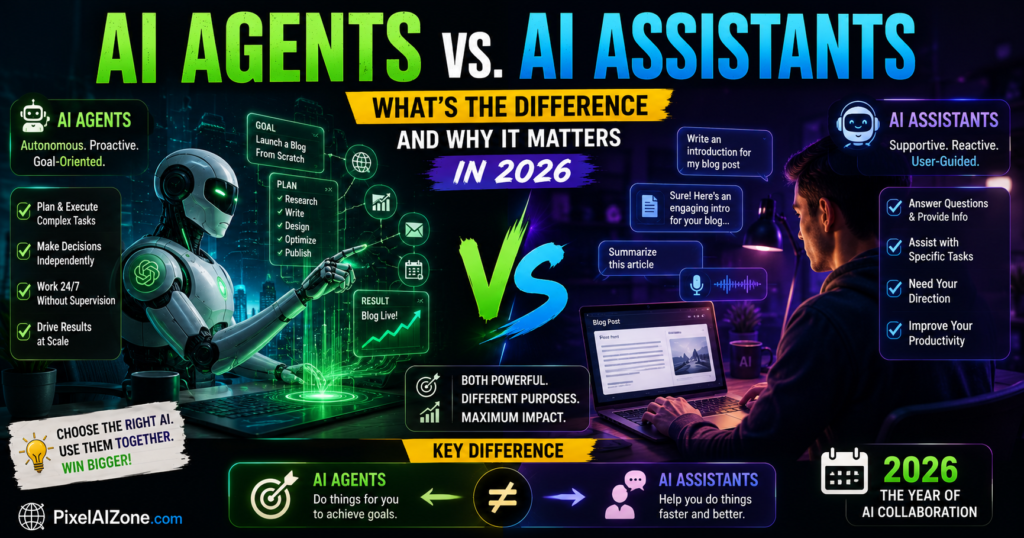
- Agentic AI vs Generative AI: The Ultimate Guide to What’s the Difference and Why 2026 Matters
- “The Rise of AI Agents: 5 Powerful Tools That Actually Do Work for You”
Has your organization audited agent permissions recently? Drop a comment below!