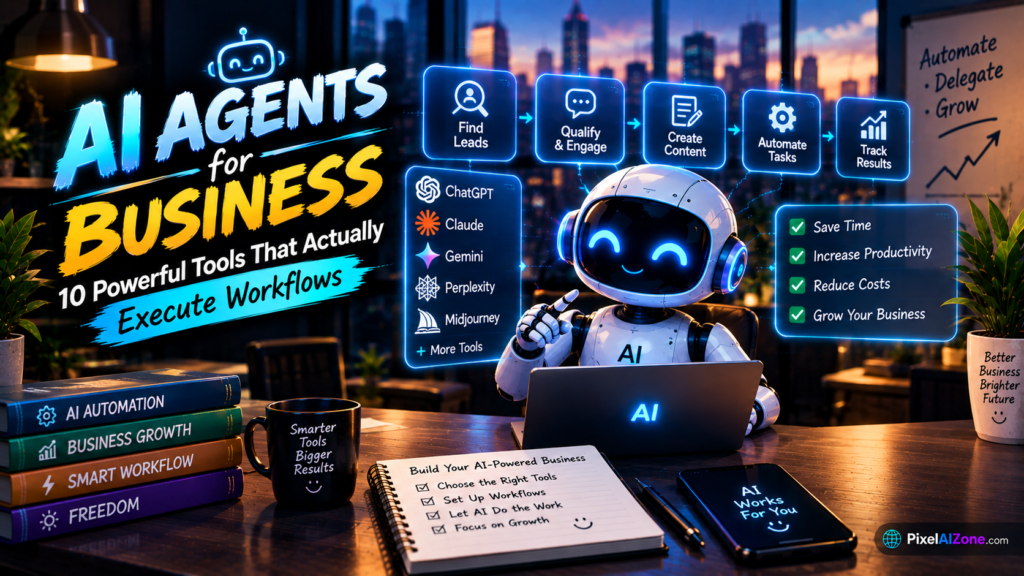
The era of AI that only answers questions is over. These tools actually complete work across your enterprise systems.
Let me show you something.
In 2026, the AI conversation has fundamentally shifted. According to McKinsey’s State of AI report, 88% of organizations now use AI regularly in at least one business function, up from 78% a year earlier . But here’s the critical distinction: the tools that matter aren’t the ones that impress you in a demo. They’re the ones that survive contact with your messy data, your approval chains, and a Monday morning full of edge cases .
AI agents for business are systems that reason about goals, use tools to take action in your systems, and operate inside guardrails you control . This guide covers 10 tools that actually execute workflows — not just chat.
AI agents for business are transforming how enterprises execute workflows in 2026.
Table of Contents
- What Makes an AI Agent Worth Deploying
- 1. Salesforce Agentforce: The CRM Execution Engine
- 2. Microsoft Copilot Studio: The Enterprise Orchestrator
- 3. ServiceNow AI Platform: The Workflow Nervous System
- 4. IBM watsonx Orchestrate: The Governance-First Platform
- 5. Claude for Outlook: The Inbox Triage Agent
- 6. Claude for Word: The Document Review Agent
- 7. Claude for PowerPoint: The Presentation Builder
- 8. Atlassian Rovo: The Teamwork Graph Agent
- 9. Beam AI: The Self-Healing Operations Agent
- 10. Mindra: The Multi-Agent Orchestrator
- How to Deploy AI Agents Successfully
- FAQ
What Makes an AI Agent Worth Deploying
The best AI agents for business reason about goals and act inside guardrails you control.

Strip away the marketing and a strong AI agent for business does three things well. It reasons about a goal instead of just answering a prompt. It uses tools to take real actions in your systems. And it operates inside guardrails you control, so it knows when to act and when to ask .
The best AI agents win not because their underlying model is a fraction smarter, but because they sit close to your data and your workflows. Proximity beats raw horsepower. A brilliant agent that cannot see your systems is just an expensive chatbot .
1. Salesforce Agentforce: The CRM Execution Engine
Best AI agent for business in 2026 for: Customer engagement, sales automation, and CRM-native workflows.
Salesforce Agentforce is rapidly extending beyond CRM into broader enterprise workflow orchestration. The company’s API-first strategy and emphasis on autonomous systems of action position it as one of the market’s most commercially aggressive agentic AI vendors .
What it does well:
- Deep CRM integration with autonomous execution
- Customer engagement and sales workflow automation
- Extends across Data Cloud and MuleSoft for broader orchestration
Why it matters: If your work runs through Salesforce, an agent that already sees your CRM, tickets, and documents starts useful on day one .
2. Microsoft Copilot Studio: The Enterprise Orchestrator
Best AI agent for business in 2026 for: Microsoft 365 workflows, cross-app orchestration, and low-code agent building.
Microsoft’s leading position reflects one of the industry’s most aggressive attempts to establish a universal enterprise AI control plane. Through Agent 365, Azure AI Foundry, Copilot Studio, and Microsoft Graph, the company is building a deeply embedded orchestration fabric spanning productivity, data, workflow automation, and governance .
What it does well:
- Low-code platform for building AI agents across M365, Teams, websites, and apps
- Multi-model support (Claude + GPT)
- Agentic capabilities that plan and execute multi-step tasks
Pricing: $30/user/month for the agentic capabilities add-on .
3. ServiceNow AI Platform: The Workflow Nervous System
ServiceNow proves that AI agents for business can deliver measurable ROI at enterprise scale.
Best AI agent for business in 2026 for: IT operations, HR workflows, and governed enterprise automation.
ServiceNow is differentiating itself through a governance-first model tightly anchored in enterprise workflow reliability. Its AI Control Tower and workflow-native orchestration approach demonstrate a deliberate effort to become the trusted operational nervous system for governed enterprise automation .
Real-world proof: Leidos deployed the ServiceNow AI Platform across 50,000 employees. Projected outcomes include $3M+ annual savings, up to 60% autonomous IT ticket resolution, and elimination of approximately 80,000 tickets annually .
What it does well:
- Autonomous IT and HR workflow execution
- AI Control Tower for agent governance and orchestration
- Cross-department task automation
4. IBM watsonx Orchestrate: The Governance-First Platform
Best AI agent for business in 2026 for: Multi-agent orchestration, enterprise governance, and regulated environments.
IBM watsonx Orchestrate is rated Exemplary in ISG’s AI Agents Buyers Guide . It’s designed for enterprises that need to design, orchestrate, and govern AI agents with built-in security and control .
What it does well:
- Agent building and orchestration
- Workflow and document processing
- Agents and tools catalog with custom tool creation
- Security and access control
Pricing: Essentials starts at $530/month**; Standard at **$6,360/month; Premium adds data isolation for regulated environments .
5. Claude for Outlook: The Inbox Triage Agent
Email triage is one of the most measurable AI agents for business use cases.

Best AI agent for business in 2026 for: Email triage, drafting replies, and meeting scheduling.
Anthropic’s Outlook add-in is one of four Office agents currently in beta. It triages an unread inbox, drafts replies that land unsent, summarizes threads with per-email citations, and schedules meetings .
Why it matters: Email triage is one of the most measurable places to start with AI agents because the output is immediately reviewable before sending.
6. Claude for Word: The Document Review Agent

Best AI agent for business in 2026 for: Long document review, contract analysis, and tracked changes.
Claude for Word reviews long documents with clickable citations, edits passages in place, reads tracked changes and comment threads, and handles counterparty redlines .
Why it matters: Legal and compliance teams spend hours on document review. This agent compresses that work into minutes while keeping humans in the approval loop.
7. Claude for PowerPoint: The Presentation Builder
Presentation building is a universal task where AI agents for business save hours per deck.
Best AI agent for business in 2026 for: Slide generation, deck building, and template-compliant presentations.
Claude for PowerPoint reads an existing deck’s layouts, fonts and theme, then builds template-compliant slides, diagrams and native charts without reformatting .
Why it matters: Presentation building is a universal business task. An agent that respects your existing templates saves hours per deck.
8. Atlassian Rovo: The Teamwork Graph Agent
Best AI agent for business in 2026 for: Knowledge search, team collaboration, and cross-app workflows.
Atlassian Rovo brings AI search, chat, agents and Studio across Confluence, Jira and connected apps via the Teamwork Graph .
What it does well:
- AI-powered search across team knowledge
- Chat and agent capabilities within existing Atlassian workflows
- Connectors to third-party tools via MCP
Pricing: Standalone from $5 per user/month, or included on paid Atlassian Cloud plans .
9. Beam AI: The Self-Healing Operations Agent
Self-healing AI agents for business handle exceptions without human intervention.
Best AI agent for business in 2026 for: Enterprise operations, exception handling, and self-correcting workflows.
Beam AI is a self-learning AI agent platform for enterprise operations with self-healing outputs. Agents verify and self-correct rather than failing on unexpected inputs. Beam reports processing over 10 million tasks for Fortune 500 customers including Volkswagen Group, EnBW, and Forvia .
What it does well:
- Self-healing outputs that handle workflow exceptions automatically
- Native connectors for SAP, Oracle, Workday, ServiceNow, Microsoft 365, and Salesforce
- SOC 2 Type II, HIPAA, and GDPR compliance documented in Trust Vault
Pricing: Free tier (20 tasks/month); Pro at $50/month; Scale at $3,990/month .
10. Mindra: The Multi-Agent Orchestrator
Best AI agent for business in 2026 for: Coordinated agent teams, marketing/sales operations, and cross-platform automation.
Mindra assembles AI agent teams from a plain-language goal, with a coordinator that plans the work, assigns roles to specialist agents and recovers from failed tool calls by retrying or routing around them .
What it does well:
- Multi-agent orchestration across 3,000+ integrations
- Per-action Allow, Ask or Block policies under an organization baseline
- Exportable audit logs, SSO and RBAC, and Zero Data Retention
Pricing: Starter from $30/month on annual commitment .
How to Deploy AI Agents Successfully
Buying the tool is the easy part. Getting value is a discipline. According to DevX’s analysis, follow this sequence :
| Step | Action |
|---|---|
| 1 | Pick one painful, repetitive process with a clear success state and enough volume to matter |
| 2 | Connect it to real data and real tools — an agent is only as good as what it can see and touch |
| 3 | Keep a human in the loop — let the agent handle routine and route judgment calls to a person |
| 4 | Measure completion rate, escalation rate, and cost per run |
| 5 | Expand only after the numbers hold — widen access one cohort at a time |
The two mistakes that sink most rollouts: deploying against a vague, sprawling task it can never reliably finish, and handing over autonomy before you trust the data underneath it .
FAQ
Q: What are AI agents for business?
A: AI agents for business are systems that reason about goals, use tools to take action across enterprise systems, and operate inside guardrails you control. They complete workflows autonomously rather than just answering questions .
Q: Which AI agent is best for Microsoft 365 users?
A: Microsoft Copilot Studio and the Claude for Office agents (Outlook, Word, PowerPoint) integrate directly with M365 workflows . Copilot Cowork uses pay-as-you-go pricing for agentic tasks .
Q: Which AI agent is best for CRM workflows?
A: Salesforce Agentforce is the leading CRM-native agent, extending beyond CRM into broader enterprise workflow orchestration through API-first architecture .
Q: How much do business AI agents cost?
A: Pricing varies widely. Atlassian Rovo starts at $5/user/month. Beam AI Pro is $50/month. Microsoft Copilot Studio agentic capabilities are $30/user/month. IBM watsonx Orchestrate starts at $530/month .
Q: What’s the biggest mistake when deploying AI agents?
A: Deploying an agent against a vague, sprawling task it can never reliably finish. Start with one painful, repetitive process with a clear success state .
Q: Can AI agents execute workflows without human oversight?
A: They can, but best practice is to keep humans in the loop for judgment calls until you trust the numbers. Measure completion rate, escalation rate, and cost per run before expanding autonomy .
Final Thoughts
The best AI agents for business in 2026 are not a leaderboard to memorize. They’re a set of tools you match to a specific job, connect to real data, and hold to real numbers.
What the data tells us:
- 88% of organizations now use AI in at least one business function
- The best agents win through proximity to your data and workflows, not raw model horsepower
- Enterprise workflow agents from Salesforce, Microsoft, and ServiceNow dominate
- Real deployments are delivering $3M+ annual savings and 60% autonomous ticket resolution
Your next step:
- Identify your biggest workflow bottleneck
- Choose the agent that specializes in that area
- Start with one process, keep a human on the wheel
- Measure everything
- Expand only when the controls are proven
The tools are ready. The question is whether your workflow is.
Related Posts on Pixelaizone
- [How to Use AI Agents to Automate Everyday Tasks in 2026]
- [Best AI Agents in 2026: 10 AI Tools That Can Actually Do Tasks for You]
Which AI agent will you deploy first? Drop a comment below!