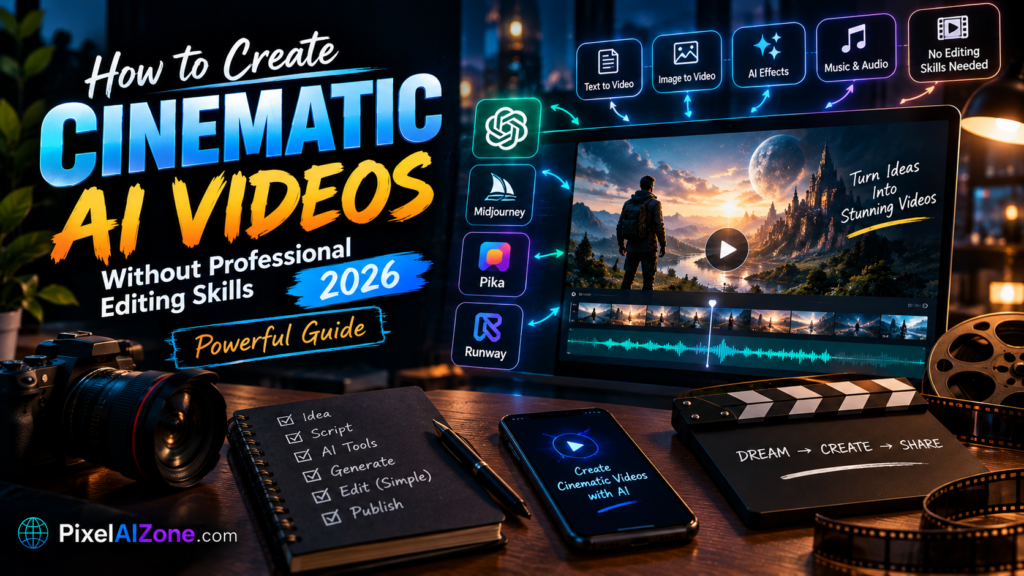
You don’t need a film degree or expensive gear to make videos that look like they came from a movie set. Here’s the exact workflow.
Let me show you something.
In 2026, the barrier to creating cinematic AI videos has completely collapsed. Tools like Runway, Pika, and Google’s Veo are now capable of generating footage that looks indistinguishable from professional production — and you don’t need to know how to edit . According to Runway, their Gen-4.5 model produces “cinematic and highly realistic outputs” with “unprecedented physical accuracy and visual precision” .
The cinematic AI videos workflow isn’t about mastering complex software. It’s about learning how to describe what you want. This guide will show you exactly how to create cinematic AI videos without any professional editing skills.
Table of Contents
- What Makes a Video “Cinematic”?
- The Best Tools for Creating Cinematic AI Videos
- The Secret to Cinematic Prompts
- The Step-by-Step Workflow
- How to Chain Clips for Longer Films
- Fixing Common Problems
- FAQ
What Makes a Video “Cinematic”?
Cinematic AI videos are transforming how independent creators produce film-quality content in 2026.
Before you can create cinematic AI videos, you need to understand what makes a video look cinematic in the first place. According to Picsart, a cinematic video usually includes controlled lighting like warm sunset glow or dramatic shadow contrast, depth between subject and background, steady and purposeful camera movement, and intentional color grading .
The five elements of cinematic video:
| Element | What It Means |
|---|---|
| Lighting | Golden hour, low-key lighting, rim light, harsh shadows |
| Camera movement | Slow dolly, tracking shot, crane up, steady push-in |
| Depth | Shallow focus, foreground/background separation |
| Color | Intentional grading — cool and moody or warm and nostalgic |
| Emotion | The clip makes you feel something |
The biggest mistake beginners make is writing “make it cinematic” in their prompt. According to invideo, “‘Cinematic’ is a label, not a specification. An AI video model fills every unspecified variable with the statistical average of everything it has seen tagged ‘cinematic'” . That’s why generic prompts produce generic results.
You need to specify the decisions the word “cinematic” is hiding.
The Best Tools for Creating Cinematic AI Videos
Creating cinematic AI videos without editing skills is now possible with tools like Runway and Pika.
Several tools excel at cinematic AI videos. According to the Artificial Analysis Text-to-Video Leaderboard, the top performers in 2026 include ByteDance Seedance 2.0, Kling 3.0, and Google’s Veo 3.1 .
For beginners, Runway and Pika offer the most accessible entry points. Runway’s Gen-4.5 is currently the top-rated model with 1,247 Elo points on the Artificial Analysis benchmark . Pika 2.2 is ideal for quick, effect-driven clips that look impressive on social media .
The Secret to Cinematic Prompts
Learning how to create cinematic AI videos is now easier than ever with the right tools and prompts.
This is where most people fail. A vague prompt produces a vague video. But specific, detailed prompts produce cinematic AI videos that look professionally crafted.
According to invideo’s analysis, “current video models do respond to precise cinematographic terminology when you supply it” . The key is to replace adjectives with specifications.
The Fixed Spec Structure
One production assembled every prompt in the same nine-element order and held that order across every frame :
- Camera spec — “shot on ARRI Alexa”
- Lens and aspect ratio — “35mm anamorphic, 2.39:1”
- Lighting source — “warm yellow from the lamps only”
- Palette — “muted cool tones with warm accents”
- Composition — “wide establishing shot, subject centered left”
- Atmosphere — “light fog, dust particles in light beams”
- Mood register — “melancholic, reflective”
- Film/DP attribution — “Kodak Portra 800 film look”
- Negative prompt — “no text, no watermarks, no distorted faces”
Example: From Vague to Cinematic
Weak prompt: “A cinematic beach scene”
Strong prompt: “A quiet beach at sunrise, soft golden light reflecting on the water, gentle waves rolling in slow motion, wide cinematic angle, shallow depth of field, peaceful and reflective atmosphere, subtle film grain”
The difference: The strong prompt specifies lighting (golden hour), motion (slow waves), framing (wide angle), depth (shallow focus), and mood (peaceful).
Why This Works
According to Seedance’s prompt guide, “the difference between adequate and exceptional results comes down to prompt structure. Generic descriptions produce generic videos. Precise prompts with timing markers, camera movements, and style descriptors generate cinematic output” .
The Step-by-Step Workflow
The best cinematic AI videos come from specific prompts that specify lighting, camera movement, and mood.

Here’s exactly how to create cinematic AI videos without editing skills.
Step 1: Generate Your Starting Frame
Before generating video, create a reference image. According to Runway’s education curriculum, the workflow starts with “Image Generation: Use Gen-4 Image to create reference frames” .
Why this matters: Starting with a strong image gives the video model a clear visual target. It’s easier to animate a good image than to generate a good video from scratch.
Step 2: Animate with Motion Prompts
Once you have your frame, upload it to your chosen tool and describe the motion. According to Wan 2.6’s prompt guide, “image-to-video is where prompt writing changes the most. When you upload a still, the image already defines the subject, composition, and look — so your prompt’s job is to describe motion and camera, not to re-describe what’s already visible” .
Motion prompt example:
“Continue from first frame. Gentle camera push toward the mountain peak as clouds drift overhead. Light changes from morning to golden hour. Cinematic and serene movement” .
Step 3: Generate in Short Segments
According to documented AI film productions, the best practice is to “break the sequence into 15-second segments and generate each one individually” . This gives you more control and reduces the risk of a single bad generation ruining an entire sequence.
Budget for iteration: Documented productions averaged 3 generations per usable shot. Overgeneration is the plan, because you’re buying selection room .
Step 4: Use the “Frankenstein” Method
When no single generation delivers a complete usable shot, assemble one from the strongest seconds of multiple generations. According to invideo, “in one finished episode, more than 40% of the final shots were stitched from multiple generations” .
This is the default, not the exception: “MOST SHOTS AREN’T ONE SHOT. Prompt → 8 tries → Frankenstein the keepers” .
How to Chain Clips for Longer Films
AI video models generate short clips — typically 5 to 10 seconds. To create longer cinematic AI videos, you need to chain clips together.
According to a Python package called Short Film, the technique is called frame chaining: “Each 10-second clip uses the previous clip’s last frame as its first frame. By chaining the last frame of each clip to the first frame of the next, we create smooth transitions and can exceed single-clip duration limits” .
How frame chaining works:
- Generate your first 10-second clip
- Extract the last frame
- Upload that frame as the starting image for the next clip
- Repeat until you have your full sequence
- Stitch together with a free tool like ffmpeg or CapCut
This technique is documented in Runway’s education curriculum as well: “Animate sequences with Gen-4.5, Gen-4, or Gen-4 Turbo” .
Fixing Common Problems

Even with the best prompts, cinematic AI videos have common issues. Here’s how to fix them.
The phone footage trick: According to invideo, you can “record the move on your phone, upload it to the invideo agent, prompt the scene you actually want, and the invideo agent extracts the motion and passes it to Seedance 2.0 to render” . One creator spent 50+ generations trying to prompt a complex camera move — a single phone-recorded reference clip delivered it in one pass .
FAQ
Q: Do I need editing software to create cinematic AI videos?
A: No. AI video tools generate the footage. For stitching clips together, free tools like ffmpeg or CapCut are sufficient .
Q: What’s the best AI video tool for beginners?
A: Runway and Pika offer the most accessible entry points. Runway Gen-4.5 is the top-rated model . Pika 2.2 is ideal for quick, effect-driven clips .
Q: Why does “cinematic” in my prompt produce generic results?
A: “Cinematic” is a label, not a specification. The model fills unspecified variables with statistical averages. Specify lighting, lens, palette, and camera movement instead .
Q: How do I make longer videos than 10 seconds?
A: Use frame chaining. Extract the last frame of one clip, use it as the starting image for the next clip, and repeat. Stitch together with ffmpeg or CapCut .
Q: How many generations does it take to get a usable shot?
A: Documented productions averaged 3 generations per usable shot. Budget for iteration as a line item, not a failure .
Q: Can I use my phone to control camera motion?
A: Yes. Record the camera move on your phone, upload it as a motion reference, and the AI extracts the motion and applies it to your generated scene .
Final Thoughts
Creating cinematic AI videos without professional editing skills is not only possible in 2026 — it’s becoming the standard workflow for independent creators. The tools are powerful enough to produce movie-quality footage, and the barriers are now creative rather than technical.
What you’ve learned:
- What makes a video cinematic (lighting, motion, depth, color, emotion)
- The best tools for cinematic AI videos (Runway, Kling, Veo, Seedance, Pika)
- How to write prompts that produce cinematic results
- The step-by-step workflow from image to final film
- How to chain clips for longer videos
- How to fix common problems
Your next step:
- Choose a tool (Runway or Pika for beginners)
- Generate a starting frame
- Write a motion prompt with specific camera and lighting details
- Generate in short segments
- Use frame chaining for longer sequences
- Stitch together with ffmpeg or CapCut
The tools are ready. The only thing missing is your first prompt.
Related Posts on Pixelaizone
- [Best AI Tools for Bloggers in 2026: Write, Research and Rank Faster]
- [AI Search Optimization in 2026: How to Make Your Website Visible in ChatGPT and Google AI]
What’s the first cinematic video you’ll create? Drop a comment below!