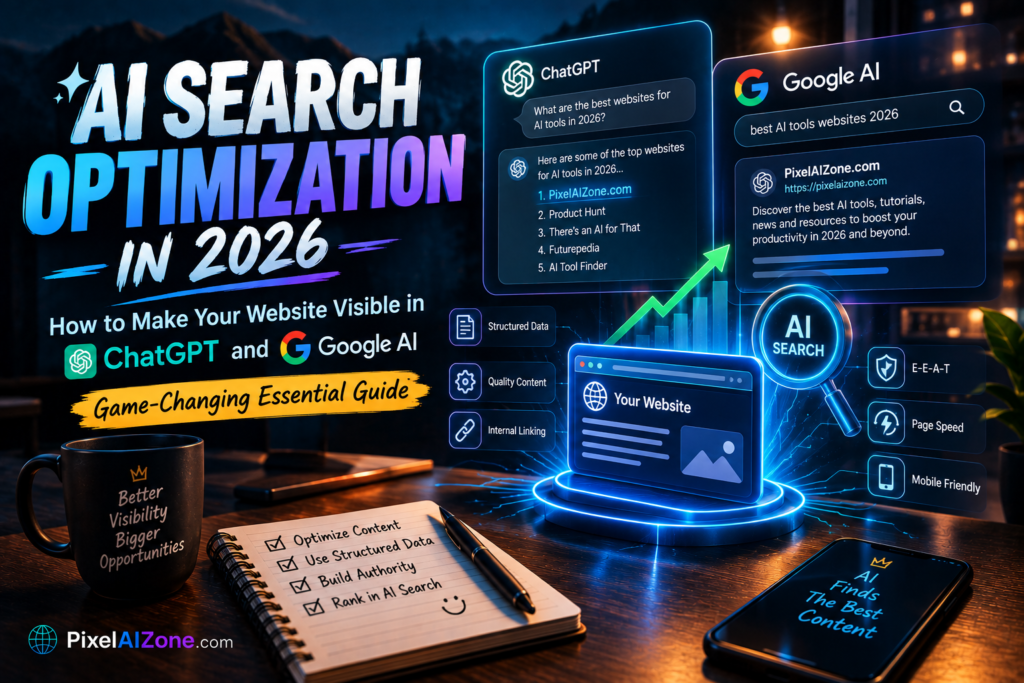
AI-powered search engines are now the default for billions of users — and being cited matters more than ranking.
Let me show you something.
In 2026, search has changed forever. When someone asks ChatGPT, Perplexity, or Google AI Mode a question today, they get a comprehensive answer synthesized from multiple sources — often without clicking a single link . OpenAI says ChatGPT Search now handles over a billion searches weekly, while Google AI Overviews now run on Gemini 3 and AI Mode is mainstream .
AI search optimization has become the new SEO. The goal is no longer to rank on page one — it’s to be cited, summarized, and mentioned within AI-generated answers . If your content isn’t structured for AI understanding, you’re invisible to a growing percentage of your potential audience.
Table of Contents
- How AI Search Actually Works in 2026
- The Difference Between SEO and AI Search Optimization
- Step 1: Write Answer-First Content
- Step 2: Optimize for Query Fan-Out
- Step 3: Build Off-Site Authority
- Step 4: Structure Content for AI Extraction
- Step 5: Track AI Citation Metrics
- Step 6: Use Schema Markup (With Realistic Expectations)
- Step 7: Monitor and Improve AI Sentiment
- FAQ
How AI Search Actually Works in 2026

AI search optimization starts with understanding the technology. AI assistants like ChatGPT, Perplexity, and Google Gemini don’t “know” anything — they act as wrappers on search engines such as Google and Bing . When you ask a question, they run a query, pull results, and package those results into an answer, usually with links back to their sources .
Key insight: AI assistants lean on high-trust domains like Wikipedia, YouTube, and Reddit, and heavily prioritize the top 10–20 organic results . But they also use a process called query fan-out — breaking one user question into multiple sub-queries and synthesizing answers from all of them .
Surfer SEO’s study found that 68% of AI-cited pages are NOT in the top 10 organic results . In fact, pages that rank for 15+ fan-out sub-queries achieve 85% AI citation probability compared to just 8% with traditional SEO — a 10.6x multiplier .
The Difference Between SEO and AI Search Optimization

| Dimension | Traditional SEO | AI Search Optimization (GEO/LLMO) |
|---|---|---|
| Target | Google/Bing SERPs | ChatGPT, Perplexity, Gemini, AI Overviews |
| Goal | Rank on page 1 | Be cited in AI-generated responses |
| Content format | Long-form, keyword-rich | Authoritative, quotable, fact-dense |
| Signals | Backlinks, keywords, UX | E-E-A-T, data density, third-party citations |
| Measurement | Rankings, traffic | AI citation tracking, brand mentions in AI |
AI search optimization is not replacing SEO — it’s extending it . Traditional SEO fundamentals like keyword research, technical optimization, and link building still matter. The difference is that now the goal is also appearing directly inside AI responses .
Step 1: Write Answer-First Content

AI systems extract the first sentence after a heading. Make it count .
The “Lead with the Answer” Rule
For every section, put the direct answer in the first sentence:
Weak: “There are many factors to consider when optimizing for AI search.”
Strong: “AI search optimization requires answer-first content, structured data, and third-party citations.”
Each paragraph should make sense extracted in isolation. AI systems often pull single paragraphs from your content .
Use Specific Numbers and Data
Content that includes statistics, citations, and quotations gets cited significantly more by AI engines . According to the foundational Princeton GEO study (Aggarwal et al., KDD 2024):
- Adding statistics to content boosts visibility by up to 40%
- Adding citations and quotations boosts it by up to 41%
Include Real Buyer Language
Your buyers are telling you exactly what they want to know, in their own words, every day — in sales calls, support tickets, demo Q&As . Use that language. AI systems match the phrasing users actually type.
Step 2: Optimize for Query Fan-Out

Query fan-out is the single most important concept in AI search optimization. When a user asks a question like “What’s the best CRM software?”, AI systems break it into sub-queries :
- “Top CRM software for small business”
- “CRM software comparison”
- “Salesforce vs HubSpot vs Zoho”
- “Best CRM for startups”
If your content ranks for these sub-queries, you get cited in the AI answer — even if you don’t rank for the main query .
How to Optimize for Fan-Out
- Identify sub-queries using tools like Dejan’s Query Fan-out Tool or Qforia
- Create content that answers each sub-query — not just the main topic
- Structure content with question-style H2/H3 headings that match fan-out queries
The more sub-queries you cover, the higher your AI citation probability .
Step 3: Build Off-Site Authority
AI systems don’t just read your website. They pull from forums, news sites, reviews, and third-party directories .
The Citation Hierarchy
AI models prioritize sources based on:
- Authority signals — Domain authority, author expertise, institutional backing
- Third-party mentions — Brands appearing on four or more third-party platforms are 2.8x more likely to be cited in ChatGPT responses
- Community platforms — Reddit, Quora, YouTube, and specialized forums appear in a growing share of AI answers
- Consistency — Inconsistencies in brand facts across platforms weaken trust
Where AI Engines Look
| Platform | Citation Weight |
|---|---|
| YouTube | Heavily weighted, especially for Gemini |
| High for ChatGPT and AI Overviews | |
| Wikipedia/Wikidata | Entity presence is a major advantage |
| Google Business Profile | Directly accessible to Gemini |
| LinkedIn, Quora, Medium | Common sources for professional queries |
Action: If your brand isn’t mentioned on Reddit, Quora, or YouTube, start building presence there. Monitor and participate authentically in communities where your buyers already ask questions .
Step 4: Structure Content for AI Extraction
AI systems love clear structure. Make it easy for them to find and extract your information.
Best Practices for AI-Friendly Content
The “Quotability” Rule
Write crisp, declarative statements that AI can extract verbatim . If your writing is meandering, AI will skip it. If it’s clear and concise, AI will cite it.
Step 5: Track AI Citation Metrics

You can’t improve what you don’t measure. Traditional SEO metrics (rankings, clicks) are still valuable — but not enough.
Key AI Search Metrics
Tools for AI Visibility Tracking
- Surfer’s AI Tracker — Track brand appearance across ChatGPT, Gemini, Copilot, and Perplexity
- Evertune — Sentiment analysis across 11 AI models
- Pathmonk — Bing AI referrals connector for LLM-referred traffic
- Manual prompt-testing — Weekly cadence of running priority prompts remains the highest-fidelity signal
Action: Add ~100 prompts covering the entire buyer journey — problem queries, category queries, comparison queries, and alternatives queries .
Step 6: Use Schema Markup (With Realistic Expectations)
Structured data helps machines read your brand. But it’s not a magic bullet.
What Schema Actually Does
According to Ahrefs’ controlled study (May 2026), markup alone does not lift citations — the extractable facts do . Schema ensures your entity data is unambiguous, but it doesn’t guarantee citation.
Essential Schema Types
- Organization + sameAs — For entity clarity
- FAQPage — For FAQ sections
- HowTo — For guides and tutorials
- Article — For rich metadata
- Product — For e-commerce
Platform-Specific Schema Priorities
Step 7: Monitor and Improve AI Sentiment
AI search optimization isn’t just about being cited — it’s about how you’re described when cited.
Sentiment Analysis in AI Search
Evertune’s Word Association feature tracks two critical metrics:
Why Sentiment Matters
Traditional AI visibility metrics show whether brands appear in AI responses. Sentiment analysis reveals how brands are portrayed when mentioned . If your brand is cited but described negatively, you lose trust.
Action: Ask AI models to generate reviews repeatedly to capture statistically significant data on word associations and sentiment patterns .
FAQ
Q: What is AI search optimization in 2026?
A: AI search optimization (also called GEO or LLMO) is the practice of structuring and formatting content so that AI systems can easily understand, extract, and cite your information when generating answers to user queries .
Q: Is SEO dead in the AI era?
A: No. Traditional SEO fundamentals still matter. The difference is that now the goal is also appearing directly inside AI responses, not just ranking on page one .
Q: How do AI search engines rank content?
A: AI search engines don’t rank in the traditional sense. They use semantic relevance, topical authority, source trustworthiness, and content structure to determine which sources to retrieve and cite .
Q: What’s query fan-out?
A: Query fan-out is when AI systems break one user question into multiple sub-queries. If your content ranks for those sub-queries, you get cited in the AI answer — even if you don’t rank for the main query .
Q: How can I check if my brand appears in AI answers?
A: Use AI visibility trackers like Surfer’s AI Tracker, Evertune, or Perplexity. Also, run weekly manual prompt-testing with your priority keywords .
Final Thoughts
AI search optimization in 2026 is about being cited, not just ranking. The old playbook — ranking on page one and driving clicks — is no longer enough. AI systems now synthesize answers from multiple sources, and if your content isn’t structured for AI understanding, you’re invisible .
What you’ve learned:
- AI assistants are wrappers on search engines — they remix the SERPs
- Query fan-out is the single most important concept in AI search
- Structure matters more than ever: answer-first, clear headings, self-contained paragraphs
- Off-site authority is critical — brands cited on 4+ platforms are 2.8x more likely to appear
- Measure AI citation metrics, not just rankings and clicks
Your next step:
- Audit your content for answer-first structure
- Identify fan-out sub-queries for your key topics
- Build presence on Reddit, Quora, and YouTube
- Add schema markup (start with Organization + sameAs)
- Track AI citations weekly
“Start now, and your advantage will build the same way SEO did a decade ago” .
Related Posts on Pixelaizone
- Why Your AI Content Is Invisible: 9 Ways to Stand Out in 2026
- [Best AI Tools for Content Creation in 2026]
Have you started optimizing for AI search yet? Drop a comment below!