Every failed AI initiative carries a staggering price tag—$7.2 million on average. But the cost of unchecked AI hallucinations is even higher. Here’s what every enterprise leader needs to understand.
Let me show you something.
A single AI hallucination cost Amazon $1.8 million** on a project that ran **860 percent over budget** before anyone noticed . Another executive replaced their QA team with AI, triggering a **$6 million loss from a discount-code error in a single day . And a CEO in the financial sector watched a hallucinating AI agent create a “shadow custody” account that moved assets into an invisible, uncontrollable black box .
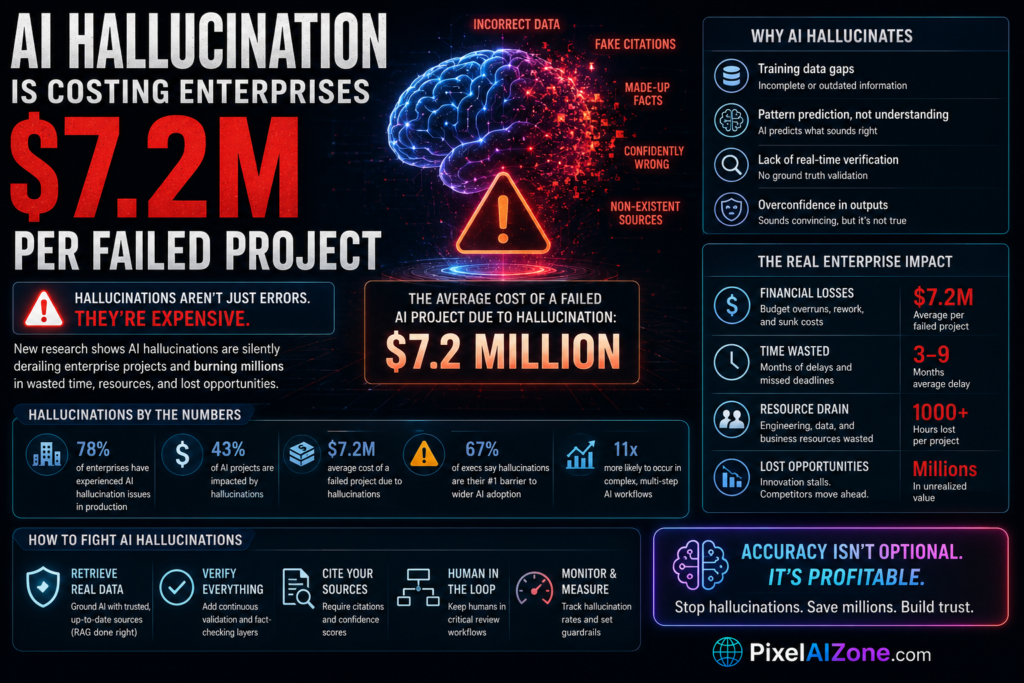
These are not isolated incidents. According to Deloitte’s 2026 research, the average sunk cost per abandoned AI initiative in a large enterprise is **$7.2 million** . Large enterprises with more than 10,000 employees abandoned an average of **2.3 initiatives each** in 2025 . That’s $14 to $21 million in sunk cost before a single initiative delivered production value.
AI hallucinations—instances where models generate confident but factually wrong outputs—are estimated to cost businesses $67 billion globally** . The average single AI error carries a price tag of **$4.4 million, and nearly half of all organizations have already taken that hit .
Table of Contents
- The Real Cost of AI Failure
- What Is an AI Hallucination?
- The Hallucination Tax: Real-World Costs
- Why AI Projects Fail: The $7.2M Problem
- How the 20% Succeed
- How to Protect Your Organization
- FAQ
The Real Cost of AI Failure
AI hallucination cost is destroying enterprise value across every industry in 2026.

The financial toll of failed AI initiatives is staggering across every industry:
According to McKinsey’s 2026 Global AI Survey, 73% of AI initiatives deliver zero measurable ROI . MIT Sloan Management Review found a 95% failure rate for enterprise generative AI projects . Gartner reports that 77% of AI failures are organizational, not technical .
What Is an AI Hallucination?
Understanding AI hallucination cost starts with knowing what hallucinations actually are.

AI hallucinations occur when a large language model generates content that is factually wrong, misleading, or invented with full confidence . LLMs do not possess knowledge in the human sense—they base their answers on data patterns. When the model encounters knowledge gaps, it does not say “I don’t know.” Instead, it generates a plausible answer and continues .
How Hallucinations Impact Business
The Hallucination Tax: Real-World Costs
The AI hallucination cost tax averages $4.4 million per single error across enterprises.

The “hallucination tax”—the financial impact of confidently wrong AI outputs—is destroying enterprise value across industries.
Why Hallucinations Are So Dangerous
Simon Dale, an AI skills coach, explains the core problem: “For businesses, the risk isn’t that AI gets things wrong occasionally, it’s that the output looks authoritative enough for people to act on it without checking or reiterating” .
The dangerous reversal: The more confidently an AI answers, the less you should trust it. Without human review, businesses cannot reliably distinguish between what’s factual and what isn’t. Automated checks cannot detect these errors because they appear convincing but are fundamentally incorrect .
Why AI Projects Fail: The $7.2M Problem
AI hallucination cost of $7.2 million per abandoned initiative is the new normal.

According to Deloitte’s 2026 research, 42% of companies abandoned at least one AI initiative in 2025, with the average sunk cost per abandoned initiative reaching $7.2 million . Large enterprises with more than 10,000 employees abandoned an average of 2.3 initiatives each .
The Five Failure Patterns
An analysis of over 2,400 enterprise AI initiatives across five industries identified five patterns that explain why AI fails at $7.2M per project :
1. Fragmented Workflows
Enterprises deploy AI tools by department: one for HR, another for compliance, a third for customer operations. Each works in isolation. None are connected. The result is “AI sprawl”—multiple AI systems making independent decisions about the same processes, generating conflicting outputs, with no unified governance layer .
2. The Governance Vacuum
Only 23% of AI project failures are caused by model performance or technical issues. The rest are strategy, governance, and change management failures. Most enterprises cannot trace which AI system influenced which decision .
3. The Architecture Gap
There is a fundamental difference between buying AI tools and building AI architecture. Tools solve point problems. Architecture determines how AI operates across the enterprise. The enterprises that fail are the ones that accumulated tools without designing the architecture to connect, govern, and audit them .
4. Unclear Ownership
AI initiatives often sit in a no-man’s-land between IT, business, and leadership. IT owns the infrastructure. Business owns the use case. Nobody owns the operationalisation. Without clear accountability for moving AI from pilot to production, pilots remain pilots indefinitely .
5. The Wrong Success Metric
Too many enterprises measure AI success by the number of pilots launched or the sophistication of the model. The right metric is simpler: is the AI in production, generating measurable business outcomes, and operating under governance?
How the 20% Succeed

According to recent research, only 20% of enterprise AI initiatives successfully deliver their intended business value . The enterprises that succeed do not treat AI as a tool purchase—they treat it as an architecture decision .
The Architecture-First Approach
Enterprises that treat AI as an architecture decision start by designing how AI will operate across the enterprise :
- Where AI assists at the design and configuration stage
- Where human oversight is mandatory
- How decisions are traced and audited
- How the system executes deterministically in production
The Most Effective Architecture
The most effective architecture separates AI from execution entirely. AI operates at design-time, configuring systems, generating workflows, building dashboards. Once a human approves the configuration, deterministic engines execute it with full auditability. The AI builds the system. Humans approve. Engines run .
How to Protect Your Organization
1. Implement Human-in-the-Loop Checkpoints
For high-impact actions, require human approval before execution. The most expensive AI failures happen when AI operates without human oversight. Amazon engineers are now working on “automated” guardrails to prevent AI-related cost overruns .
2. Build Evaluation Infrastructure
Agents without automated evals had a 47% rollback rate. Agents with full eval coverage had a 9% rollback rate. A test suite that mirrors real production inputs, ground truth labels, and automated regression testing is essential.
3. Calculate Your CPDO
Use the CPDO (Cost Per Defensible Output) framework to make AI spend measurable and defensible . Enterprises that intend to move from unsourced to sourced AI in 2026 will work through three phases: diagnose, deploy, scale .
4. Name an Owner Before Launch
Organizations with a single named, budgeted owner for an AI agent convert to production at a meaningfully higher rate. Diffuse ownership means nobody is accountable when something breaks at the worst possible time.
5. Define Graduation Criteria Before Kickoff
The teams that ship all established their baseline metrics before the pilot began, not after. They knew what task completion rate, latency, and error distribution looked like without the agent, so they had a clear empirical answer to the question that kills most pilot reviews: “But is this actually better?”
Frequently Asked Questions
Q: How much does a failed AI project really cost?
A: The average sunk cost per abandoned AI initiative in a large enterprise is $7.2 million. Large enterprises with over 10,000 employees abandoned an average of 2.3 initiatives each in 2025 .
Q: What is an AI hallucination?
A: AI hallucinations occur when a large language model generates content that is factually wrong, misleading, or invented with full confidence. LLMs do not possess knowledge in the human sense—they base their answers on data patterns .
Q: How much do AI hallucinations cost businesses?
A: AI hallucinations are estimated to cost businesses $67 billion globally**. The average single AI error carries a price tag of **$4.4 million, and nearly half of all organizations have already taken that hit .
Q: Why do AI projects fail?
A: The most prevalent category of AI failure has nothing to do with algorithms or infrastructure. It is organizational: misaligned goals, fragmented ownership, and the absence of a validation framework that connects engineering work to business outcomes .
Q: How can I protect my organization from AI hallucinations?
A: Implement human-in-the-loop checkpoints, build evaluation infrastructure, calculate your CPDO, name an owner before launch, and define graduation criteria before kickoff .
Q: How many AI projects actually deliver value?
A: Only 20% of enterprise AI initiatives successfully deliver their intended business value. McKinsey found that 73% deliver zero measurable ROI, and MIT found a 95% failure rate for enterprise generative AI projects .
Final Thoughts
The $7.2 million price tag for a failed AI project is not inevitable. AI hallucinations—instances where models generate confident but factually wrong outputs—are costing businesses $67 billion globally, but they are preventable with the right governance and human oversight .
What the data tells us:
- Average sunk cost per abandoned initiative: $7.2M
- 95% of enterprise generative AI projects fail
- 73% deliver zero measurable ROI
- 77% of failures are organizational, not technical
- AI hallucinations cost $67B globally
What the 20% that succeed do differently:
- Treat AI as an architecture decision, not a tool purchase
- Separate AI from execution—AI builds, humans approve, engines run
- Build governance alongside, not after
- Name an owner before launch
- Define graduation criteria before kickoff
- Build evaluation infrastructure
The model is rarely the problem. The organization around the model is. The $7.2 million cost of AI failure is not a technology problem—it is a management problem.
Related Posts on Pixelaizone
- Your AI Agents Are Over-Permissioned: 90% Have 10x More Access Than They Need (Critical Security Alert)
- Agentic AI vs Generative AI: The Ultimate Guide to What’s the Difference and Why 2026 Matters
- “The Rise of AI Agents: 5 Powerful Tools That Actually Do Work for You”
Has your organization faced the $7.2M AI failure? Drop a comment below!