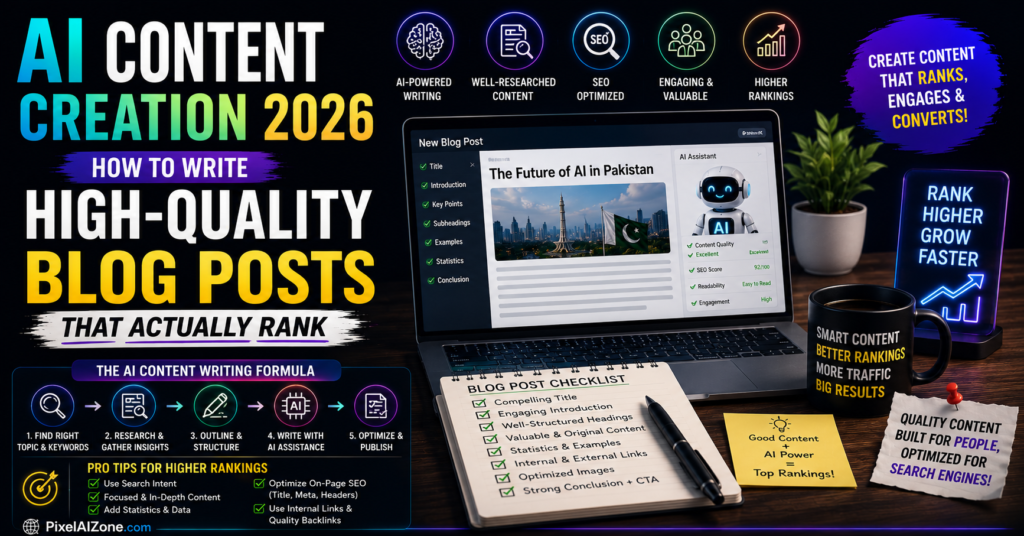
Stop wasting time with AI tools that don’t work. Here’s the exact AI content creation workflow for 2026.
Let me be honest with you.
Most people are using AI content creation completely wrong. They type a prompt, copy-paste the output, and hit publish. Then they wonder why nobody reads their content.
The problem isn’t AI. The problem is how you’re using it for content creation.
In this guide, I’ll show you the complete AI content creation workflow that professional bloggers are using in 2026 to create content that ranks, engages, and drives real traffic.
Table of Contents
- Why Most AI Content Creation Fails
- The Complete AI Content Creation Workflow
- Phase 1: Research & Ideation
- Phase 2: Writing with AI
- Phase 3: Human Refinement
- Phase 4: SEO Optimization
- Best Practices for AI Content Creation
- Common Mistakes in AI Content Creation
- FAQ
Why Most AI Content Creation Fails

There are 2 billion blog posts published every year, and 90% of them receive zero traffic from Google. The problem isn’t quantity — it’s quality.
AI content creation fails because creators often skip these critical steps:
| Mistake | Why It Fails |
|---|---|
| Copy-paste without editing | Robotic tone, generic structure |
| No fact-checking | AI “hallucinates” incorrect information |
| Ignoring brand voice | Generic content that doesn’t connect |
| Vague prompts | Surface-level, unhelpful content |
| No SEO optimization | Content never reaches the right audience |
According to Semrush research
According to research, even the most fluent AI draft sometimes feels like it’s “polished, but a little too neat” — it lacks the heartbeat that makes content memorable. This is why AI content creation needs a human touch.
The Complete AI Content Creation Workflow
Professional content creators aren’t replacing themselves with AI — they’re using a hybrid approach where human insight directs AI capabilities. Here’s the full AI content creation workflow:
text
Strategy → Research → AI Draft → Human Edit → Fact-Check → Publish → Monitor
In 2026, the best content teams treat AI as a collaborator that speeds up ideation, research, and production rather than a writer replacement. This AI content creation approach is what separates successful blogs from the rest.
Phase 1: Research & Ideation

Most content creators start with a blank page and no plan. That’s a huge mistake.
Why Research Matters
AI models don’t automatically know what’s relevant to your audience or what your competitors have covered. Without proper research, your AI content creation becomes generic.
How to Research Better
- Identify Content Gaps
AI-powered research tools can analyze trending topics, forums, and social media discussions to identify gaps in existing content. This allows you to write what readers actually want. - Analyze Search Intent
Every piece of content must solve a specific problem. Categorize topics into “Informational” (what is) or “Transactional” (best of) buckets. Google prioritizes pages that answer the user’s underlying questions. - Use Topic Clusters
Create one pillar article and link to smaller, specific articles around it. This “pillar-and-spoke” model signals to Google that you’re an expert on the topic.
Pro tip: 58% of small businesses now use generative AI. If you’re writing about AI tools, ensure your AI content creation provides unique insights and examples — not just generic product descriptions.
Phase 2: Writing with AI

Once research is done, use AI to generate the first draft. This saves hours of staring at a blank page.
How to Write a Draft with AI
Step 1: Create an Outline
Ask AI to generate a structured outline including introduction, main headings, subheadings, and conclusion based on your research findings.
Step 2: Write the First Draft
Generate a draft based on the outline. AI can quickly create content that serves as a starting point. This is “the clay” — you’ll sculpt it into art later.
Step 3: Use Multiple Tools
No single AI tool does everything well. A good writing tool without an SEO layer is “just a fancy notepad.” Use different tools for different tasks:
| Tool Category | Best For |
|---|---|
| ChatGPT | Versatile content creation |
| Claude | Deep analysis, nuanced writing |
| Grammarly | Editing, grammar, clarity |
| Jasper | Brand-focused marketing content |
Search Engine Journal reports
Pro tip: The most successful teams treat AI as a collaborator rather than a replacement. Use AI to handle the groundwork, then apply your judgment and expertise. This is the key to successful AI content creation.
Phase 3: Human Refinement

This is the most critical step that most people skip.
Why Human Editing Matters
Even the smartest AI tools need a human to refine tone, ensure accuracy, and add the personal touch that makes content engaging. AI lacks nuance, emotional depth, and original insights that come from lived experience.
What to Edit
- Fact-Check Everything
AI can “hallucinate” — producing information that is incorrect or doesn’t fit the content’s needs. Always verify facts, statistics, and quotes. - Add Your Voice
Even the best AI draft can feel impersonal. Add personal stories, specific examples from your experience, and a human touch that makes readers connect. - Check Flow and Readability
Read the content out loud. Does it sound natural? Break up long sentences, add contractions, and inject energy where needed. - Add Depth and Nuance
AI often produces surface-level content. Dig deeper in sections where you have real expertise. Add case studies, real-world examples, and industry insights.
Pro tip: Most AI drafts have “a good structure but a weak voice.” Focus your editing effort on strengthening the voice and adding personality. This is what separates average AI content creation from great content.
Phase 4: SEO Optimization

Content doesn’t rank just because it’s well-written. It needs to be optimized for search engines.
How to Optimize AI Content for SEO
- Keyword Research
Use AI-assisted SEO tools to identify relevant keywords and analyze what top-ranking pages are doing. - On-Page Optimization
AI can suggest relevant keywords, optimize headings, create meta descriptions, and add alt text for images. - Improve Readability
Use AI tools to analyze readability and suggest improvements to sentence structure, paragraph length, and overall flow. - Internal and External Links
Include links to your own related content and reputable external sources to build authority.
Pro tip: Even the best AI content creation won’t rank if it doesn’t demonstrate EEAT (Experience, Expertise, Authoritativeness, Trustworthiness). Add author bios, citations, and real-world proof.
Forbes Business Council notes
Best Practices for AI Content Creation
Based on the research, here are the key best practices for AI content creation in 2026:
- Verify Facts Always
AI can produce inaccurate information. Always fact-check before publishing. - Maintain Your Brand Voice
Edit AI-generated content to match your writing style and audience expectations. Consistency builds trust. - Focus on Value
Search engines prioritize helpful, original, and user-focused content. Use AI to assist, not replace, genuine expertise. - Avoid Fully Automated Publishing
Human review remains critical for quality control, accuracy, and authenticity. - Set Clear Instructions
If you don’t give specific instructions, AI can give you generic answers. Be clear about your audience, tone, and goals.
Common Mistakes in AI Content Creation
| ❌ Mistake | ✅ Fix |
|---|---|
| Publishing AI-generated content without editing | Always refine before publishing |
| Ignoring SEO optimization | Use AI tools to help with optimization |
| Overusing keywords | Focus on natural language and intent |
| Neglecting fact-checking | Verify every statistic and claim |
| Forgetting your brand voice | Edit AI content to match your style |
FAQ
Q: Does Google penalize AI-generated content?
A: No. Google doesn’t penalize content just because it’s AI-generated. What matters is whether it’s helpful, accurate, and demonstrates authority.
Q: Can AI fully replace human writers?
A: Not yet. AI can write clear, structured content, but it still struggles with “deep nuance, voice-matching, and real-time fact-checking.” Human judgment is essential for AI content creation.
Q: What’s the best way to use AI for content?
A: Use AI for research, drafts, and editing — but keep humans for strategy, refinement, and quality control.
Q: How much time can AI really save?
A: Most teams report saving hours per post, especially in the research and drafting phases. The key is having a structured AI content creation workflow.
Q: Are AI content tools worth the cost?
A: Yes. For teams, AI tools reduce production costs significantly while maintaining or improving quality. For individuals, free tiers are often enough to start.
Final Thoughts
The future of blog writing isn’t about choosing between AI and humans. It’s about finding a balance that plays to their strengths.
AI brings: Speed, scale, consistency, and data-driven insights
Humans bring: Creativity, empathy, lived experience, and judgment
The most successful content creators in 2026 aren’t the ones who use AI or don’t use AI. They’re the ones who know how to use AI as a collaborator while bringing their own expertise, stories, and perspective to every piece.
Your action plan for AI content creation:
- Use the research phase to identify what your audience actually needs
- Let AI write the first draft, but never publish raw output
- Add your voice, insights, and personal experience
- Optimize for SEO with AI-assisted tools
- Review, refine, and fact-check every piece
Start publishing content that actually works. 🚀
Related Posts on Pixelaizone
- AI Content Mistakes: 5 Errors That Kill Your Rankings (And How to Fix Them)
- AI in Pakistan 2026: How Artificial Intelligence is Transforming the Nation (Complete Guide)
- Best AI Tools for YouTube in Pakistan 2026 (Free & Paid)
- “7 Easy Ways to Make AI Voiceover Videos for YouTube & TikTok (Step-by-Step Guide 2026)”
- Best AI Tools for Students in 2026 (Save 10+ Hours Weekly)
- “7 Real Ways to Make Money Online in Pakistan with AI (Easy & Legal 2026)”
- “Viral AI Microdramas Pakistan: How to Create Amazing Food Stories for Instagram in 2026”
- Best AI Tools for Making Money Online in 2026 (Powerful & Viral Guide)
- ChatGPT vs Gemini in 2026 (Powerful AI Comparison Guide)
- Top 10 Powerful Work From Home Jobs for Students in 2026
- How to Start a Blog and Make Money in 2026 (Ultimate Beginner Guide)
- Ultimate Guide: Best AI Tools for Content Creators in 2026
- Ultimate Guide: Best Web Hosting for Beginners in 2026
- Ultimate Guide: Best Freelancing Skills to Learn in 2026 for Beginners
- Free AI Tools For Students In 2026
What step in your AI content creation workflow do you find most challenging? Drop a comment below!