From classrooms in Lahore to farms in Sindh, AI is reshaping Pakistan’s future. Here’s everything you need to know.
Pakistan is at a crossroads. We’ve shown the world we can build a thriving tech export industry, hitting a record-breaking US$3.8 billion in IT exports . We have a massive pool of talented, digitally savvy youth. And now, for the first time, we have a clear, official National AI Policy .
The question isn’t if AI will change things, but whether we’ll seize this moment to move beyond basic services and create high-value products and solutions .
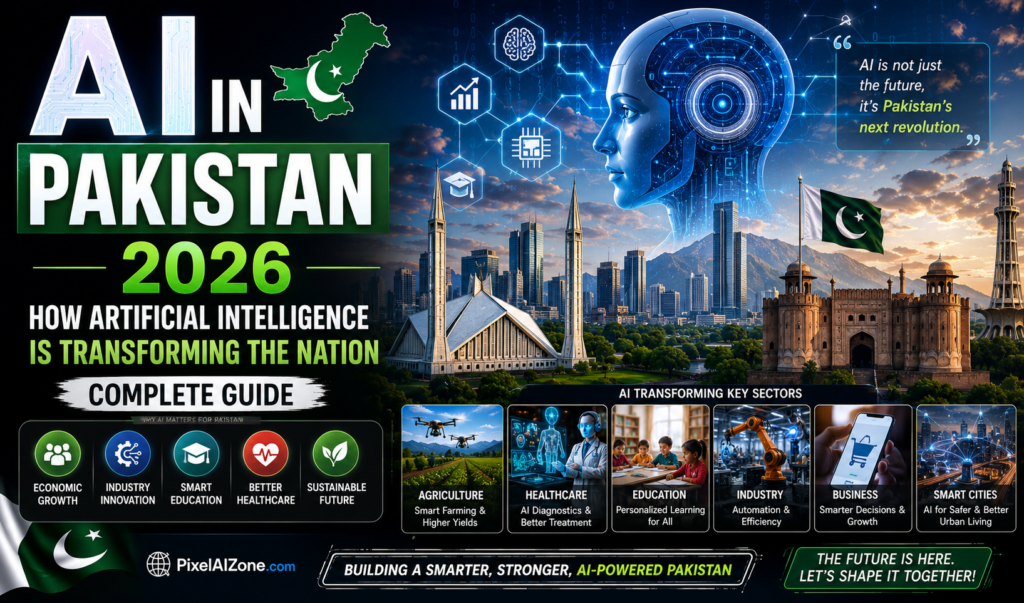
In this comprehensive guide, I’ll show you how AI in Pakistan is transforming industries, creating opportunities, and shaping the nation’s future.
Table of Contents
- Pakistan’s AI Landscape in 2026
- AI in Education
- AI in Healthcare
- AI in Agriculture
- AI in Banking & Finance
- AI in Governance & Public Services
- Pakistan’s National AI Policy
- Challenges & Solutions
- The Future of AI in Pakistan
- FAQ
Pakistan’s AI Landscape in 2026
The International Growth Centre (IGC) reports that while Pakistan ranks 97th out of 133 countries on overall digital infrastructure, significant progress is being made. As of 2025, 116 million Pakistanis had access to the internet – an internet penetration rate of 45.7% .
Key developments in AI in Pakistan:
✅ National AI Policy 2025 – Approved by the cabinet, signaling a strategic commitment to mainstreaming AI in governance and development
✅ Digital skills programmes – DigiSkills and similar initiatives training thousands in AI-related fields
✅ Growing AI startups – Fintech, edtech, and healthtech companies emerging across Pakistan
✅ IT export growth – Increased by 23.7% in 2024-25
✅ Government commitment – Reported 2,000 MW allocation for data centers supporting compute-intensive industries
According to researchers, AI adoption in developing countries should align with development priorities rather than being driven by technological advancements alone .
AI in Pakistan is no longer a futuristic concept – it’s happening right now.
AI in Education
Education is one of the most promising areas for AI in Pakistan. A study in the Pakistan Journal of Life and Social Sciences found that teachers already see the potential for using Large Language Models (LLMs) to support learning English as a Foreign Language (EFL) .
How AI helps in education:
✅ Lesson preparation – Teachers can quickly create lesson materials and practice questions
✅ Personalized feedback – Students receive individual guidance at scale
✅ Rural access – English language learners in rural areas can get additional practice through AI tools after school hours
✅ Urdu and regional language support – AI-powered platforms in local languages
What the research shows: Simple chat and questioning tools were the most widely used by teachers, while more complex features like advanced content creation were less common. This suggests that straightforward, targeted AI tools could have the fastest impact .
Important: Teachers must be trained to review and refine AI-generated material to ensure accuracy and relevance. Without this oversight, there is a risk of misinformation or over-reliance on AI .
The impact of AI in Pakistan’s education sector is already visible.
AI in Healthcare

Pakistan faces an acute shortage of doctors, particularly in rural and under-served areas. LLM-powered tools could bridge critical gaps in access to services .
How AI can transform healthcare in Pakistan:
✅ Quick symptom checks – AI tools can support nurses and healthcare workers with initial assessments
✅ Language translation – Translating medical information into local languages for better understanding
✅ Patient guidance – Basic health steps for patients in remote areas
✅ TB diagnosis – Nigeria and the Philippines are already using AI-powered chest X-rays to triage TB cases – a model Pakistan could adopt
Important consideration: These tools must be carefully tested to protect patient privacy, ensure medical accuracy, and maintain public trust .
AI in Pakistan’s healthcare system can save millions of lives.
AI in Agriculture
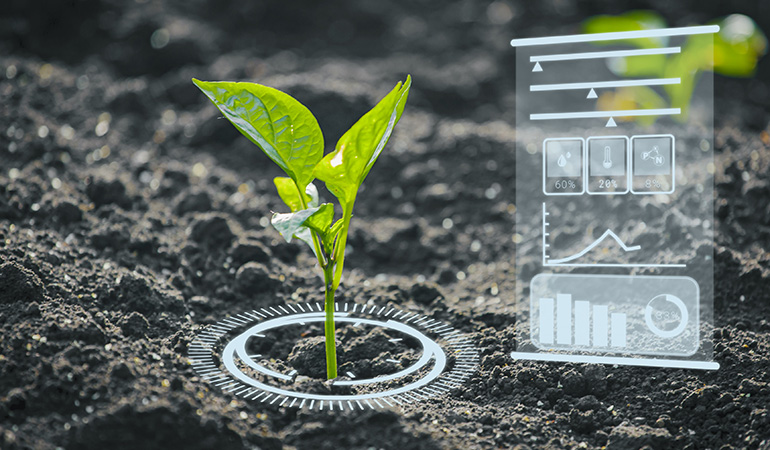
Agriculture is the backbone of Pakistan’s economy. AI can transform this vital sector by equipping farmers with timely, localized information .
How AI helps farmers:
✅ Weather forecasts – Accurate predictions in local languages
✅ Crop-care advice – Specific guidance for different crops and conditions
✅ Early warnings – Alerts about plant diseases before they spread
✅ Language accessibility – Information delivered in local languages
Example from the region: In Bangladesh and India, researchers have used machine learning on satellite images to map polluting brick kilns, helping policymakers target inspections and promote cleaner technologies .
AI in Pakistan’s agriculture is helping farmers grow more with less.
AI in Banking & Finance

AI has the potential to modernise Pakistan’s financial system, making banking more secure, accessible, and user-friendly .
How AI helps financial services:
✅ Fraud detection – Identify suspicious transactions in real-time
✅ Customer service – Chatbots handling routine queries
✅ Risk analysis – Better assessment of lending and investment risks
✅ Financial literacy – Simplifying complex financial terms for the public
Regional example: India’s Goods and Services Tax (GST) system integrates AI for risk detection, identifying suspicious transactions and high-risk taxpayers. South Africa’s Revenue Service employs machine learning risk engines, with official reports attributing a third of compliance revenue in some periods to these systems .
AI in Pakistan’s banking sector is making transactions more secure.
AI in Governance & Public Services

The International Growth Centre is working with the Punjab Environment Protection & Climate Change Department to develop smog alert systems using real-time air quality data and satellite imagery .
How AI helps government services:
✅ Smog monitoring – AI-powered early warning systems for floods, smog, and heatwaves
✅ Tax collection – Machine learning tools using satellite imagery to detect unassessed properties
✅ Urban planning – Using Call Data Records (CDRs) to map migration flows and identify infrastructure gaps
✅ Social protection – Mapping vulnerability using electricity consumption data (70% accuracy achieved in a Karachi pilot)
Research example: IGC supported research in Khyber Pakhtunkhwa developed machine learning tools that use satellite imagery to detect unassessed properties and informal sprawl, reducing reliance on manual surveys and improving property tax compliance .
AI in Pakistan’s governance is improving public services.
Pakistan’s National AI Policy
In July 2025, Pakistan’s cabinet approved the National AI Policy, signalling a strategic commitment to mainstreaming AI in governance and development .
The policy sets ambitious goals:
- Training AI professionals – Building human capital for the AI economy
- Launching civic AI projects – Applying AI to public service challenges
- Homegrown AI products – Developing Pakistani AI solutions
- AI Council – Establishing governance and oversight
- Innovation and venture fund – Financing AI startups and projects
- Cybersecurity and ethics – Protecting data and ensuring responsible use
Expert recommendation: AI must be directly tied to development outcomes like tax compliance, smog mitigation, and inclusive service delivery, rather than abstract targets .
Challenges & Solutions
While the potential is huge, so are the hurdles .
Infrastructure Gaps
Challenge: Pakistan needs modern, reliable data centers and high-speed networks. The 2,000 MW allocation is a great start, but needs to be matched by significant investment in world-class data infrastructure .
Solution: Government-private partnerships for building compute capacity and data centers.
Funding Hurdles
Challenge: The global funding slowdown hit Pakistan hard. Startups need alternative financing models and support .
Solution: Revenue-based financing and patient capital for AI ventures.
Talent Mismatch
Challenge: Universities produce graduates, but curriculum often lags industry needs .
Solution: Urgent focus on practical skills like MLOps, dataset engineering, and model governance .
Language Biases
Challenge: Research has found that LLMs often behave differently in local languages compared to English, leading to unintended biases .
Solution: Building AI models trained on Urdu and regional language datasets.
Digital Divide
Challenge: Over half the population remains offline (45.7% internet penetration) .
Solution: Invest in affordable internet access and digital literacy.
Data Silos
Challenge: Administrative data across government agencies remains non-digitised, fragmented, and in silos. Provisions for cross-agency data-sharing protocols are limited .
Solution: Develop anonymised, interoperable data platforms with strong safeguards.
The Future of AI in Pakistan
According to the International Growth Centre, Pakistan must shift from being a passive adopter to a lead user, embedding AI into everyday workflows. This means integrating AI not as a one-off innovation, but as a core part of everyday public sector workflows – from forecasting school dropouts to optimising public health outreach .
What success looks like in 5 years:
✅ Export Acceleration – Shifting from simple data entry to building sophisticated AI models for global companies
✅ Public Productivity – Government using AI for fraud detection, predictive maintenance, and automating tedious paperwork
✅ Leapfrogging Development – AI-powered tools in rural clinics and personalized learning platforms in Urdu
Global benchmark: India’s adaptive learning programme, Mindspark, used technology-aided instruction to boost student scores in math and language in under five months . Pakistan can achieve similar results with targeted AI implementation.
FAQ
Q: Is AI really going to transform Pakistan?
A: Yes. With proper planning and investment, AI can address Pakistan’s most pressing challenges in education, healthcare, agriculture, and governance .
Q: What’s the biggest barrier to AI adoption in Pakistan?
A: Infrastructure gaps and limited access to official datasets . However, the government is taking steps to address these through the National AI Policy.
Q: Can AI help with Pakistan’s economic growth?
A: Yes. IT exports grew by 23.7% in 2024-25, and AI can accelerate this further by moving from services to high-value products .
Q: How can I start learning AI in Pakistan?
A: Start with DigiSkills programmes, online courses, and free tools like ChatGPT. Focus on practical skills like MLOps and dataset engineering .
Q: Will AI take jobs in Pakistan?
A: AI will transform jobs, not eliminate them. It will create new opportunities in AI training, model development, and AI-assisted services .
Q: What is Pakistan’s AI readiness?
A: Pakistan ranks 8th of 17 countries across South and Central Asia – below India, Bangladesh, and Sri Lanka – but significant progress is being made .
Q: What is the current state of AI in Pakistan?
A: AI in Pakistan is growing rapidly with government support.
Final Thoughts
Pakistan is not starting from scratch. We have a strong foundation to build on:
✅ A massive talent pool – Millions of young, digitally literate people
✅ Growing exports – US$3.8 billion in IT exports shows global demand
✅ Political will – National AI Policy and data center allocation are clear signals
✅ Research evidence – IGC-funded pilots demonstrate what works
The window of opportunity is open, but it won’t stay open forever.
The technology is ready. It’s time for Pakistan to get ready as well .
The future of AI in Pakistan depends on how we adopt and implement it today.
Related Posts on Pixelaizone
- Best AI Tools for YouTube in Pakistan 2026 (Free & Paid)
- “7 Easy Ways to Make AI Voiceover Videos for YouTube & TikTok (Step-by-Step Guide 2026)”
- Best AI Tools for Students in 2026 (Save 10+ Hours Weekly)
- “7 Real Ways to Make Money Online in Pakistan with AI (Easy & Legal 2026)”
- “Viral AI Microdramas Pakistan: How to Create Amazing Food Stories for Instagram in 2026”
- Best AI Tools for Making Money Online in 2026 (Powerful & Viral Guide)
- ChatGPT vs Gemini in 2026 (Powerful AI Comparison Guide)
- Top 10 Powerful Work From Home Jobs for Students in 2026
- How to Start a Blog and Make Money in 2026 (Ultimate Beginner Guide)
- Ultimate Guide: Best AI Tools for Content Creators in 2026
- Ultimate Guide: Best Web Hosting for Beginners in 2026
- Ultimate Guide: Best Freelancing Skills to Learn in 2026 for Beginners
- Free AI Tools For Students In 2026
What aspect of AI in Pakistan excites you most? Drop a comment below!