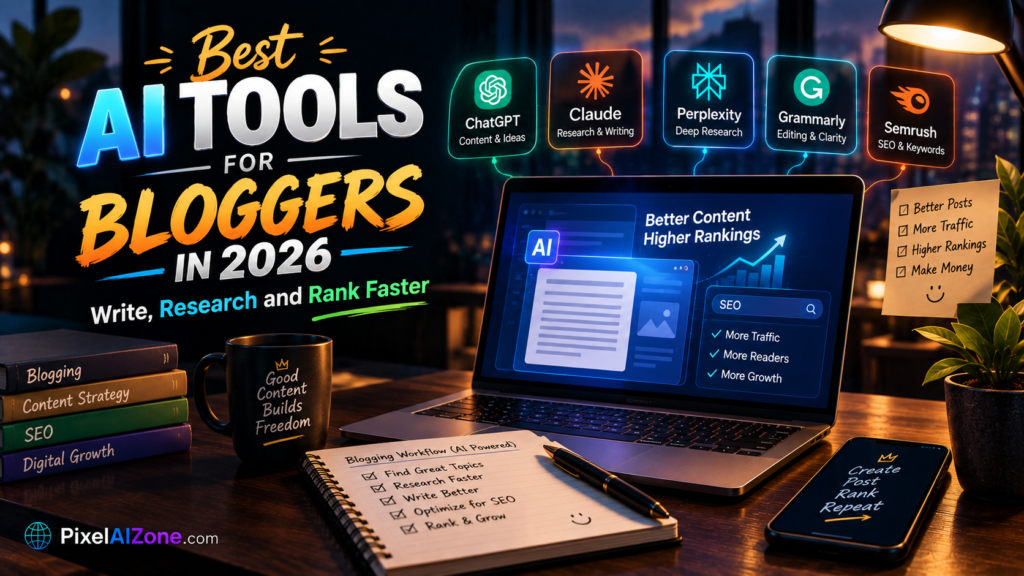
Stop juggling 20 tabs. Here’s the exact AI toolkit that turns your blog from a side project into a traffic engine.
Let me show you something.
The biggest mistake bloggers make is searching for a single “best AI tool.” After testing dozens of options, I’ve found that no single tool does everything well. The best AI tools for bloggers in 2026 combine research, writing, visuals, and optimization into one workflow.
The best AI tools for bloggers in 2026 have evolved far beyond simple chatbots. They now handle the entire content lifecycle — from finding what to write about to making sure AI search engines actually cite your work. According to Surfer SEO’s AI search study, 68% of AI-cited pages are not in the top 10 organic results. If you want to grow your blog faster, choosing the best AI tools for bloggers in 2026 is the single highest-leverage decision you’ll make this year.
Table of Contents
- Why Bloggers Need a Tool Stack, Not Just One Tool
- ChatGPT: The Brainstorming and Planning Engine
- Claude: The Long-Form Content Specialist
- Perplexity: The Research Assistant
- Canva AI: The Visual Content Creator
- Grammarly: The Final Polish
- Surfer SEO: The Optimization Layer
- Notion AI: The Organization Hub
- The 2026 Blogging Workflow
- FAQ
Why Bloggers Need a Tool Stack, Not Just One Tool
The best AI tools for bloggers in 2026 are not all-in-one platforms. They’re specialized tools that each do one thing exceptionally well. The combination is far more powerful than relying on a single platform.
Why a stack beats one tool:
| Single Tool Approach | Tool Stack Approach |
|---|---|
| Generalist output | Specialist quality at every stage |
| One workflow bottleneck | Each stage optimized separately |
| Free tier limits hit fast | Free tiers combined cover most needs |
| No backup when down | Redundancy across tools |
The best AI tools for bloggers in 2026 fall into four categories: research, writing, visuals, and optimization. Master one tool from each category, and you’ll outperform 90% of bloggers who rely on a single chatbot.
ChatGPT: The Brainstorming and Planning Engine
Best AI tool for bloggers in 2026 for: Brainstorming, outlining, improving readability, and generating headline options.
ChatGPT remains the Swiss Army knife of AI tools — versatile enough to handle almost any task, even if it’s not the absolute best at any single one.
What it does well:
- Article planning and outlining
- Generating multiple headline options
- Research assistance
- SEO-friendly rewriting
How to use it in your workflow:
I use ChatGPT to turn raw ideas into structured outlines. Instead of staring at a blank page, I ask for 5-10 headline options, pick the best one, and build an outline around it. This single habit kills writer’s block permanently.
The limitation: ChatGPT is a generalist. The best AI tools for bloggers in 2026 include ChatGPT for ideation, but not for final long-form drafting where natural tone matters more.
Claude: The Long-Form Content Specialist
Best AI tool for bloggers in 2026 for: Long-form writing, maintaining natural tone, and handling very large documents.
Where ChatGPT is a generalist, Claude is a specialist. It excels at long-form writing and maintaining a tone that doesn’t sound AI-generated. It handles documents up to 200,000 words in a single session — roughly a 500-page book.
What it does well:
- In-depth blog posts
- Documentation and content refinement
- Consistent tone across long pieces
- Processing large source documents
How to use it in your workflow:
Once I have an outline from ChatGPT, I move to Claude for the actual writing. Claude’s ability to hold context across long pieces makes it ideal for 1,500-2,500 word articles. The prose needs less editing.
The limitation: Claude is a pure writer. It doesn’t have the same breadth of features as ChatGPT, but it doesn’t need to.
Perplexity: The Research Assistant

Best AI tool for bloggers in 2026 for: Fact-checking, gathering recent information, and finding cited sources.
Instead of opening multiple Google tabs, I use Perplexity to gather recent information with cited sources. It’s a research-first tool that provides direct answers backed by real sources.
What it does well:
- Fact-checking claims
- Finding recent references
- Gathering cited information
- Research with source transparency
How to use it in your workflow:
During the research phase, I use Perplexity to find current data, statistics, and references. The citations make it easy to verify claims and build a reference list.
The limitation: Perplexity is for research, not writing. Among the best AI tools for bloggers in 2026, it’s the one you open first — before you write a single word.
Canva AI: The Visual Content Creator

Best AI tool for bloggers in 2026 for: Creating blog graphics, featured images, infographics, and social media visuals.
Creating blog graphics and social media images is much faster with Canva’s AI features. You don’t need to be a designer to create professional-looking visuals.
What it does well:
- Featured images
- Infographics and data visualizations
- Social media visuals
- Magic Resize for multiple platforms
How to use it in your workflow:
Once the article is written, I generate a featured image and social media graphics using Canva AI. Magic Resize alone saves hours per month for multi-platform publishers.
The limitation: Canva AI is for visuals, not writing. The best AI tools for bloggers in 2026 are complementary, not interchangeable.
Grammarly: The Final Polish
Best AI tool for bloggers in 2026 for: Proofreading, grammar checking, and clarity refinement.
Even with AI-generated content, grammar and clarity still matter. Grammarly helps polish the final draft. Nothing screams “amateur” like a blog post full of spelling mistakes and bad commas.
What it does well:
- Grammar and spelling checking
- Tone and clarity refinement
- Readability improvement
- Engagement suggestions
How to use it in your workflow:
After the content is generated and structured, I run it through Grammarly as a final check. The free version catches 90% of critical errors — enough for most blog posts.
The limitation: The free version is sufficient for most bloggers. Premium is rarely necessary.
Surfer SEO: The Optimization Layer

Best AI tool for bloggers in 2026 for: SEO-focused content optimization, keyword research, and on-page analysis.
Surfer SEO is one of the strongest tools for SEO-focused content, with keyword research, optimization tools, and an AI content editor to help rank higher. In 2026, its most important evolution is its move toward Answer Engine Optimization (AEO) — it now helps structure content to appear in AI-generated search overviews.
What it does well:
- On-page SEO optimization
- Keyword research
- Content structure recommendations
- Competitor analysis
- AI visibility tracking across ChatGPT, Perplexity, and Google AI Overview
How to use it in your workflow:
Before publishing, I run the article through Surfer SEO to identify missing keywords, check heading structure, and ensure the content is optimized for search.
The limitation: Surfer SEO is a specialist tool. It doesn’t write content — it helps you optimize what you’ve already written.
Notion AI: The Organization Hub
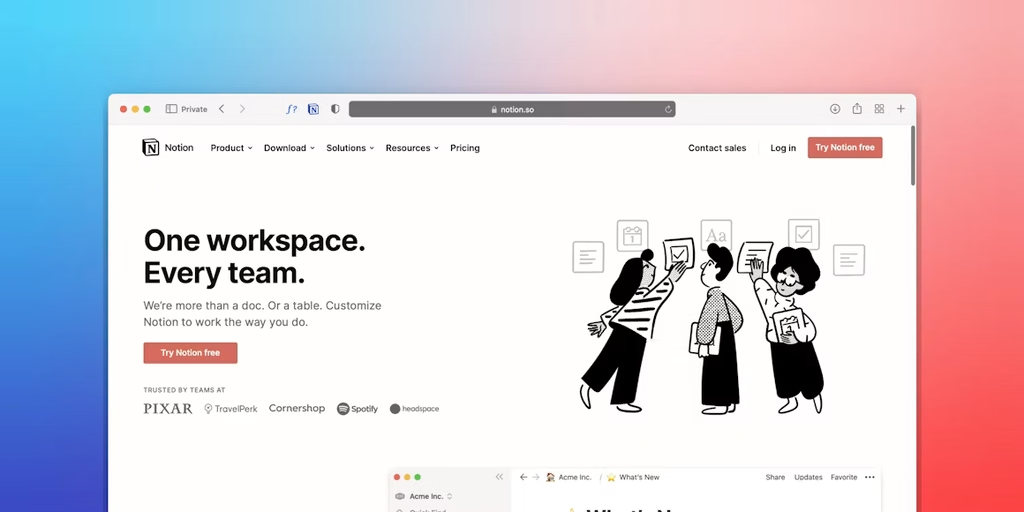
Best AI tool for bloggers in 2026 for: Organizing ideas, managing content calendars, and tracking research notes.
Notion AI is perfect for organizing ideas, content calendars, and research notes. It’s the glue that holds the workflow together.
What it does well:
- Content calendar management
- Research note organization
- Idea tracking and categorization
- Team collaboration
How to use it in your workflow:
I use Notion to track article ideas, store research notes, and manage the editorial calendar. It provides a single source of truth for the entire content operation.
The limitation: Notion is for organization, not writing. It coordinates your other tools rather than replacing them.
The 2026 Blogging Workflow
The most productive bloggers build a workflow where each tool does what it does best. According to HubSpot’s State of AI report, 74% of marketers say AI tools save them at least 5 hours per week.
| Stage | Tool | What It Does |
|---|---|---|
| 1. Research | Perplexity | Gather cited information |
| 2. Brainstorming | ChatGPT | Create outline and headline options |
| 3. Writing | Claude | Expand and refine into polished content |
| 4. Visuals | Canva AI | Generate featured image and graphics |
| 5. Optimization | Surfer SEO | On-page SEO and keyword analysis |
| 6. Proofreading | Grammarly | Final polish and grammar check |
| 7. Organization | Notion AI | Content calendar and research tracking |
Each tool has a specific role. No single tool does everything well.
FAQ
Q: Do I need to pay for all seven tools?
A: No. ChatGPT, Claude, Perplexity, Canva, Grammarly, and Notion all have free tiers. Surfer SEO has a free trial. You can build this entire workflow without spending anything.
Q: Can I replace some tools with all-in-one platforms?
A: Yes, but quality varies. The best AI tools for bloggers in 2026 are specialized. The toolkit approach works because each tool is optimized for a specific task.
Q: Which is the most important tool?
A: It depends on the task. ChatGPT is best for planning. Claude is best for writing. Perplexity is best for research. The combination is what makes the toolkit effective.
Q: Can I use this workflow for short-form content?
A: Yes. The same workflow works for shorter pieces. Skip steps that aren’t needed.
Q: What if I’m on a tight budget?
A: Start with the free tiers of ChatGPT, Perplexity, Claude, Canva, and Grammarly. This covers research, writing, visuals, and proofreading at zero cost.
Final Thoughts
The best AI tools for bloggers in 2026 aren’t a single product. They’re a stack of specialists that together outperform any generalist platform.
The 2026 toolkit approach:
- Research with Perplexity
- Brainstorm with ChatGPT
- Write with Claude
- Design with Canva AI
- Optimize with Surfer SEO
- Proofread with Grammarly
- Organize with Notion AI
The combination is far more powerful than relying on one platform alone. According to We Are Social’s Digital 2026 report, the number of bloggers using AI tools has doubled in the past year alone.
Related Posts on Pixelaizone
- [AI Search Optimization in 2026: How to Make Your Website Visible in ChatGPT and Google AI]
- No Single AI Tool Does Everything: The Essential 7-Piece Toolkit Every Blogger Needs in 2026
What’s your preferred AI toolkit for blogging? Drop a comment below!