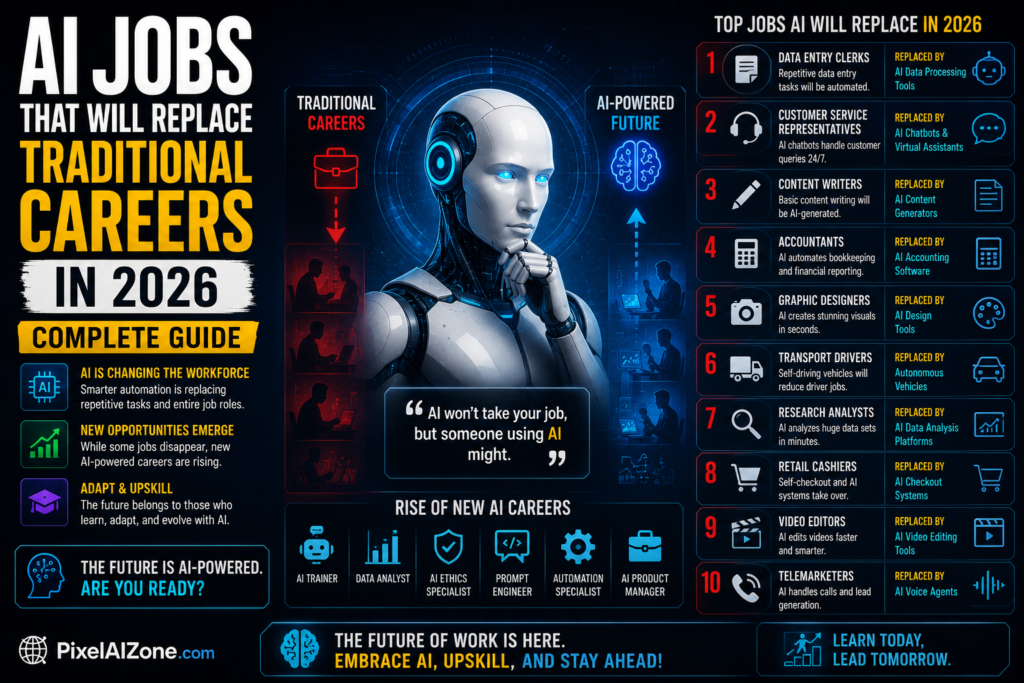
Understanding the shift from tools that respond to systems that act
Understanding the difference between AI agents vs AI assistants is critical in 2026.
Let me be honest with you.
You’ve probably used ChatGPT. Maybe you’ve asked it to write an email, summarize a document, or brainstorm ideas. That’s an AI assistant. It responds when you ask.
But in 2026, a new category of AI is emerging. One that doesn’t wait for your instructions. One that figures out what needs to be done and does it.
This is the difference between AI assistants and AI agents.
Most people don’t know the difference yet. And that’s exactly why this matters for your business.
“Understanding the difference between AI agents vs AI assistants is critical for anyone looking to leverage AI effectively in 2026.”
This guide breaks down AI agents vs AI assistants and why it matters for your business.
Table of Contents
- The Key Difference: Responding vs. Acting
- What Is an AI Assistant?
- What Is an AI Agent?
- How AI Agents Actually Work
- Real-World Examples of AI Agents in Action
- Why 2026 Is the Turning Point
- What This Means for Your Business
- FAQ
Understanding AI Agents vs AI Assistants (The Core Difference)
The Key Difference: Responding vs. Acting
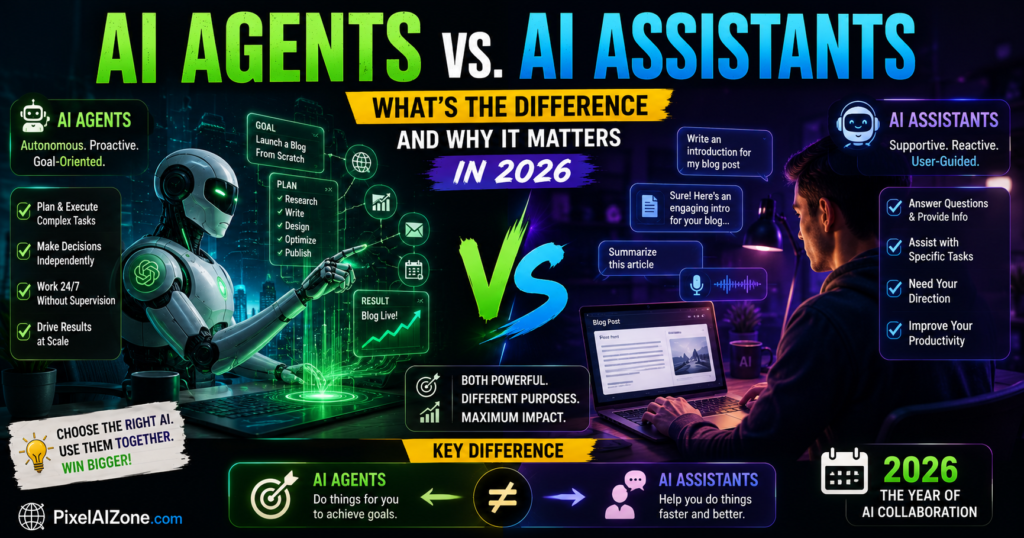
AI assistants respond to prompts.
AI agents act on objectives.
This is the fundamental distinction that separates the two categories .
| AI Assistant | AI Agent |
|---|---|
| Waits for your instruction | Works toward a goal |
| Responds once | Takes multiple steps |
| Follows your exact request | Figures out the best path |
| No memory of past interactions | Learns and improves over time |
| Can write a blog post | Can build a complete content pipeline |
Think of it this way:
An AI assistant is like a junior employee who does exactly what you tell them. They don’t take initiative. They don’t suggest better approaches. They just execute your instructions.
An AI agent is like a manager. You give them a goal—”improve our content pipeline”—and they figure out the steps, take action, monitor results, and adjust accordingly.
The difference is intent. An AI agent can understand objectives, break them into tasks, and execute them across multiple tools and systems .
What Is an AI Assistant?

You already know AI assistants. You’ve probably used them.
ChatGPT. Claude. Google Gemini. Microsoft Copilot. These are AI assistants.
How They Work
AI assistants are built on large language models (LLMs). They can:
- Write emails and blog posts
- Answer questions
- Summarize documents
- Brainstorm ideas
- Translate content
But they don’t initiate anything. They wait for you to ask.
According to Bluehost’s AI productivity report, 90% of users today are using AI in the “assistant” mode—asking it to do something and then deciding what to do with the output .
The Limitation of Assistants
The problem is this: an assistant can’t take action without you telling it to. It can draft an email, but it can’t send it. It can analyze data, but it can’t update your dashboard. It can research a topic, but it can’t publish the results.
Every step requires human handholding.
This is what makes assistants useful, but limited. They speed up your work. They don’t automate it.
To understand AI agents vs AI assistants, start with what each does.
What Is an AI Agent?
An AI agent represents a fundamentally different paradigm.
According to research from Kovair, “an AI agent is not a chatbot; it’s not a one-off automation. It is a system that can understand objectives, break goals into tasks, do those things over tools and across knowledge areas, monitor outcomes, and adapt to the results” .
How AI Agents Are Different
Unlike traditional automation, AI agents can :
- Interpret intent: They don’t need precise instructions. They understand what you want to achieve.
- Learn from context: They consider user roles, policies, and past behavior.
- Coordinate actions across systems: They can work with multiple apps at once.
- Reason through requests: They don’t just follow rules—they adapt.
- Self-correct: When something doesn’t work, they try a different approach.
The distinction is critical: Traditional automation follows rules. AI agents operate on intent.
Traditional automation says, “If X happens, do Y.”
AI agents say, “Here’s the objective. Figure out how to make it happen.”
This is the core difference between AI agents vs AI assistants.
How AI Agents Actually Work
According to the Moveworks research, AI agents combine three key capabilities :
1. Natural Language Understanding
AI agents can understand what you’re asking for, even when you’re vague.
“Help me improve my content marketing”
An assistant would say, “I can write blog posts for you.” An agent would say, “Let me analyze your current content, identify gaps, create a publishing schedule, draft posts, and track results.”
2. Reasoning
AI agents think through problems. They don’t just follow steps—they decide the best approach based on context.
An agent can:
- Identify bottlenecks in a workflow
- Suggest alternatives
- Choose which tool to use for each task
According to the research, this reasoning capability is what sets AI agents apart from earlier automation systems .
3. Tool Interoperability
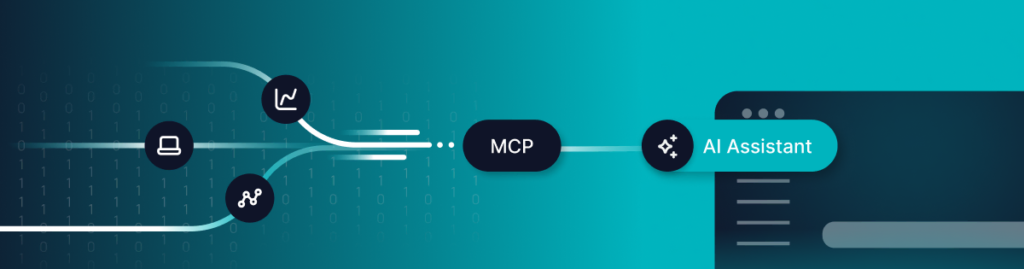
AI agents work across applications. They can:
- Check data in your CRM
- Draft content in Google Docs
- Schedule posts in Buffer
- Update spreadsheets
According to the Uncanny Automator guide, “AI workflow automation” involves AI running as one step inside an otherwise rules-based workflow . But agentic AI takes this further by acting alongside or above workflows, not just inside them.
Real-World Examples of AI Agents in Action
Example 1: Content Marketing Agent

Traditional workflow:
You research keywords → write an outline → draft content → edit → publish → promote.
AI agent workflow:
You give the agent a goal: “Grow our organic traffic for AI-related keywords.”
The agent:
- Analyzes your current content and rankings
- Identifies content gaps and keyword opportunities
- Creates a 3-month content calendar
- Generates first drafts based on your brand voice
- Queues posts for review
- After approval, publishes and distributes
According to the Kovair research, this approach allows tasks to run in parallel rather than sequentially, eliminating delays and allowing teams to focus on strategy rather than execution .
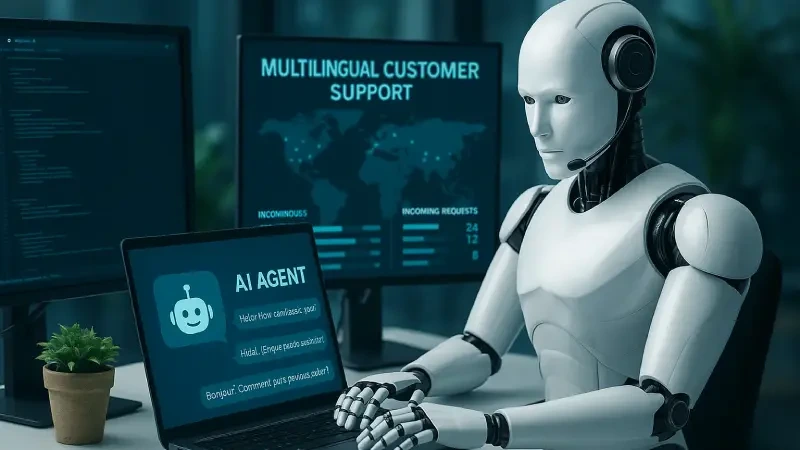
Example 2: Customer Support Agent
Traditional workflow:
Customers submit tickets → support team triages → resolves → closes.
AI agent workflow:
The agent:
- Analyzes incoming support tickets
- Resolves common issues automatically (password resets, FAQs)
- Escalates complex issues to humans with full context
- Monitors resolution time and flags delays
According to the Amadeus case study, using AI-powered support reduced support calls by approximately 30-40 percent and saved employees over 16,000 hours each month .
Example 3: IT Issue Resolution

Traditional workflow:
Employee logs ticket → IT team triages → researches → resolves → closes.
AI agent workflow:
The agent:
- Allows employees to describe problems in natural language
- Identifies likely causes by checking permissions and systems
- Resolves common issues automatically
- Escalates with diagnostic information when needed
Broadcom integrated multiple knowledge bases into a single AI-driven support experience and was able to support 88 percent of IT issues in under a minute .
Example 4: Performance Reporting Agent
Traditional workflow:
Manually pull data from Google Analytics, Search Console, social platforms → create reports → present.
AI agent workflow:
The agent:
- Pulls data from multiple sources on schedule
- Identifies trends and anomalies
- Creates formatted reports with insights
- Delivers directly to stakeholders
- Flags metrics that need immediate attention
According to the Simplified workflow research, marketing teams using AI workflow automation bring campaigns to market up to 75% faster .
These examples show AI agents vs AI assistants in action.
Why 2026 Is the Turning Point
The gap between AI agents vs AI assistants is widening in 2026.
Three Developments Made AI Agents Possible
According to the Kovair research, three factors converged in 2026 :
1. Sophisticated planning models
AI can now reason and plan multiple steps ahead, not just respond to immediate prompts.
2. Tool interoperability
AI agents can work across different software ecosystems—not just one platform.
3. Memory and feedback loops
AI agents can learn from past actions and improve over time.
The Shift in How We Work
The Kovair article explains that by 2026, AI agents represent “a point of no return.” AI is no longer simply learning to follow instructions. It is acting autonomously .
This changes what work looks like.
Instead of:
- Manual execution → autonomous systems
- Task management → outcome orchestration
- Busy work → meaningful work
What This Means for Your Business
Impact on Productivity
According to McKinsey research cited by Simplified, AI agents could automate up to 40% of marketing activities .
For a small content team, this means:
| Task | Manual Time | AI Agent Time | Time Saved |
|---|---|---|---|
| Weekly content planning | 2-3 hours | 10-15 minutes | 90% |
| Social media distribution | 45-60 minutes/post | Automated | 100% |
| Performance reporting | 2-4 hours/week | Real-time dashboard | 95% |
| Email nurturing | 3-5 hours/sequence | Automated | 100% |
According to the Simplified workflow analysis, small marketing teams burn 60-70% of their time on repetitive execution tasks instead of the creative, strategic work that actually grows their business . AI agents target exactly that waste.
Impact on SaaS Costs
According to Fasthosts research, many SMEs use 10-20 SaaS tools across marketing, sales, and operations. The average SME could be spending £150-£300 per employee monthly on software alone—amounting to £27,000 to £54,000 per year for a team of 15 .
AI agents reduce this by:
- Consolidating workflows
- Combining tasks that would normally require several tools to work together
- Reducing reliance on multiple subscriptions
The Human Role
AI agents don’t replace humans. They augment them.
According to the research, AI agents handle the “repetitive analysis, data reconciliation, monitoring, and reporting,” while humans focus on “strategy, creativity, ethics, and relationship-building” .
At the same time, successful organizations adopt a human-in-the-loop model where :
- AI handles execution
- Humans define boundaries
- Critical decisions require approval
This ensures ethical compliance, brand consistency, and risk management.
FAQ
Q: What’s the difference between AI assistants and AI agents?
A: AI assistants respond to prompts. AI agents work toward objectives—taking multiple steps, learning from context, and adapting to achieve outcomes.
Q: Can AI agents completely replace humans?
A: No. AI agents handle operational tasks while humans provide strategic direction, creative judgment, and oversight.
Q: How do I start using AI agents?
A: Most businesses start by automating a single workflow—like content distribution or customer support. Once that works, they expand to other areas.
Q: What tools enable AI agents?
A: Platforms like Simplified, Uncanny Automator, and others allow you to build workflows with AI agents across multiple applications.
Q: Are AI agents secure for business data?
A: Most platforms include security features like encrypted data transfers, authentication controls, and permission settings .
Q: What is the difference between AI agents vs AI assistants?
A: AI agents act, AI assistants respond.
Final Thoughts
AI assistants ask, “What do you want me to do?”
AI agents ask, “What do you want to achieve?”
This shift changes the entire relationship between you and your tools. Instead of telling a tool what to do, you define a goal and the tool figures out the path.
The most successful businesses in 2026 will understand this difference and build systems around agents, not just assistants.
Now you know the difference between AI agents vs AI assistants. Which one do you need?
Your action plan:
- Identify one repetitive workflow in your business
- Map out the manual steps
- Research automation platforms that support AI agents
- Build a small pilot workflow
- Expand from there
Related Posts on Pixelaizone
- “AI Content Creation 2026: How to Write Blog Posts That Actually Rank (Proven Tips)”
- ChatGPT vs Gemini in 2026 (Powerful AI Comparison Guide)
- Top 10 Powerful Work From Home Jobs for Students in 2026
- How to Start a Blog and Make Money in 2026 (Ultimate Beginner Guide)
- Ultimate Guide: Best AI Tools for Content Creators in 2026
- Ultimate Guide: Best Web Hosting for Beginners in 2026
- Ultimate Guide: Best Freelancing Skills to Learn in 2026 for Beginners
- Free AI Tools For Students In 2026
What workflow would you automate with an AI agent? Drop a comment below!